Pressure drop is not a defect — it is physics
Every gas filter creates pressure drop. When you force gas through a porous medium — whether it is borosilicate glass microfibre, sintered stainless steel, or activated carbon — you lose some pressure. That loss is the price of filtration.
The problem is not that pressure drop exists. The problem is when it is excessive — because every millibar of unnecessary pressure drop translates directly into wasted compressor energy. For a compressed air system running at 7 bar, a 0.5 bar pressure drop increase across a blocked filter costs approximately 7% more energy. At industrial scale, that is thousands of euros per year.
What determines pressure drop?
Five factors control the pressure drop across a gas filter. Understanding them is the key to minimising energy waste:
Flow rate
Higher gas velocity through the element increases ΔP proportionally. This is the single biggest factor — and the one you control through correct sizing.
Element media density
Finer filtration grades (HE, UX) use denser media that creates more resistance than coarser pre-filter grades (PF, ST).
Contamination loading
As particles and aerosol accumulate in the element, pore space reduces and ΔP rises progressively until element replacement is required.
Gas properties
Temperature, pressure, gas type, and moisture content all affect gas density and viscosity — and therefore the pressure drop at a given flow rate.
Clean ΔP vs. operating ΔP — the distinction that matters
Every filter housing has a clean pressure drop — the ΔP when the element is brand new and the gas is clean. This is typically 0.05–0.1 bar for a correctly sized coalescing filter and even lower for particulate elements.
In service, the ΔP rises as the element loads with contaminants. The operating ΔP at any given time reflects how much of the element's capacity has been consumed. When it reaches the replacement threshold (typically 0.7 bar for compressed air coalescers, 0.3 bar for vacuum pump exhaust filters), the element needs replacing.
The cost of delayed replacement
Continuing to operate beyond the replacement threshold does not save money — it costs money. A heavily loaded element at 1.0 bar ΔP forces the compressor to work harder, consuming far more energy than the cost of a replacement element. In severe cases, excessive ΔP can cause element collapse and contamination breakthrough.
How to measure and monitor pressure drop
Pressure drop should be measured across the filter housing — not estimated from time in service. Contamination loading varies enormously with operating conditions, so calendar-based replacement is unreliable.
Differential pressure indicators
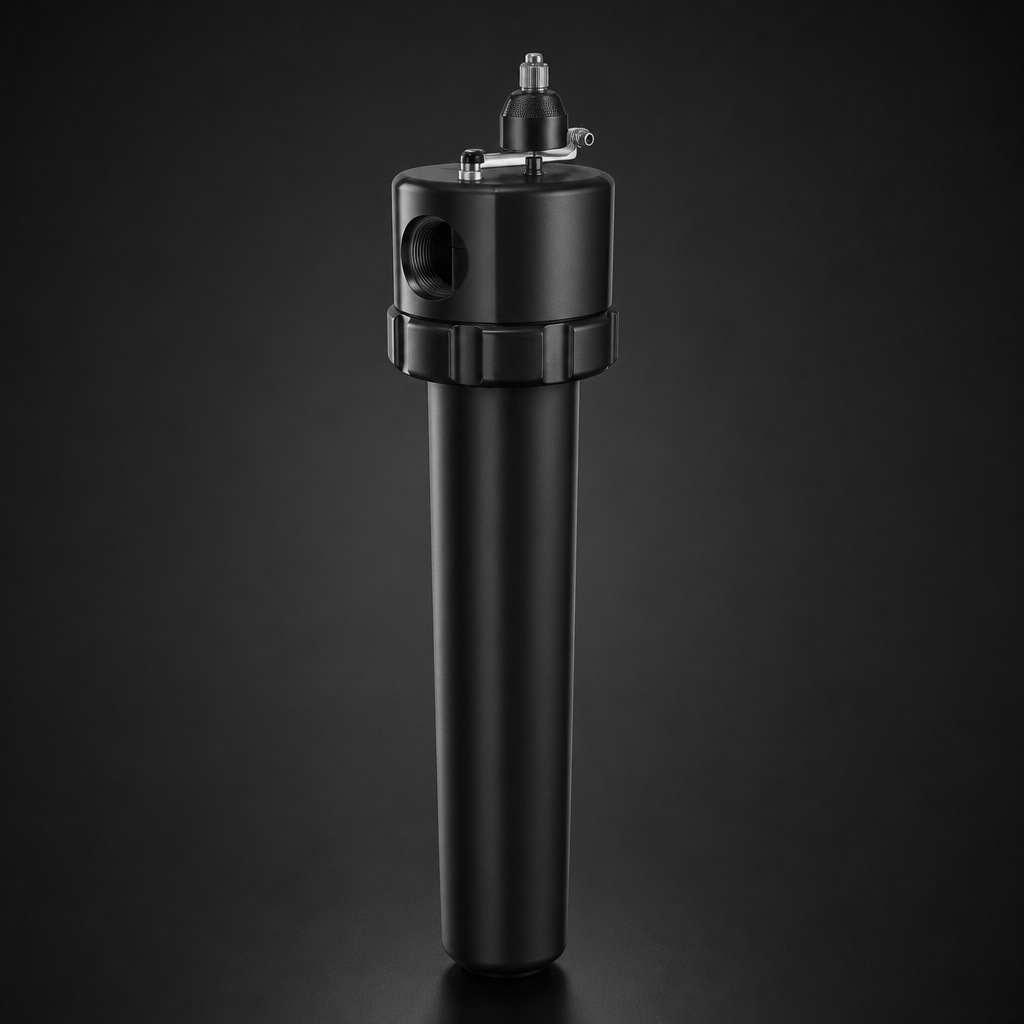
Many R+F filter housings are available with built-in differential pressure indicators (models with I suffix, e.g. RF-H-370FI, RF-H-383I). These provide a direct visual indication of element condition. For critical applications, electronic DP transmitters allow remote monitoring and alarm setpoints.
How correct sizing minimises pressure drop
The single most effective way to minimise pressure drop is to correctly size the filter housing for your actual flow rate. An undersized housing forces gas through the element at higher velocity, creating unnecessary ΔP from day one and shortening element life.
The sizing principle is simple:
- Select a housing whose rated flow capacity meets or exceeds your actual flow
- Allow a 20–30% safety margin above your nominal flow rate to account for system surges and element loading
- For applications with high contamination levels, consider oversizing by 50% or adding a pre-filter stage
Multi-element housings for high flow
For flow rates above 75 Nm³/hr, multi-element housings (3, 7, or 16 elements) distribute the gas across more media surface area. This reduces the velocity per element and delivers significantly lower clean ΔP — plus longer element life between changes.
Pressure drop and element selection
| Element Grade | Typical Clean ΔP | Replacement ΔP | Application |
|---|---|---|---|
| PF (Pre-Filter) | 0.02–0.04 bar | 0.3 bar | Bulk debris removal upstream |
| ST (Standard) | 0.03–0.06 bar | 0.5 bar | General particulate, pipeline filtration |
| HE (High Efficiency) | 0.05–0.10 bar | 0.7 bar | Oil aerosol, instrument protection |
| CC (Activated Carbon) | 0.03–0.05 bar | Calendar / test | Oil vapour, odour, chemical traces |
Two-stage thinking saves energy
Installing a coarse pre-filter (Grade PF) upstream of a high-efficiency coalescer (Grade HE) often reduces total system ΔP — because the pre-filter captures bulk contamination at low ΔP, allowing the fine coalescer to load more slowly and stay at low ΔP for longer.
Practical guidelines
- Always monitor ΔP — either with built-in indicators or separate gauges. Time-based replacement wastes either money (too early) or energy (too late).
- Size for actual flow, not compressor output — unless you are filtering the main header.
- Consider pre-filtration for dirty gas streams — protecting fine elements extends their life and keeps ΔP low.
- Account for altitude and temperature — lower atmospheric pressure and higher temperature both increase volumetric flow at the filter.
- Record ΔP trends — a sudden increase indicates an upstream problem (failed separator, compressor oil carry-over) rather than normal element loading.
Key Takeaway
Pressure drop is not optional — but excessive pressure drop is. Correct filter sizing, appropriate element selection, pre-filtration for dirty streams, and ΔP monitoring together ensure you get the filtration performance you need at the lowest possible energy cost.
Size your filter correctly — avoid unnecessary ΔP
Enter your flow rate, pressure, and temperature. The Engineering Tool recommends the housing model with the right capacity for your application.