When a 0.3 µm particle costs you a day of troubleshooting
Gas analysers, chromatographs, mass spectrometers, and oxygen sensors are precision instruments. They are designed to detect chemical composition at parts-per-million or parts-per-billion levels. At that sensitivity, even microscopic contamination in the sample gas causes problems:
- Measurement drift: Contamination coats detector surfaces, changing response characteristics gradually
- False readings: Particles or droplets in the measurement cell scatter light or alter conductivity
- Sensor failure: Corrosive particles or condensate attack sensor elements
- Blocked sample lines: Particulate accumulates in narrow capillaries and orifices
Where contamination comes from
Even in a well-maintained gas system, the sample gas reaching your instrument is rarely as clean as the gas leaving the treatment plant. Contamination is introduced at every stage:
Distribution piping
Rust, scale, weld spatter, and thread sealant particles accumulate in piping over time — particularly in carbon steel systems.
Temperature changes
Temperature drops across regulators and long pipe runs cause condensation. Moisture and hydrocarbon droplets form in the sample line.
Pressure reduction
The Joule-Thomson effect cools gas during pressure let-down, potentially condensing moisture and hydrocarbons into aerosol.
Upstream failures
Failed upstream filters, separator drain blockages, or compressor oil carry-over send contamination spikes downstream.
What contamination does to specific instruments
| Instrument Type | Contamination Effect | Filtration Requirement |
|---|---|---|
| Gas chromatograph (GC) | Column contamination, detector fouling, baseline drift | Particulate HE/UX + moisture removal |
| Mass spectrometer | Ion source contamination, vacuum degradation | Particulate UX + coalescing HE |
| NDIR / FTIR analyser | Window fouling, measurement cell contamination | Particulate HE + coalescing |
| Electrochemical O₂ sensor | Membrane blockage, electrolyte contamination | Particulate HE, moisture removal |
| Paramagnetic O₂ analyser | Cell contamination, flow restriction | Particulate HE + coalescing |
| Process photometer | Window fouling, scattered light | Particulate UX |
The right filter for sample conditioning
Sample conditioning filters for analytical instruments require specific characteristics that general industrial filters do not:
316L stainless steel construction
Instrument sample gas is often corrosive or reactive. All wetted parts — housing body, internal components, and element support — must be 316L stainless steel to prevent corrosion particles from entering the sample stream.
Ultra-fine filtration grades
Standard industrial grades (PF, ST) are insufficient. Analyser protection requires Grade HE (99.99% at 0.1 µm) as a minimum, with Grade UX (99.9999% at 0.01 µm) for critical applications like mass spectrometry and semiconductor gas analysis.
Compact inline design
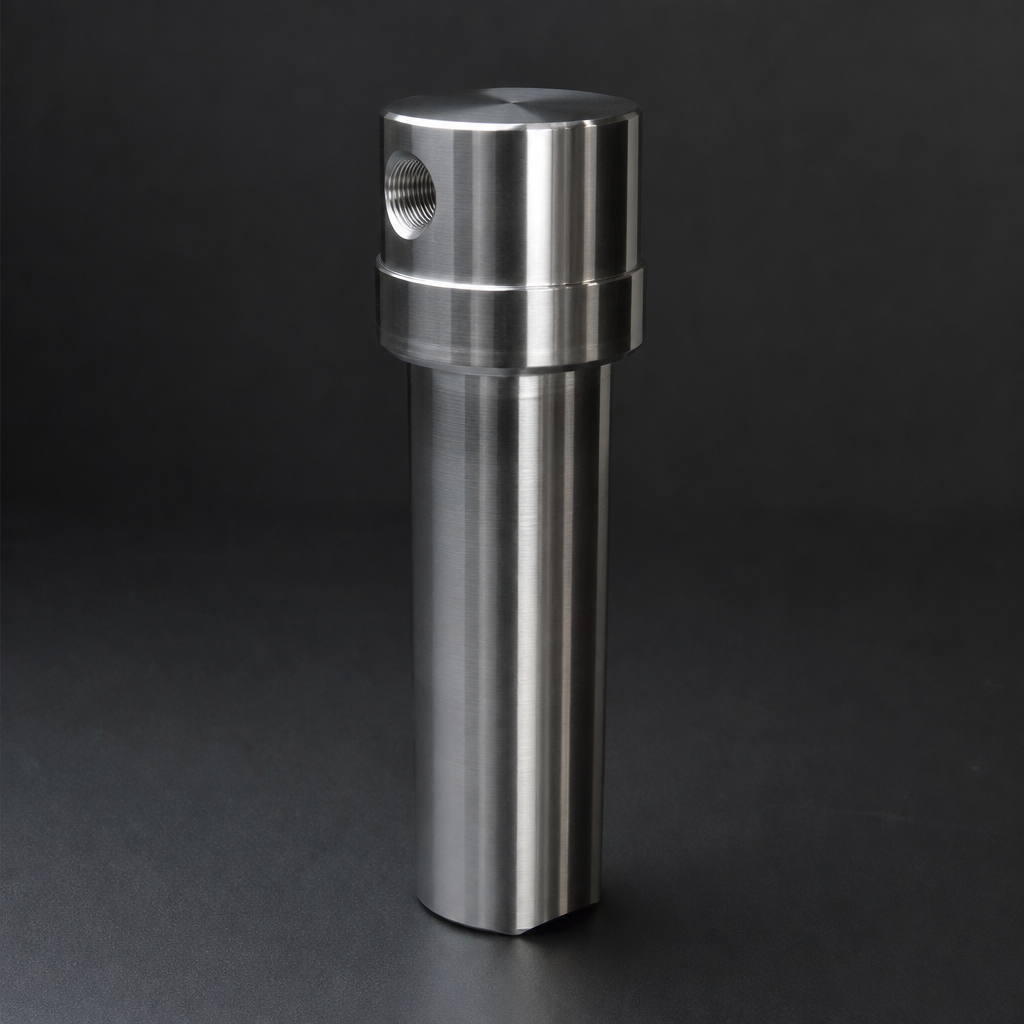
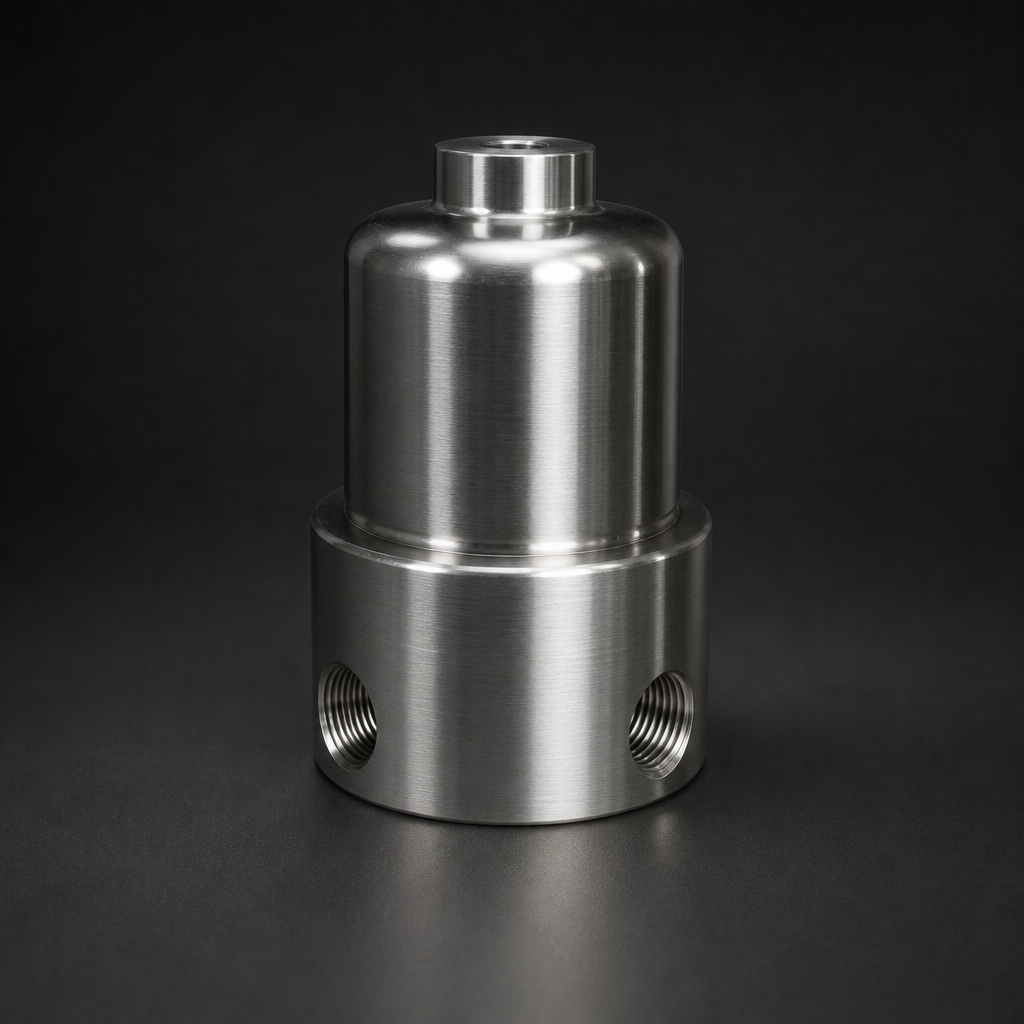
Sample lines operate at low flow rates (typically 0.5–5 L/min). Compact inline housings like the RF-H-110 to RF-H-170 series are specifically designed for this duty — small dead volume, low ΔP, and easy element access.
SilcoNert and surface treatment
For trace-level analysis (ppb and below), even 316L stainless steel can be a contamination source. Active metal surfaces adsorb and desorb sample molecules, causing memory effects and response lag.
Inert coatings for trace analysis
SilcoNert® and similar silicon-based inert coatings passivate internal surfaces, preventing sample molecule adsorption. This is critical for trace-level sulphur, mercury, and reactive compound analysis. Our RF-H-170 and RF-H-129S housings are available with optional SilcoNert coating for these applications.
Key Takeaway
Analytical instruments are only as accurate as the sample gas they receive. Inline filtration with the correct grade — HE minimum, UX for critical applications — eliminates the contamination that causes drift, false readings, and premature sensor failure. The cost of a proper sample conditioning filter is negligible compared to the cost of a single misdiagnosis or instrument repair.
Find the right analyser protection filter
Select 'Instrumentation & Gas Analysis' in the Engineering Tool to see compatible inline housings and element grades for your application.