
How much molecular sieve does your gas dryer need?
Size the adsorber by the run time you want – not by the housing. Enter flow, inlet dew point, pressure and run time; the calculator returns the water load, the media volume and the run time of our standard refillable adsorber housings.
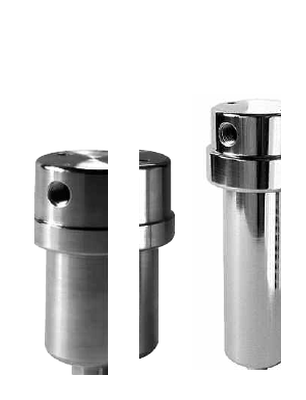
Run time is the design parameter
Water in = media used
Every gram of water entering the dryer is stored in the sieve until breakthrough. The water load follows directly from flow and inlet dew point.
Small housings still work
A small adsorber works at any flow – it simply saturates sooner. The question is how often you want to change the media.
Rule of thumb
With 10 wt-% usable capacity and 0.64 g/cm³ bulk density, 1 g of water needs about 15.6 cm³ of molecular sieve.
Adsorber sizing calculator
Run time per standard housing
| Housing | Fill | Run time @ 10 % | Run time @ 15 % |
|---|---|---|---|
| 1 × RF-H-134-ADS (¼″ NPT) | 110 cm³ | 4.5 h | 6.8 h |
| 1 × RF-H-146-ADS (½″ NPT) | 265 cm³ | 10.9 h | 16.4 h |
| 2 × RF-H-146-ADS in series (½″ NPT) | 530 cm³ | 21.8 h | 32.8 h |
Estimate only – final sizing on request. No guaranteed outlet dew point.
Reference table (near atmospheric pressure, 10 % usable capacity)
| Run time | 1 NL/min, saturated 25 °C | 7 NL/min, saturated 25 °C | 7 NL/min, pre-cooled to 5 °C |
|---|---|---|---|
| Water load | 1.55 g/h | 10.87 g/h | 2.93 g/h |
| 1 h | 24 cm³ | 170 cm³ | 46 cm³ |
| 8 h | 194 cm³ | 1,358 cm³ | 366 cm³ |
| 24 h | 582 cm³ | 4,075 cm³ | 1,099 cm³ |
| 40 h | 970 cm³ | 6,792 cm³ | 1,831 cm³ |
Capacity 10 % · typical 15 % → volume × 0.67. Estimate only – final sizing on request. No guaranteed outlet dew point.
Pre-cooling quarters the desiccant
Saturated gas at 5 °C carries only about a quarter of the water it carries at 25 °C. A small cooler with condensate drain before the dryer makes the molecular sieve last roughly four times longer – the cheapest way to extend run time.
Recommended drying train
- 1 · Coalescing filterRemoves droplets and aerosols that would load the sieve immediately.
- 2 · Refillable adsorberMolecular sieve 3A/4A, sized for the run time. Two housings in series allow lead/lag changes.
- 3 · Particulate filterRetains fines from the adsorbent bed.
- 4 · Dew-point sensorShows breakthrough before it reaches your process.
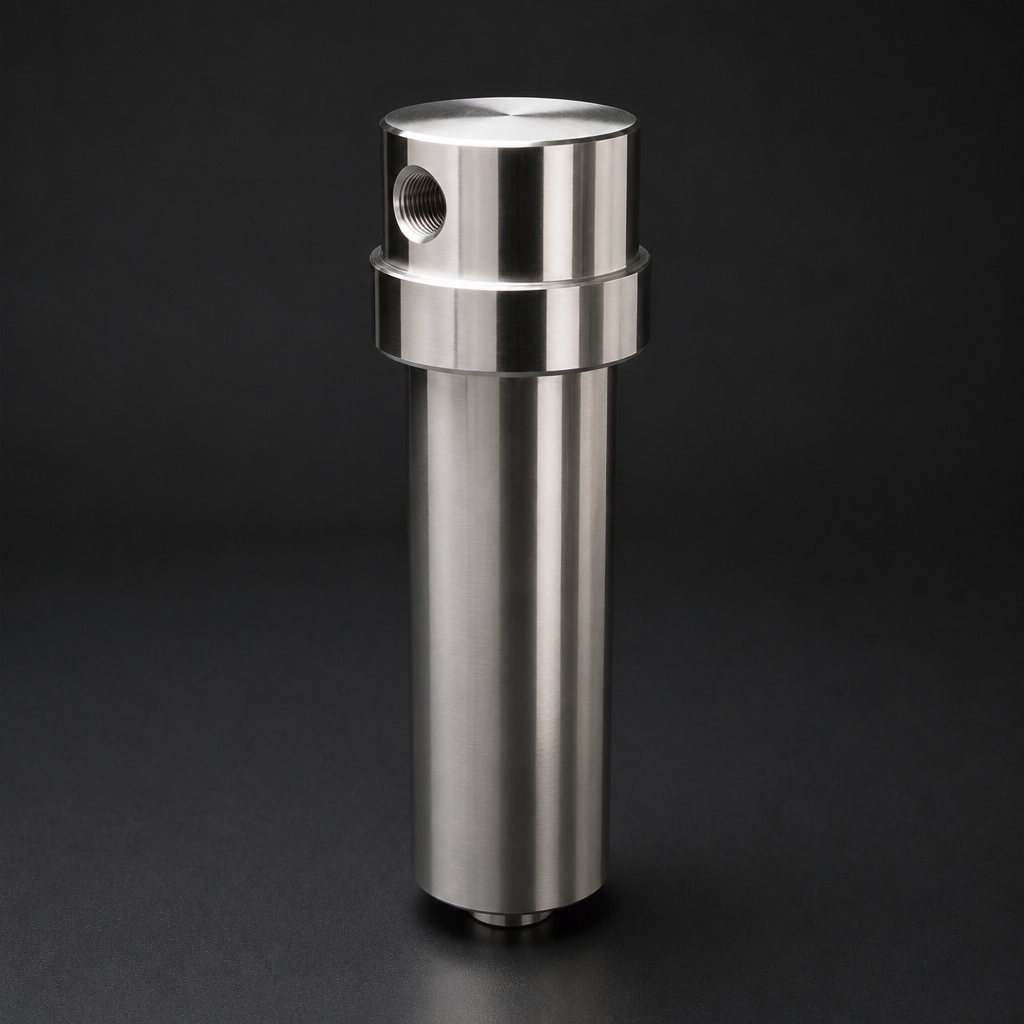
Refillable adsorber housings
Limits of this estimate
- Usable capacity depends on temperature, contact time, regeneration state and required outlet dew point – 10 % and 15 % are planning values.
- Liquid water or electrolyte carry-over is not covered – install a coalescer and drain upstream.
- Standard refillable adsorber housings are rated 100 bar; media charge, larger volumes and high-pressure versions on request.
- Drying systems with regeneration are outside our scope – we supply filters and refillable adsorber housings.
Frequently asked questions
How much molecular sieve do I need to dry hydrogen?
It depends on the water you bring in and the run time you want, not on the housing. Water load [g/h] = gas flow × water content at the inlet dew point. Media volume [cm³] ≈ water load × run time ÷ (usable capacity × bulk density). With a conservative 10 wt-% usable capacity and 0.64 g/cm³ bulk density, every gram of water needs about 15.6 cm³ of molecular sieve. Example: 1 NL/min hydrogen saturated at 25 °C near atmospheric pressure carries about 1.6 g water per hour – roughly 24 cm³ of sieve per hour of operation.
Why does the run time matter more than the housing size?
An adsorber is a consumable store: it fills with water until breakthrough. A small housing works at any flow – it simply saturates sooner. Define how long the dryer must run between media changes (one shift, one day, one test campaign), then size the media volume for that run time.
How can I reduce the amount of desiccant?
Cool the gas before the dryer and drain the condensate. Saturated gas at 5 °C carries only about a quarter of the water it carries at 25 °C, so the molecular sieve lasts about four times longer. Operating at higher pressure also reduces the water content per normal litre. A coalescing filter upstream removes liquid droplets and aerosols that would otherwise load the sieve immediately.
Which usable capacity should I assume for a 3A or 4A molecular sieve?
Equilibrium capacity of 3A/4A sieves is around 20 wt-% at room temperature, but the usable capacity up to breakthrough at low-ppm outlet values is lower. For planning we use 10 wt-% (conservative) and 15 wt-% (typical). Real values depend on temperature, contact time, regeneration state and the required outlet dew point.
Does R+F guarantee an outlet dew point?
No. The calculator is a planning estimate. Outlet dew point depends on media, temperature, contact time and regeneration. We recommend a dew-point sensor downstream of the dryer and a particulate filter after the adsorber to retain dust. Final sizing is confirmed on request with your operating data.
Which housings are available for refillable adsorbers?
Standard refillable 316L adsorber housings: RF-H-134-ADS (¼″ NPT, 100 bar, about 110 cm³ fill) and RF-H-146-ADS (½″ NPT, 100 bar, about 265 cm³ fill). Two housings in series double the volume and allow a lead/lag change. Larger volumes or higher pressures are available on request.
Technical Note (PDF)
The method, formulas, reference table and drying train on two pages – to forward to colleagues or attach to an inquiry.
Send us your gas data – we size the adsorber
Flow, pressure, temperature or dew point, required outlet dew point and the run time you want. We reply with a configuration: coalescer, adsorber volume and after-filter.