When a process gas still smells of hydrocarbons after mechanical filtration, or when downstream catalysts, membranes and analysers keep losing performance, the culprit is almost always the same: oil vapour and volatile organic compounds (VOCs) that a coalescing filter simply cannot capture. Mechanical filters remove liquid droplets and solid particles — they do nothing to molecules that are already in the vapour phase. That final polishing step belongs to activated carbon adsorption.
This article explains how vapour-phase adsorption works in a process gas system, when a dedicated bulk carbon adsorber such as the RF-H-160-CC is the right choice, and how to size, install and re-charge it for years of reliable service.
Why mechanical filtration cannot remove vapours
A high-efficiency coalescing element captures liquid aerosols down to 0.01 µm and reduces oil content dramatically — but oil vapour and light hydrocarbons pass straight through, because there is no liquid droplet to coalesce. The same is true of odours and many VOCs. Once a contaminant exists as individual gas-phase molecules, only adsorption (or a chemical reaction) can remove it.
Activated carbon works by physical adsorption: van der Waals forces hold contaminant molecules against the enormous internal surface area of the carbon — up to 1,200 m² per gram. Because that surface area is finite, adsorption capacity is finite too, which is why an adsorber is a consumable-media stage rather than a permanent mechanical barrier.
Where vapour-phase adsorption belongs in the filtration train
Adsorption is a polishing stage. It should always sit downstream of mechanical filtration, never in front of it. The correct sequence is:
| Stage | Function | Removes |
|---|---|---|
| 1 · Particulate | Solid protection | Dust, rust, scale, pipe debris |
| 2 · Coalescing | Liquid removal | Oil and water aerosols down to 0.01 µm |
| 3 · Adsorption | Vapour polishing | Oil vapour, hydrocarbons, VOCs, odours |
If liquid aerosols reach the carbon bed they blind the pore structure and destroy adsorption capacity in days rather than months. Protecting the carbon with an upstream coalescing stage is the single most important factor in adsorber service life.
The dedicated bulk adsorber: RF-H-160-CC
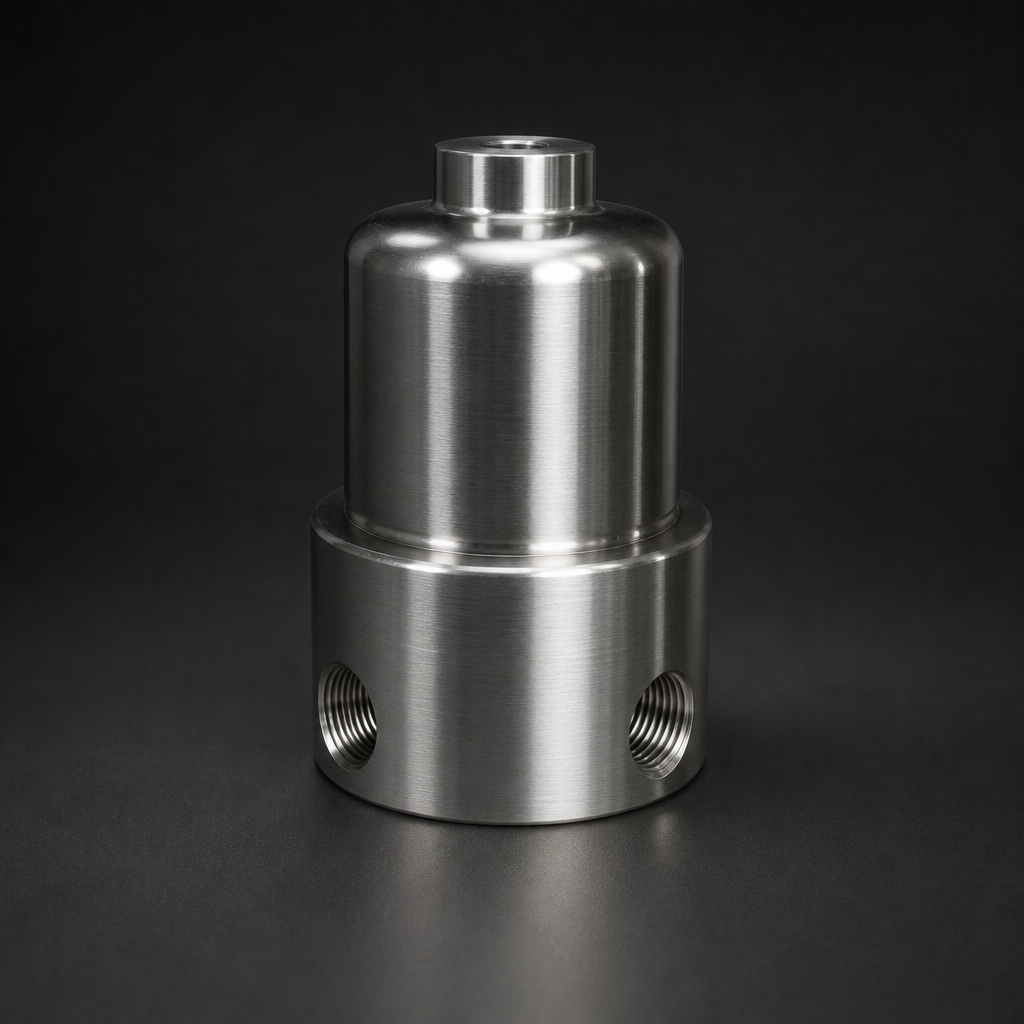
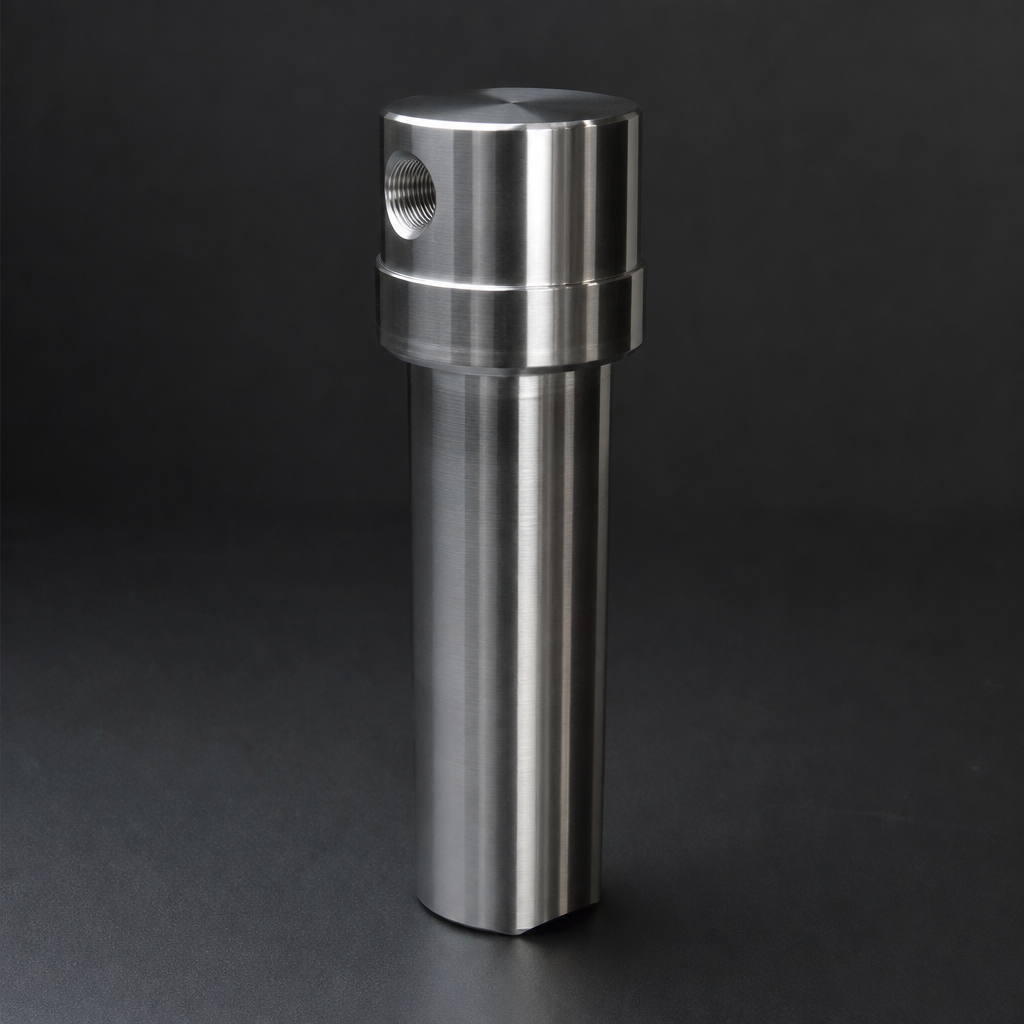
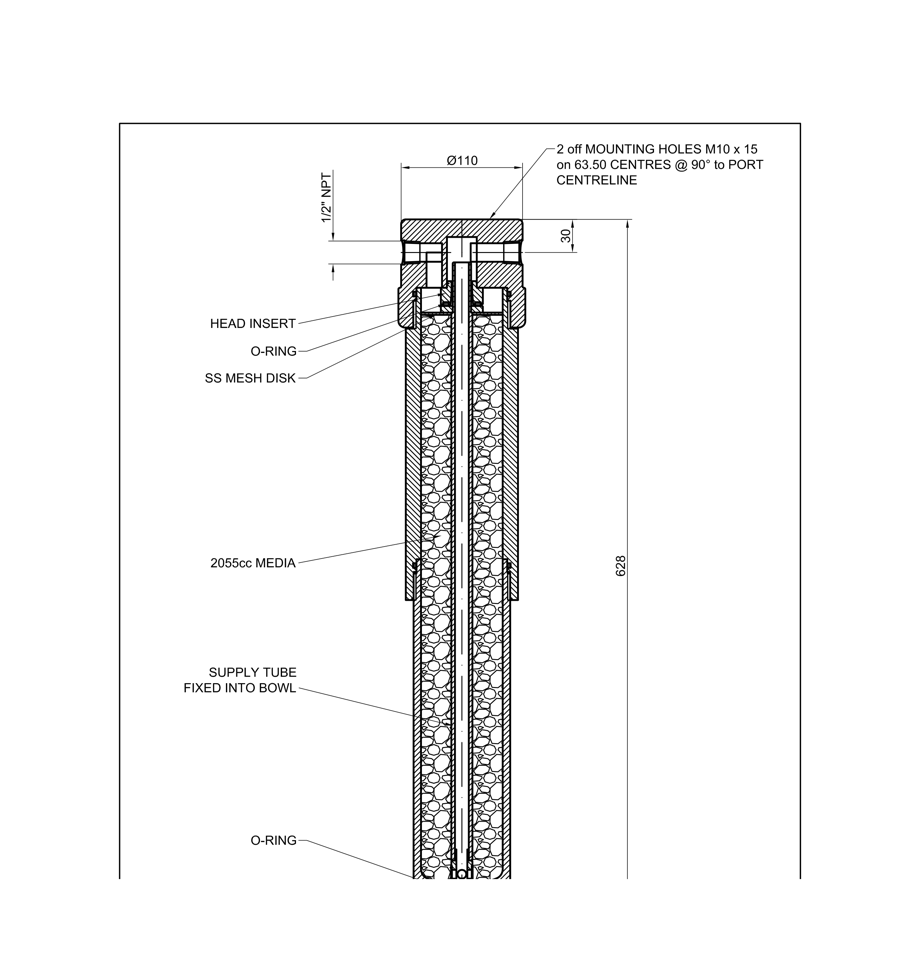
For process gas duty we recommend a dedicated bulk carbon vessel rather than a small cartridge. The RF-H-160-CC is a 316L stainless steel vapour-phase adsorber housing that holds 2055 cc — roughly 2 kg — of bulk activated carbon. It is rated to 250 bar and 200 °C with ½″ NPT connections, and the internal stainless steel support mesh retains the carbon bed while allowing full flow.
The key advantage is media volume. A large bulk charge gives a long mass-transfer zone and a high total adsorption capacity, which translates directly into a long interval between re-charges. The housing itself is permanent: when the carbon is spent it is simply emptied and refilled with a fresh RF-AC-REFILL-160 charge, so there is no recurring housing cost and no disposable pressure vessel to certify.
Use our free Engineering Tool to get a filtration recommendation for your specific application in under 2 minutes.
Sizing and service life
Two variables dominate adsorber sizing: the contaminant load (how much vapour per unit of gas) and the residence time (how long the gas is in contact with the carbon). A larger bed lowers gas velocity, lengthens the mass-transfer zone, and pushes back the moment of breakthrough — the point at which the outlet concentration starts to rise because the carbon is saturating.
Because adsorption capacity is non-linear near saturation, breakthrough should never be relied upon as a warning. Either monitor the outlet with a suitable detector, or adopt a conservative time-based replacement schedule derived from the known load. When the RF-AC-REFILL-160 charge is spent, residual oil vapour again climbs above the <0.003 mg/m³ target, which is the signal to re-charge.
Materials, seals and safe operation
The RF-H-160-CC is built entirely from 316L stainless steel, making it suitable for most process gases including hydrogen and moderately corrosive streams. Seal material must be matched to the actual operating temperature and gas chemistry — confirm your operating pressure and temperature so the correct O-ring compound is specified. For oxygen or ultra-clean service, the housing can be supplied degreased and hydrocarbon-free.
As with any adsorption stage, remember that a saturated carbon bed holds the contaminants it has captured. Spent carbon should be handled and disposed of according to the nature of the adsorbed substance and local regulations.
- A high-efficiency coalescing element captures liquid aerosols down to 0.
- Adsorption is a polishing stage.
- For process gas duty we recommend a dedicated bulk carbon vessel rather than a small cartridge.
- Two variables dominate adsorber sizing: the contaminant load (how much vapour per unit of gas) and the residence time (how long the gas is in contact with the carbon).
Getting the specification right
Vapour-phase adsorption is the difference between “nearly clean” gas and gas that genuinely meets a <0.003 mg/m³ residual oil target. Put the carbon in the right place — after mechanical filtration — give it enough media volume, and protect it from liquid carryover, and a single RF-H-160-CC will quietly polish your process gas for years between re-charges. If you tell us your gas, pressure, temperature and flow rate, we will size the complete filtration train and confirm the correct seal material for your conditions.