Why Compressed Air Quality Makes or Breaks Your Paint Finish
Walk through any automotive body shop or industrial coating facility and you will find the same frustration at the spray booth: a panel that looked perfect under the gun emerges from the oven covered in fish-eye craters, silicone spots, or a rough orange-peel texture. The spray gun is blamed, the paint is blamed, the operator is blamed — yet in the majority of cases, the real culprit is invisible: the compressed air driving the atomisation.
Compressed air leaving a typical industrial compressor carries oil aerosols from the lubrication system, water vapour that condenses in distribution pipework, rust and pipe-scale particles from ageing steel mains, and — in facilities using silicone-based release agents — trace silicone contamination that is catastrophic for paint adhesion. Any one of these contaminants reaching the spray gun will compromise the finish.
Correctly specified compressed air filtration, matched to the ISO 8573-1 Class 1.2.1 purity standard required for automotive and high-quality industrial finishing, eliminates each contaminant class before the air reaches the gun. This article explains what that standard means in practice, which contaminants cause which defects, and how to specify a filtration train that protects your finish quality every shift.
Understanding ISO 8573-1 and What Class 1.2.1 Actually Means
ISO 8573-1 is the international standard that classifies compressed air purity across three contaminant categories: solid particles, water (liquid and vapour), and oil (aerosol and vapour). Each category is assigned a class number from 0 (the most stringent) to 9 (the least stringent), and the three numbers are written together as a purity class designation.
For spray painting — particularly automotive refinishing and any coating where gloss, adhesion, or colour accuracy is critical — the minimum acceptable purity is Class 1.2.1:
| Contaminant Category | Class | Limit | Why It Matters for Painting |
|---|---|---|---|
| Solid particles (≥ 0.1 µm) | 1 | ≤ 20,000 particles/m³ at 0.1–0.5 µm; 0 at > 1 µm | Particles above 1 µm embed in wet paint, creating visible inclusions and surface roughness |
| Water (pressure dew point) | 2 | ≤ −40 °C PDP | Liquid water causes blushing, adhesion loss, and corrosion under the coating |
| Total oil (aerosol + vapour) | 1 | ≤ 0.01 mg/m³ | Oil at any concentration causes fish-eye craters and prevents inter-coat adhesion |
Many facilities assume that a single coalescing filter on the compressor outlet is sufficient. It is not. A single coalescing stage will reduce bulk oil aerosol but cannot achieve the 0.01 mg/m³ oil limit, cannot address water vapour (only liquid water), and will not remove oil vapour at all. Reaching Class 1.2.1 requires a three-stage filtration train — and that train must be correctly sized for the actual flow demand of the spray equipment.
The Four Contaminants That Destroy Paint Quality
1. Oil Aerosols and Oil Vapour
Oil contamination is the most damaging and the most misunderstood. Oil aerosols — tiny droplets carried in the compressed air stream — are partially captured by coalescing filters, but the finest sub-micron droplets pass through a single-stage filter. Oil vapour, which exists as a gas rather than a liquid droplet, passes through coalescing filters entirely and can only be removed by adsorption.
When oil reaches the spray gun, it deposits on the substrate surface. The solvent in the paint cannot wet an oily surface uniformly, so the paint film pulls away from the contaminated spots as it flows out, leaving the characteristic circular craters known as fish-eyes. Even a single fish-eye on an automotive panel means a full strip-and-repaint — a cost that dwarfs the investment in proper filtration many times over.
2. Water — Liquid and Vapour
Compressed air is saturated with water vapour at the compressor outlet. As the air cools in distribution pipework, that vapour condenses into liquid water that collects in low points, travels to the spray gun, and arrives as slugs or fine mist mixed with the atomised paint. The result is blushing (a milky haze in solvent-borne coatings), adhesion failure, and — in metal substrates — corrosion that lifts the coating from beneath.
Water vapour that remains as a gas is equally problematic in waterborne paint systems, where it disrupts the carefully controlled humidity balance that governs film formation. A pressure dew point of −40 °C or better, as required by Class 2, ensures that water cannot condense anywhere in the distribution system downstream of the dryer.
3. Solid Particles and Pipe Scale
Rust, pipe scale, compressor wear debris, and filter media fragments all travel in the compressed air stream. Particles above 1 µm in diameter are large enough to embed in a wet paint film and remain visible after curing as grit inclusions. In high-gloss automotive finishes, even a handful of inclusions per panel is unacceptable. Particulate filtration to Class 1 removes these particles before they reach the gun.
4. Silicone Contamination
Silicone is unique in that it does not originate from the compressor — it enters the compressed air system from the facility environment. Silicone-based mould release agents, lubricants, polishes, and even some hand creams volatilise and are drawn into the compressor intake. Once in the system, silicone is extraordinarily difficult to remove and causes the same fish-eye defect as oil, but with even greater persistence because silicone has a much lower surface energy than oil.
Activated carbon adsorption is the only reliable method for removing silicone vapour from compressed air. This is why the adsorption stage is non-negotiable in any paint-finishing filtration train, even in facilities that use oil-free compressors.
The Three-Stage Filtration Train for Spray Painting
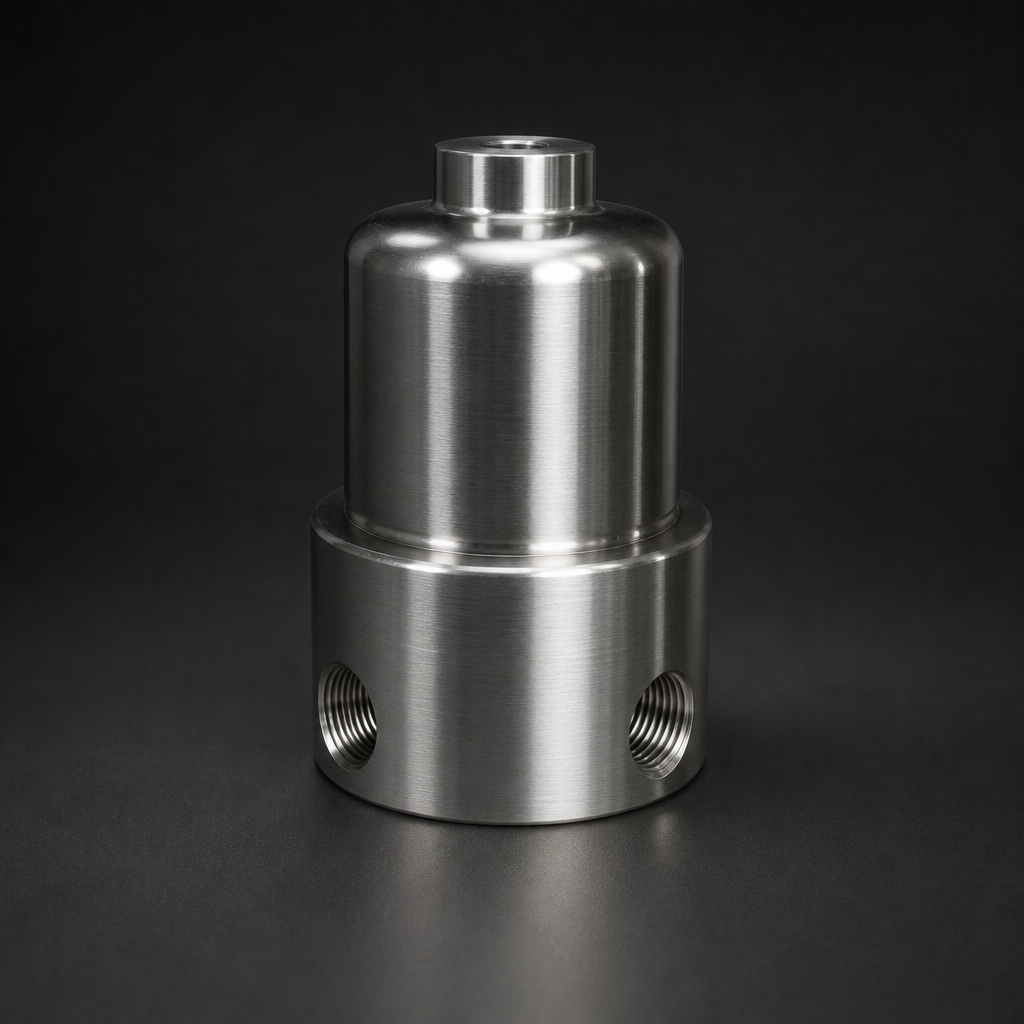
Achieving ISO 8573-1 Class 1.2.1 at the point of use requires three filtration stages in series, each targeting a specific contaminant class. R+F FilterElements offers a complete range of housings and elements for each stage, sized to match the flow demands of single spray guns through to large multi-gun paint booths.
Stage 1 — Coalescing Pre-Filter (General Purpose)
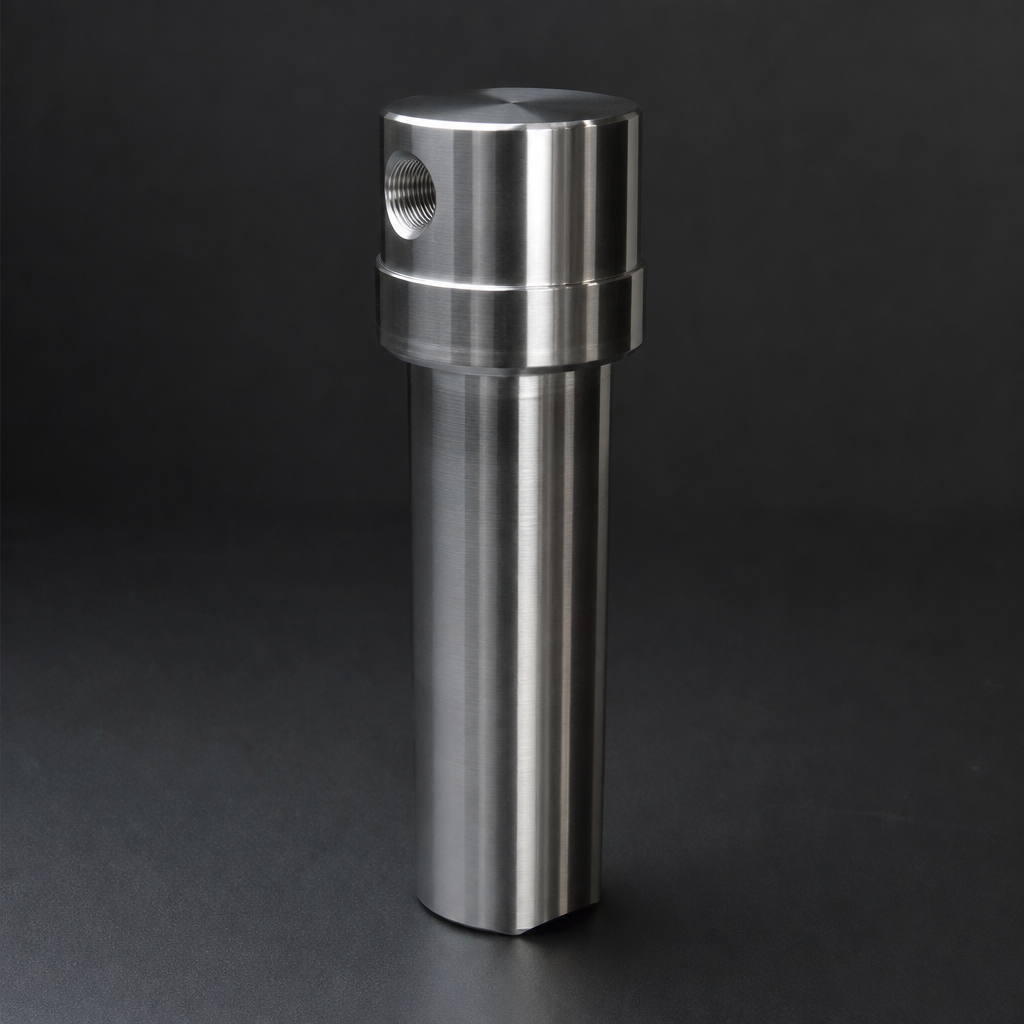
The first stage removes bulk liquid water, bulk oil aerosol, and solid particles down to approximately 1 µm. This protects the downstream stages from premature loading and extends their service life significantly. A general-purpose coalescing filter housing from the R+F compressed air range — such as the RF-H-310 to RF-H-380 series — fitted with RF-C coalescing elements is appropriate for this duty. The RF-C element uses borosilicate glass microfibre media with 99.99% efficiency at ≥ 0.1 µm, ensuring that the downstream stages receive air that is already substantially cleaner than the compressor outlet.
Stage 2 — High-Efficiency Coalescing Filter
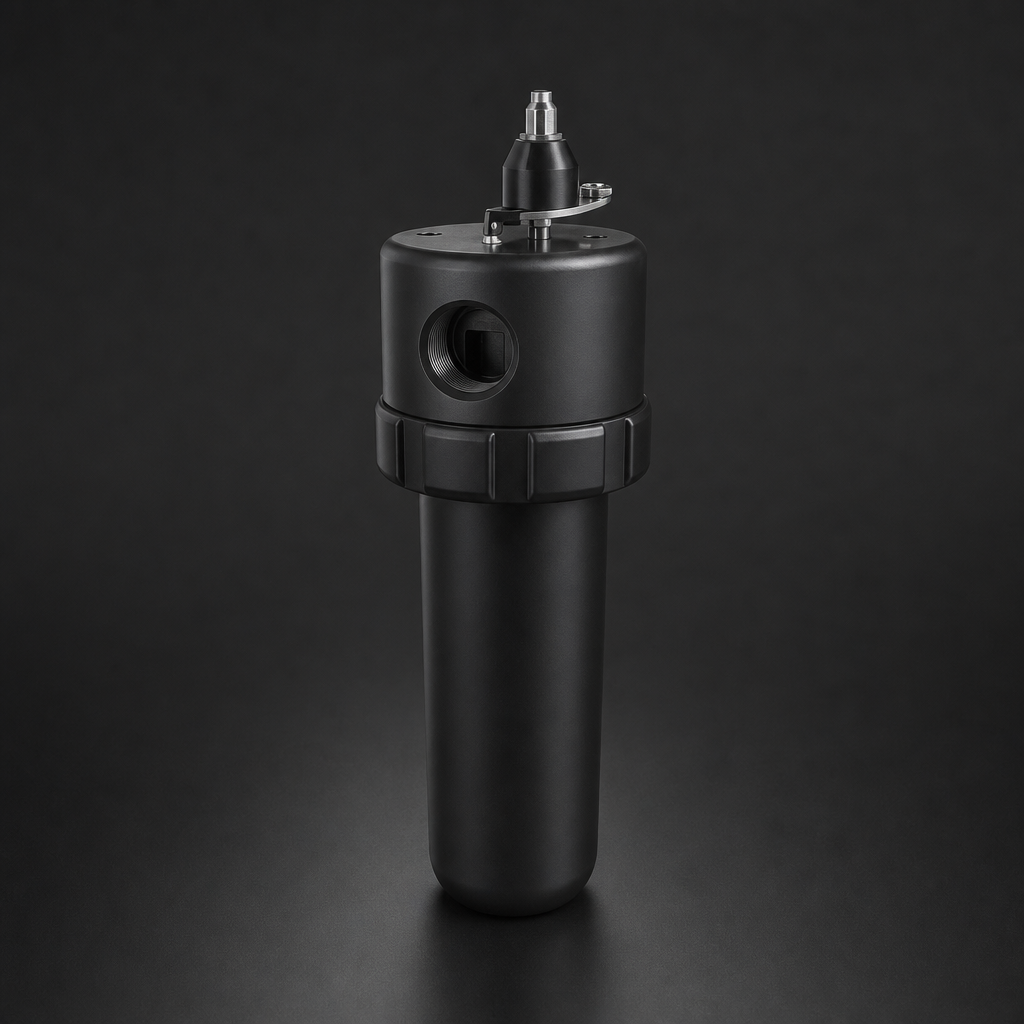
The second stage achieves the sub-micron oil aerosol removal required to approach the 0.01 mg/m³ oil limit. The RF-H-380AI housing, fitted with high-efficiency RF-C elements, is specifically suited to this duty. The AI-series housings incorporate an automatic drain as standard, ensuring that coalesced liquid is continuously removed without operator intervention — a critical feature in paint-finishing environments where manual drain checks are easily overlooked during busy production periods.
| Parameter | RF-H-380AI (Stage 2) |
|---|---|
| Housing material | Aluminium with anodised finish |
| Maximum working pressure | 17 bar g |
| Maximum temperature | 120 °C |
| Flow range | Up to 12,000 Nm³/h (element-size dependent) |
| Element type | RF-C coalescing (borosilicate glass microfibre) |
| Oil aerosol removal efficiency | 99.99% at ≥ 0.1 µm |
| Drain type | Automatic float drain (standard) |
Stage 3 — Activated Carbon Adsorber
The third stage is the adsorption stage, and it is the one most frequently omitted — with predictable consequences. The RF-AC adsorber element, available in the same housing series as the coalescing stages, uses activated carbon media to adsorb oil vapour and silicone vapour to a residual concentration of less than 0.003 mg/m³ — well within the Class 1 oil limit and sufficient to prevent silicone-related fish-eye defects.
The RF-AC element is fitted into a dedicated adsorber housing downstream of the Stage 2 coalescing filter. Because activated carbon is rapidly deactivated by liquid water and bulk oil, the upstream coalescing stages must be correctly maintained — a saturated or bypassed coalescing filter will destroy an adsorber element in hours rather than months. This interdependence is why the three stages must be treated as a system, not as independent components.
For a complete view of available R+F filter elements including RF-C coalescing, RF-P particulate, and RF-AC adsorber types, the R+F FilterElements product range covers all three stages in a unified housing platform.
Sizing the Filtration Train Correctly
A filtration train that is undersized for the actual flow demand will generate excessive pressure drop, reducing atomisation pressure at the gun and causing the operator to compensate by increasing compressor output — which in turn increases energy consumption and accelerates element loading. Oversizing wastes capital cost and can, in some configurations, reduce filtration efficiency by reducing the residence time of air in the filter element.
Correct sizing requires three inputs: the total connected flow demand of all spray guns and ancillary equipment (in Nm³/h or l/min), the operating pressure at the filter inlet (in bar g), and the maximum acceptable pressure drop across the filtration train (typically 0.2–0.5 bar for painting applications). R+F FilterElements provides a sizing wizard that takes these inputs and recommends the appropriate housing size and element type for each stage.
As a guide, a single spray gun at 4–6 bar requires approximately 200–400 l/min; a four-gun paint booth may need 2,000–4,000 l/min. The RF-H-380AI and its sister housings in the RF-H-310 to RF-H-395 series cover this entire range through element size selection.
Use our free Engineering Tool to get a filtration recommendation for your specific application in under 2 minutes.
Maintenance — The Factor That Determines Whether Filtration Actually Works
Even a correctly specified and sized filtration train will fail to protect paint quality if maintenance is neglected. The two most common maintenance failures in paint-finishing environments are:
- Overdue element replacement: Coalescing elements that have exceeded their service life become saturated with captured oil and begin to re-entrain contamination into the downstream air. RF-C and RF-AC elements should be replaced on a fixed schedule — typically every 12 months or at the pressure differential indicator's change-out threshold, whichever comes first.
- Blocked automatic drains: The automatic float drains on coalescing housings can become blocked by accumulated contamination, causing liquid to build up in the housing bowl and eventually carry over into the downstream air. A weekly drain function check takes less than a minute and prevents this failure mode entirely.
A maintenance log recording element change dates, drain checks, and pressure differential readings provides the evidence base needed to demonstrate air quality compliance and diagnose the cause of any paint defects that do occur.
Oil-Free Compressors — Do They Eliminate the Need for Filtration?
A common misconception is that oil-free compressors eliminate the need for downstream filtration. In reality, atmospheric air drawn into any compressor already contains oil vapour (typically 0.05–0.5 mg/m³), which passes through unchanged. Silicone contamination, water vapour, and solid particles are entirely unaffected by compressor type and must still be removed by filtration.
For oil-free compressor installations, the Stage 1 general-purpose coalescing filter can sometimes be omitted or replaced with a particulate-only filter, but Stages 2 and 3 remain mandatory for Class 1.2.1 compliance.
Specifying the Right Solution for Your Facility
The specification of a compressed air filtration train for spray painting is straightforward when approached systematically:
- Confirm the required purity class — ISO 8573-1 Class 1.2.1 for automotive and high-quality industrial finishing
- Measure or calculate the total flow demand at operating pressure
- Select three-stage filtration: general-purpose coalescing → high-efficiency coalescing (RF-H-380AI with RF-C elements) → activated carbon adsorber (RF-AC elements)
- Size each stage using the R+F engineering sizing tool or by contacting the R+F FilterElements technical team
- Establish a maintenance schedule with fixed element replacement intervals and weekly drain checks
R+F FilterElements, a German-based filtration specialist operating to European engineering standards, can support the full specification process from flow survey through to commissioning verification. For enquiries about compressed air filtration for spray painting and surface finishing applications, contact the team at process-gas-filter.com/contact.
- three-stage filtration train
- Oil contamination is the most damaging and the most misunderstood.
- A filtration train that is undersized for the actual flow demand will generate excessive pressure drop, reducing atomisation pressure at the gun and causing the operator to compensate by increasing compressor output — which in turn increases energy consumption and accelerates element loading.
- Overdue element replacement: