The oil mist you cannot see is the one costing you money
Every oil-sealed rotary vane vacuum pump exhausts a mixture of air and oil aerosol. Under normal operating conditions, this mist contains sub-micron oil droplets — typically between 0.1 and 1.0 µm — that are essentially invisible to the naked eye. You might notice a faint haze near the exhaust port, or a thin film accumulating on nearby surfaces. But by the time the problem is visible, the damage has been ongoing for months.
Left unfiltered, vacuum pump oil mist creates a cascade of problems: contaminated workspaces, accelerated equipment degradation, wasted lubricating oil, and potential non-compliance with occupational exposure limits.
What exactly comes out of a vacuum pump exhaust?
Oil-sealed vacuum pumps — rotary vane, rotary piston, and liquid ring types — use oil both as a sealant and as a coolant. During the compression cycle, gas and oil are intimately mixed. The pump's internal separator removes the bulk of the oil, but a residual fraction is always carried through to the exhaust as fine aerosol.
The exhaust stream typically contains:
- Oil aerosol: Sub-micron droplets (0.1–1.0 µm), typically 5–50 mg/m³ depending on pump type, age, and operating temperature
- Oil vapour: Gaseous oil that increases with exhaust temperature — particularly significant above 80 °C
- Process contaminants: Whatever the pump has been evacuating — solvents, moisture, particulate, chemical vapours
The hidden cost
For a medium-sized rotary vane pump operating at 100 m³/hr, even a modest 20 mg/m³ oil carry-over equates to roughly 0.5 litres of oil lost per 24-hour day. That oil ends up on your walls, your equipment, and in the air your operators breathe.
The real cost of unfiltered exhaust
The costs are rarely captured in a single budget line — they are distributed across maintenance, consumables, compliance, and lost productivity.
| Cost Category | Mechanism | Typical Impact |
|---|---|---|
| Oil consumption | Carry-over loss through exhaust | 0.3–1.5 litres/day per pump |
| Maintenance labour | Cleaning oil residue from surfaces, ducting | 2–8 hours/month per installation |
| Downstream equipment | Oil fouling of ducting, scrubbers, heat exchangers | Reduced efficiency, accelerated corrosion |
| Workplace compliance | Oil mist exceeding OEL (typically 5 mg/m³) | HSE action, potential fines |
| Product contamination | Airborne oil reaching clean areas via HVAC | Batch rejection, quality non-conformance |
| Environmental | Oil aerosol discharged to atmosphere | Permit violations, remediation costs |
How coalescing exhaust filters work
A vacuum pump exhaust filter is essentially a coalescing separator mounted directly on the pump's exhaust port. The operating principle: sub-micron oil droplets enter the filter element, collide with borosilicate glass microfibres, and progressively merge into larger droplets that drain under gravity.
Exhaust enters element core
Oil-laden exhaust gas flows from the inside of the element outward through the coalescing media.
Microfibres capture droplets
Borosilicate glass microfibres intercept sub-micron oil droplets within the progressively denser media.
Droplets coalesce and grow
Tiny droplets merge into larger, heavier drops. Anti-reintrainment mesh prevents them from re-entering the gas.
Clean exhaust exits, oil drains
Clean gas exits the housing. Coalesced oil drains to a sump and can be returned to the pump.
Key differences from inline coalescers
Flow direction is inside-to-outside (opposite to most inline coalescers). Operating pressure is near-atmospheric (max. 2 bar), allowing lighter housing designs. Temperature is a factor — exhaust temperatures of 60–100 °C are normal.
CS-type coalescing elements: purpose-built for exhaust duty
Not all coalescing elements are suitable for vacuum pump exhaust service. Standard compressed air coalescing elements use a fluorocarbon binder that limits their temperature range.
CS-type coalescing elements are specifically designed for this application:
- Borosilicate glass microfibre media with a silica-based binder — thermally stable to 200 °C
- Optimised for high oil loading — handles concentrated aerosol without premature blinding
- Anti-reintrainment mesh: Outer wrap prevents coalesced droplets from being stripped back into the gas stream
- Performance: 99.9% efficiency at 0.1 µm, rated as RF-CS Grade HE
Aluminium vs. stainless steel housings
Exhaust filter housings are available in two material families, each suited to different operating conditions:
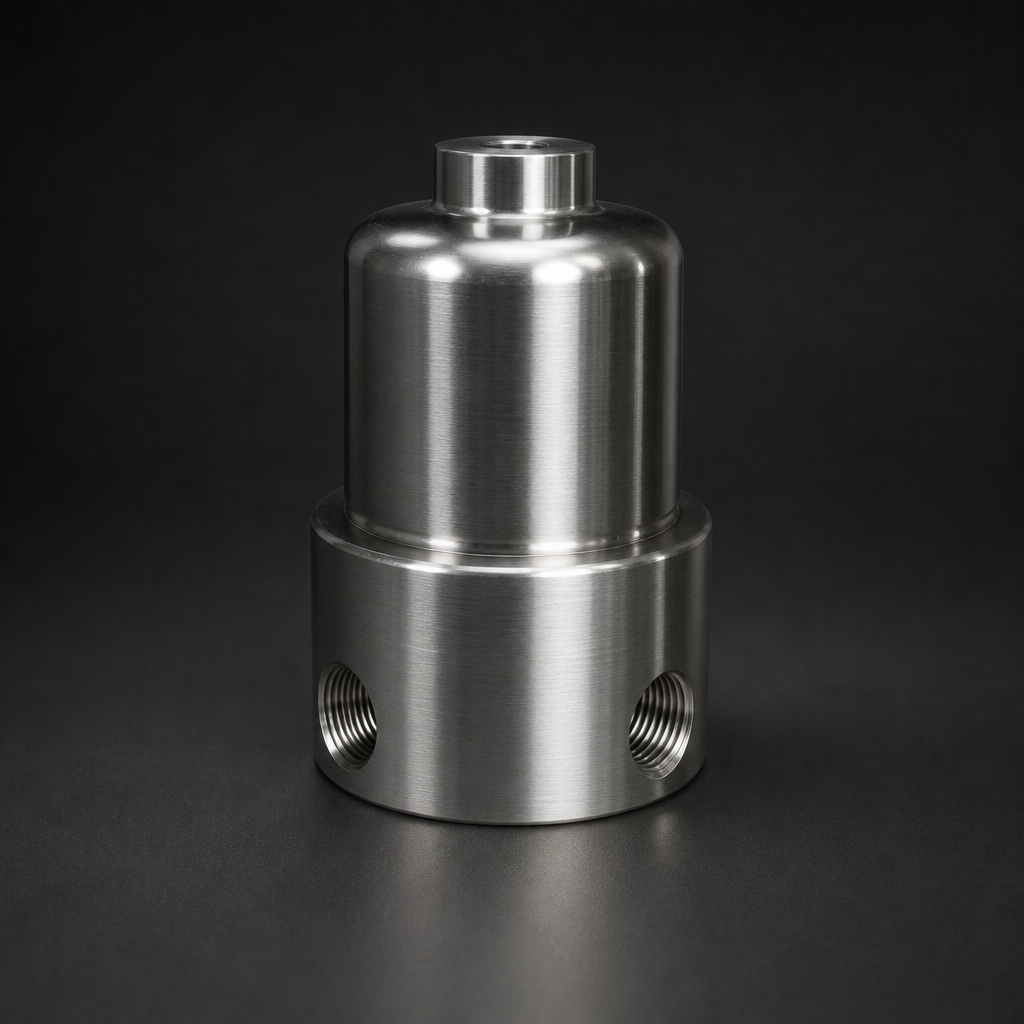
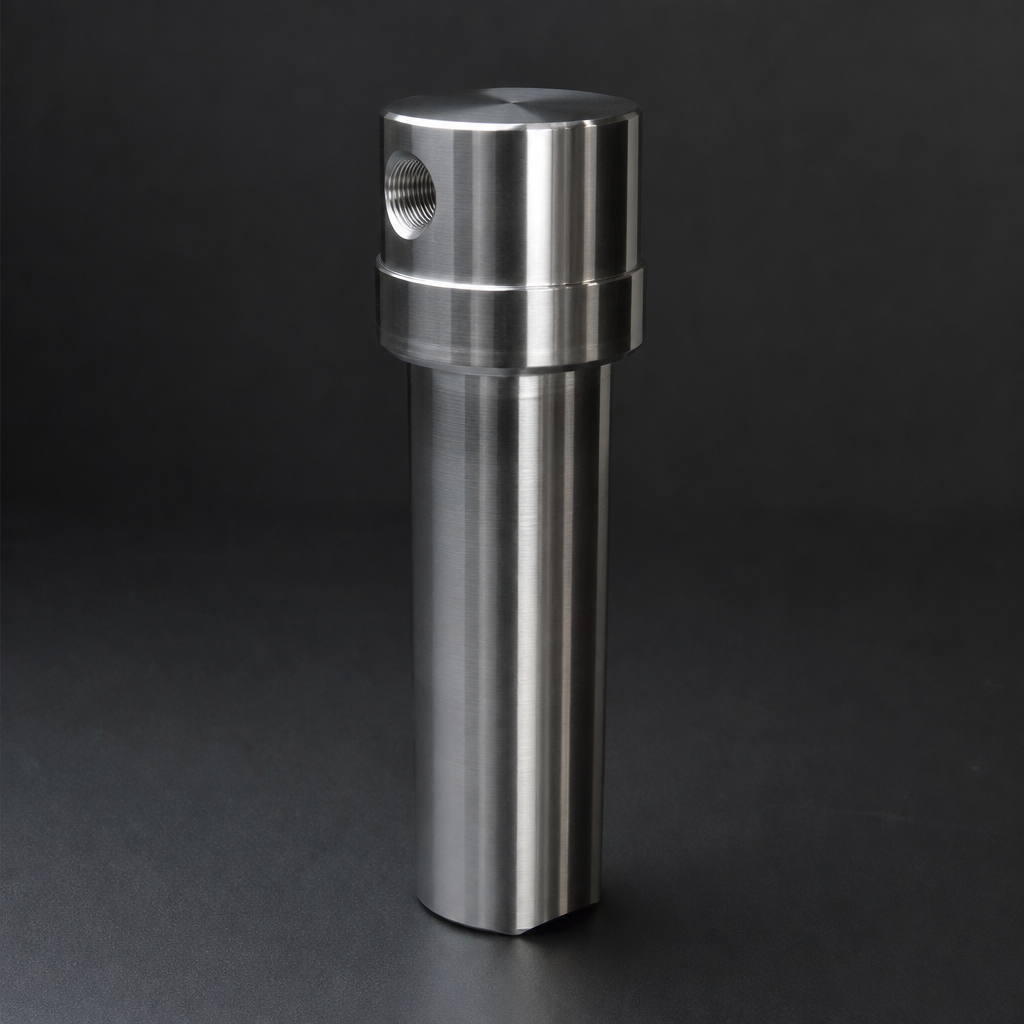
Aluminium housings (RF-H-420–456 series)
The standard choice for most applications. Lightweight, cost-effective. Max. 120 °C, 2 bar. Port sizes ½″ to 3″ NPT. Flow range 5–765 m³/hr. Nitrile gaskets standard.
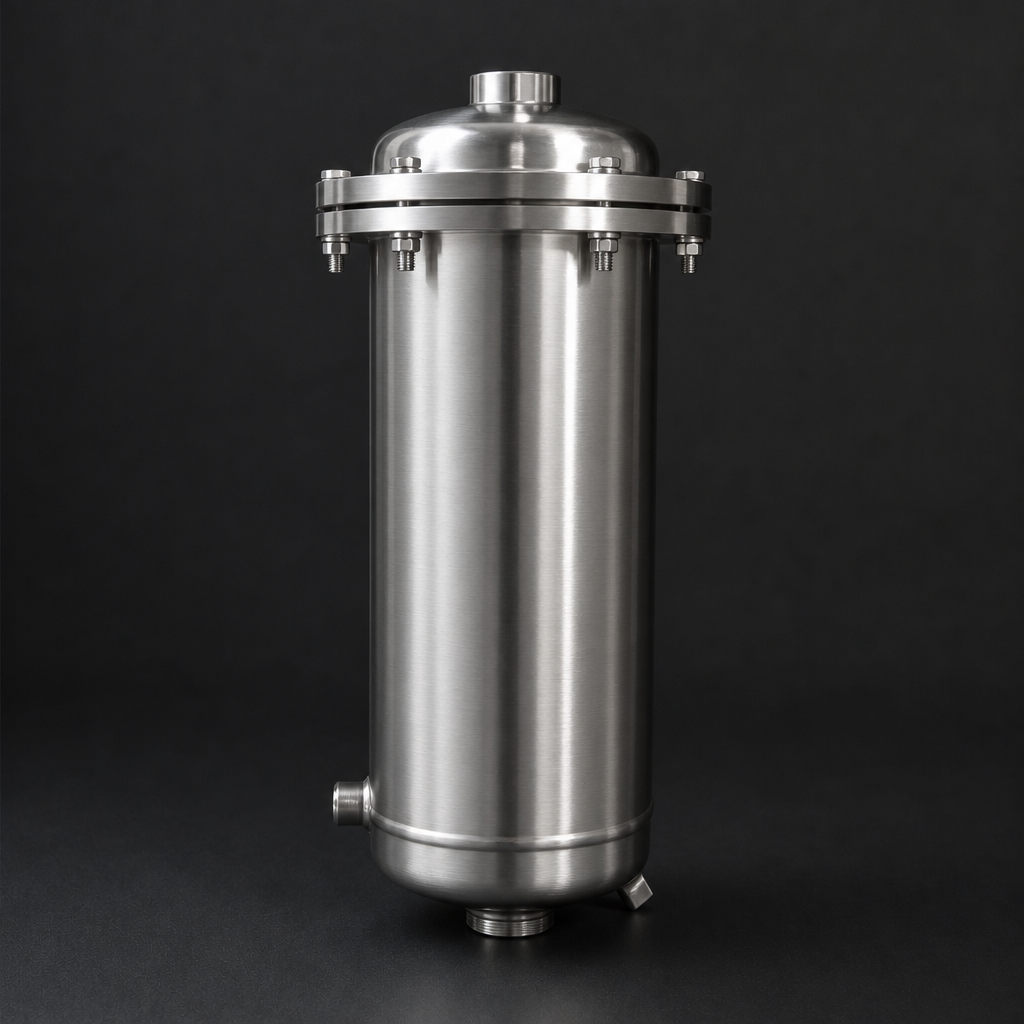
Stainless steel housings (RF-H-420S–456S series)
For corrosive exhaust, temperatures above 120 °C, or where 316L is mandated. Max. 200 °C, 2 bar. Viton (FKM) gaskets. Required for chemical processing, pharmaceutical GMP, and high-temperature vacuum drying.
Sizing: getting the flow rate right
Correct sizing is essential. An undersized exhaust filter creates excessive back pressure, reducing vacuum capability and increasing energy consumption. The sizing parameter is simple: match the filter's rated free air flow to the pump's displacement (FAD), with 20–30% margin.
| Pump Displacement | Model (AL) | Model (SS) | Elements |
|---|---|---|---|
| Up to 5 m³/hr | RF-H-420 | RF-H-420S | 1 |
| Up to 15 m³/hr | RF-H-425 | RF-H-425S | 1 |
| Up to 35 m³/hr | RF-H-430 | RF-H-430S | 1 |
| Up to 75 m³/hr | RF-H-433 | RF-H-433S | 3 |
| Up to 150 m³/hr | RF-H-443 | RF-H-443S | 3 |
| Up to 170 m³/hr | RF-H-437 | RF-H-437S | 7 |
| Up to 340 m³/hr | RF-H-447 | RF-H-447S | 7 |
| Up to 765 m³/hr | RF-H-456 | RF-H-456S | 16 |
Temperature correction
For pumps operating at elevated temperatures (above 80 °C exhaust), apply a temperature correction factor: multiply the pump FAD by (Texhaust + 273) / 293 to get the actual volume flow at the filter.
Oil recovery: turning waste into savings
A well-designed exhaust filtration system does not just remove oil — it recovers it. Coalesced oil drains from the filter element by gravity, and in a correctly piped installation, returns directly to the pump's oil reservoir.
For the oil return to work correctly:
- The filter drain must be piped back to the pump oil fill port or a collection vessel
- The drain line should slope continuously downward — no U-bends or traps
- A check valve may be required to prevent pump oil from being drawn back into the filter
- The collected oil should be periodically checked for contamination before re-use
Installation considerations
Mount vertically
Filter must be vertical with drain at bottom for gravity oil drainage. No horizontal mounting.
Minimise exhaust piping
Install as close to the pump exhaust port as practical. Long runs cause oil to condense in piping.
Support larger models
RF-H-433 and above are heavy when loaded. Support independently — do not cantilever from exhaust port.
Monitor back pressure
Use integral gauges or add a separate gauge to the exhaust line. Replace element at 0.3 bar ΔP.
When to replace the element
Coalescing elements in exhaust service have a finite life. The glass microfibre media gradually loads with contaminants that cannot be drained. As the element loads, pressure drop increases.
Replacement criteria
Replace when: pressure drop reaches 0.3 bar (300 mbar), or the pump manufacturer's maximum allowable back pressure — whichever is lower. If oil carry-over becomes visible downstream, the element is saturated. Coalescing elements cannot be cleaned or regenerated — they must be replaced.
Industries and applications
Vacuum pump exhaust filtration is relevant across virtually any industry that uses oil-sealed vacuum pumps:
- Pharmaceutical production: Vacuum drying, distillation, freeze-drying — clean exhaust required by GMP. Stainless steel housings typically specified.
- Food and beverage: Vacuum packaging, degassing, evaporation — product contamination prevention.
- Chemical processing: Reactor evacuation, solvent recovery — corrosive exhaust streams requiring 316L construction.
- Semiconductor manufacturing: Ultra-clean environments where any airborne contamination is unacceptable.
- Laboratories and research: Rotary evaporators, vacuum ovens — compact filters (RF-H-420) for small bench-top pumps.
- Plastics and composites: Vacuum forming, autoclave moulding — high oil loading from continuous-duty pumps.
- Printing and packaging: Vacuum hold-down tables, pneumatic feeding — indoor air quality protection.
Key Takeaway
Vacuum pump exhaust filtration is not optional — it is a basic engineering requirement. The cost of a filter and periodic element replacement is a fraction of the total cost of operating a vacuum pump, yet it eliminates oil waste, protects your facility, and keeps you on the right side of environmental and workplace regulations.
Size your exhaust filter in minutes
Enter your pump displacement and operating conditions — the Engineering Tool recommends the right housing model and element type.