A quality complaint lands on your desk. The product is contaminated, the process has failed, or the instrument is giving erratic readings — and all signs point to the compressed air supply. What do you do next? Guessing is expensive. A systematic audit of your compressed air system, working from the compressor room to the point of use, is the only reliable way to find the root cause and prevent recurrence.
This guide walks through the four-stage audit path that R+F FilterElements recommends for any compressed air quality complaint investigation: compressor room, treatment train, distribution network, and point of use. At each stage you will find the key checks, the failure modes to look for, and the R+F products that address them.
Why Compressed Air Quality Complaints Happen
Compressed air is an invisible utility. Unlike a leaking pipe or a tripped breaker, contamination in the air supply is rarely obvious until it causes a downstream problem. The most common contaminants — oil aerosols, water vapour, particulate, and micro-organisms — are all invisible to the naked eye. By the time a quality complaint surfaces, the contamination event may have been ongoing for weeks.
ISO 8573-1 defines seven classes of compressed air purity across three contaminant types: particulate, water, and oil. Understanding which class your process requires — and which class your system is actually delivering — is the starting point for any ISO 8573-1 compressed air quality investigation.
Stage 1 — The Compressor Room
Start at the source. The compressor room is where the majority of contamination enters the system. Check the following:
- Compressor inlet air quality: Is the inlet positioned away from exhaust fumes, solvent vapours, or other contaminant sources? Inlet air quality directly determines the baseline contamination load.
- Compressor oil condition: For oil-lubricated machines, check the oil service record. Degraded compressor oil produces higher aerosol carryover and can introduce oxidation products into the air stream.
- Aftercooler and separator performance: The aftercooler condenses bulk water. A fouled aftercooler or a failed separator drain means liquid water enters the treatment train — overwhelming downstream filters.
- Compressor loading: Is the machine running at or above its rated capacity? Overloaded compressors run hotter, produce more oil aerosol, and give the aftercooler less time to cool the air.
Stage 2 — The Treatment Train
The treatment train — dryer, pre-filter, coalescing filter, and adsorption filter — is where contamination should be removed. When a quality complaint occurs, this is where most audits find the root cause.
Dryer Performance
A refrigerant dryer should deliver a pressure dew point of +3 °C or better. A desiccant dryer should achieve −40 °C or lower for critical applications. Check the dew point meter reading against the specification. If no dew point meter is installed, that is itself a finding.
Filter Element Condition
This is the most common failure point. Filter elements have a finite service life — typically 12 months or 8,000 operating hours, whichever comes first. An expired element does not simply stop working; it can shed previously captured contamination back into the air stream, making the downstream air quality worse than if no filter were present.
Check the element change date on the housing. If it is overdue, replace immediately with the correct R+F filter elements. For coalescing duty, the RF-C series (borosilicate glass microfibre, 99.99% efficiency at ≥ 0.1 µm) is the standard recommendation. For particulate removal, the RF-P series delivers 99.99% efficiency at ≥ 0.3 µm.
Differential Pressure Indicators
Every filter housing should have a differential pressure (ΔP) indicator. A high ΔP reading confirms a blocked element. A zero ΔP reading on a housing that has been in service for over 12 months may indicate a bypassed or missing element — check the housing internals.
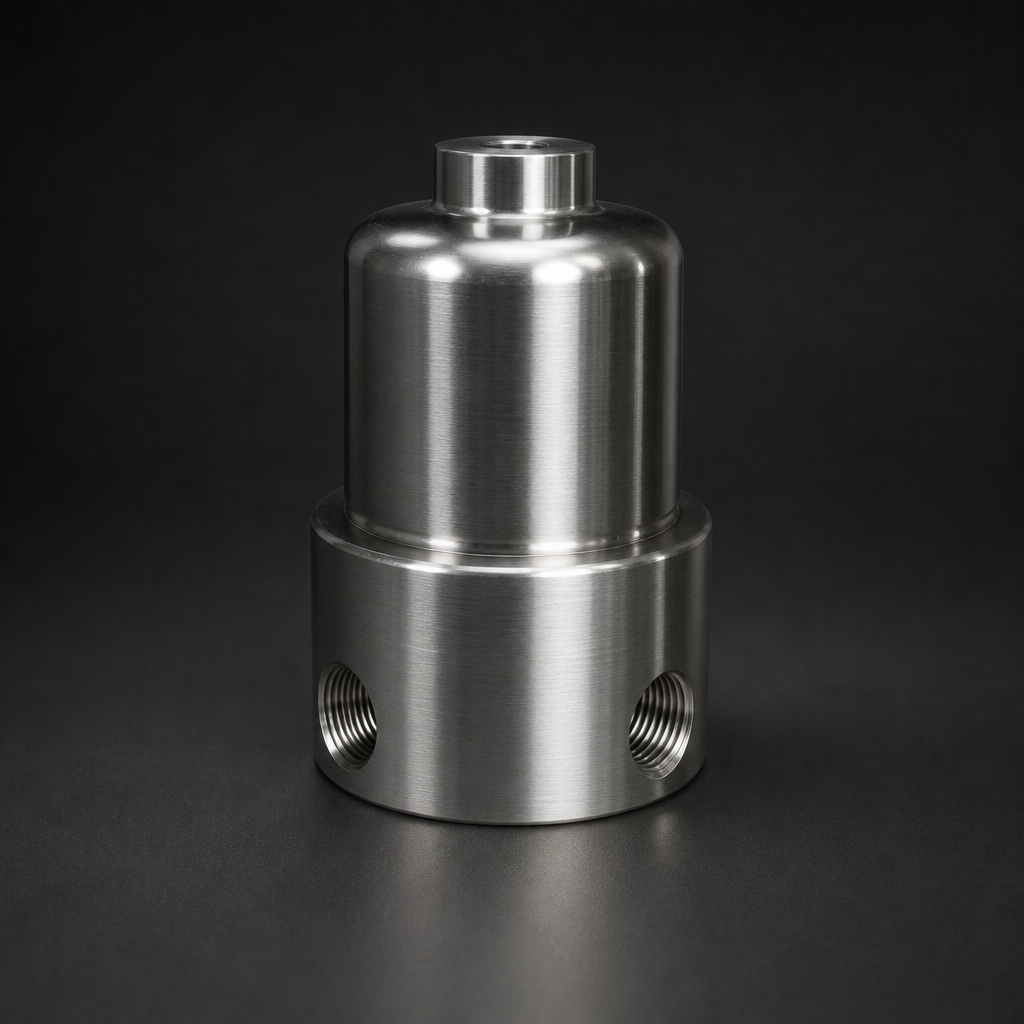
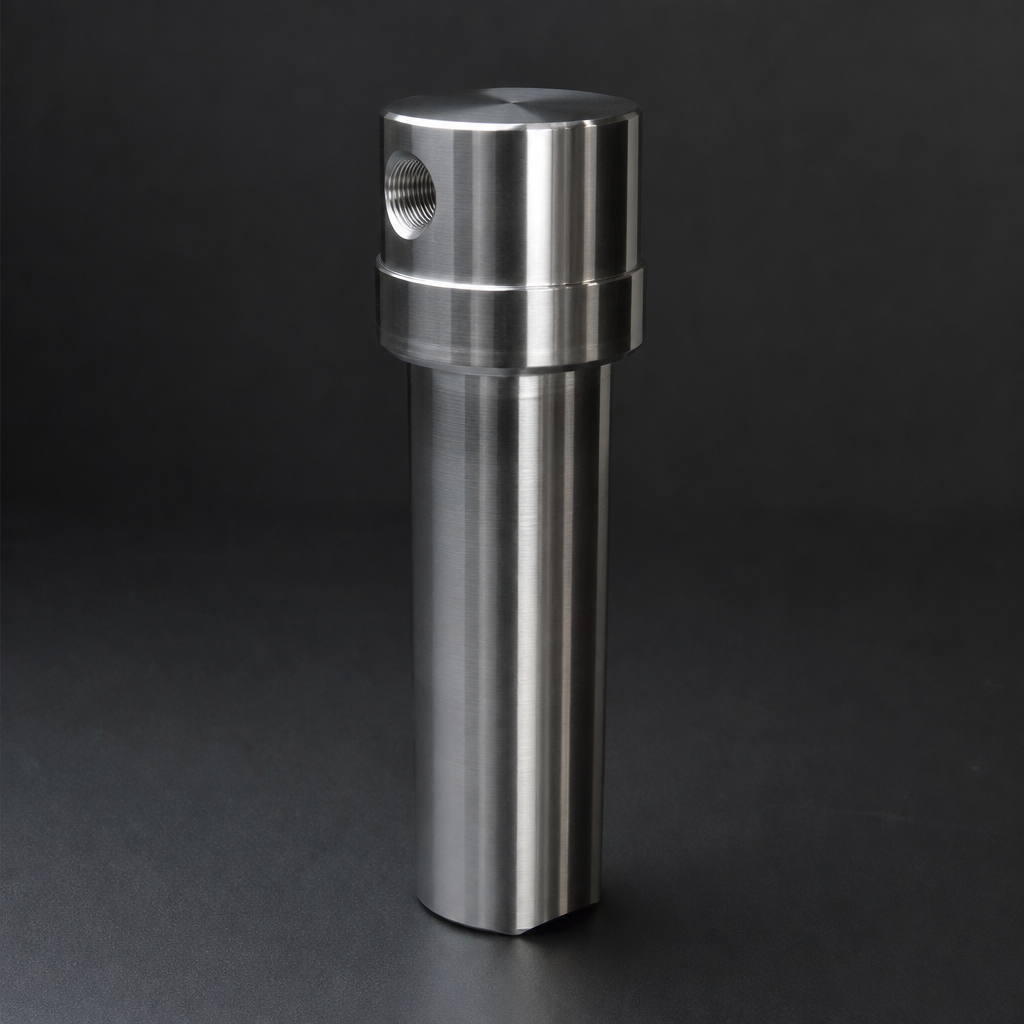
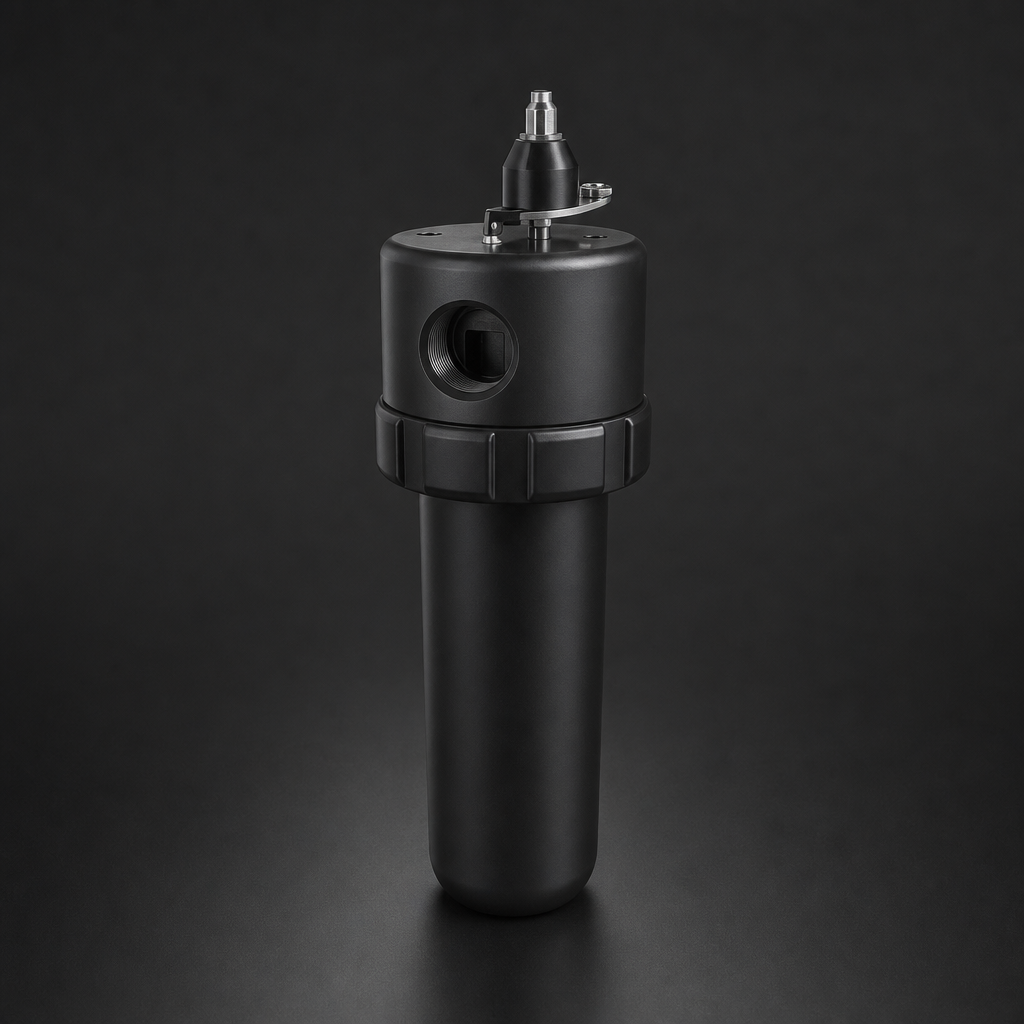
The RF-H-310 to RF-H-395 compressed air filter housings are designed for straightforward element inspection and replacement, with clear ΔP indicator ports as standard.
Need help selecting the right filter?
Stage 3 — The Distribution Network
Even a perfectly maintained treatment train cannot compensate for a contaminated distribution network. Pipework corrosion, dead legs, and condensate accumulation are common sources of particulate and microbial contamination that appear long after the treatment train has been audited.
- Pipework material: Galvanised steel pipework corrodes internally over time, releasing iron oxide particulate. If the system uses galvanised pipe and the complaint involves particulate contamination, the distribution network is a prime suspect.
- Dead legs: Any section of pipework that is not regularly purged can accumulate condensate and support microbial growth. Map the distribution system and identify any dead legs.
- Condensate drains: Check every automatic drain in the distribution system. A failed drain allows liquid water to accumulate and be carried downstream as a slug when flow demand increases.
- Point-of-use filters: Are point-of-use inline filters installed at critical connections? The RF-DIL disposable inline filter provides a final particulate barrier at the instrument or process connection, protecting against contamination introduced by the distribution network itself.
Use our free Engineering Tool to get a filtration recommendation for your specific application in under 2 minutes.
Stage 4 — Point of Use
The final stage of the audit is the point of use itself — the instrument, process connection, or application where the quality complaint originated. Check the following:
- Connection integrity: Are fittings and tubing in good condition? Cracked PTFE tubing or a loose compression fitting can introduce atmospheric contamination at the point of use.
- Local filtration: Is there a point-of-use filter installed? If not, consider adding an RF-DIL inline filter or an RF-DIA inline adsorber for applications sensitive to hydrocarbon vapours.
- Instrument condition: For analyser or instrument applications, check whether the instrument itself has been contaminated. A contaminated instrument will continue to give false readings even after the air supply has been corrected.
Audit Checklist Summary
| Audit Stage | Key Check | Common Finding | R+F Solution |
|---|---|---|---|
| Compressor Room | Oil condition, inlet air, aftercooler | Overloaded compressor, failed separator drain | RF-C coalescing pre-filter |
| Treatment Train | Element age, ΔP, dew point | Expired element, bypassed filter | RF-C / RF-P elements, RF-H-310–395 housings |
| Distribution | Pipework material, drains, dead legs | Corroded galvanised pipe, failed auto-drain | RF-DIL point-of-use inline filter |
| Point of Use | Fittings, local filtration, instrument condition | No local filter, contaminated instrument | RF-DIL / RF-DIA inline filters |
- Compressed air is an invisible utility.
- Compressor inlet air quality:
- The treatment train — dryer, pre-filter, coalescing filter, and adsorption filter — is where contamination should be removed.
- Point-of-use filters:
After the Audit: Corrective Actions and Verification
Once the root cause has been identified, implement corrective actions in order of severity. Replace expired elements first — this is the quickest win and the most common root cause. Then address any structural issues in the distribution network. Finally, verify the corrective actions by taking air quality measurements at the point of use against the ISO 8573-1 class required by your process.
For ongoing assurance, consider installing permanent dew point monitoring and ΔP indicators on all filter housings. The natural gas and process gas solutions pages on this site include guidance on continuous monitoring approaches that can be adapted for compressed air systems.
If you need support selecting the correct replacement elements or sizing a new treatment train, the coalescing vs particulate filter elements guide is a useful starting point.
Related Reading
- ISO 8573-1 Compressed Air Quality Classes Explained
- Coalescing vs Particulate Filter Elements — Which Do You Need?
- Oxygen Filtration Safety — What Every Engineer Should Know
Try our Engineering Sizing Tool → or discuss your requirements with our team.