Why Dry Vacuum Pumps Are Especially Vulnerable to Contamination
Oil-sealed rotary vane pumps have long dominated industrial vacuum applications, but dry vacuum technology — encompassing scroll, claw, and screw pump designs — has grown rapidly in sectors where hydrocarbon contamination of the process stream is unacceptable. Semiconductor fabrication, pharmaceutical manufacturing, food processing, and analytical instrumentation all rely on dry pumps to deliver clean, oil-free vacuum.
The defining characteristic of a dry pump is also its greatest vulnerability: the absence of lubricating oil in the compression chamber. In an oil-sealed pump, the oil film acts as a buffer, suspending fine particulates and carrying them away from critical surfaces. In a dry pump, there is no such protection. The rotor-to-stator clearances — often as tight as 50–150 µm in a scroll pump — are exposed directly to whatever the process stream delivers.
When process dust, polymer fines, or condensed moisture enter a dry pump without adequate inlet filtration, the consequences are predictable and severe: abrasive wear accelerates, clearances open up, ultimate vacuum deteriorates, and — in the worst case — hard particles bridge the gap between moving surfaces and cause catastrophic seizure. Pump replacement or major overhaul costs can easily reach five figures, and unplanned downtime in a production environment multiplies that figure many times over.
Effective dry vacuum pump inlet filtration is therefore not an optional accessory — it is a fundamental element of pump protection strategy.
How Dry Pump Filtration Differs from Oil-Sealed Pump Filtration
Engineers familiar with oil-sealed pump protection sometimes assume that the same filtration approach will work for dry pumps. In practice, there are important differences that must be understood before specifying inlet filters.
No Oil Mist Recirculation
Oil-sealed pumps generate an oil mist on the exhaust side that is typically captured by an exhaust oil mist filter and, in some designs, partially recirculated. Dry pumps produce no such mist. The exhaust stream from a dry pump may still carry process vapours, reaction by-products, or fine particulates that have passed through the pump, but there is no oil to act as a carrier or coalescing medium. This means that exhaust-side filtration for dry pumps is a separate engineering challenge — but it also means that the inlet filter does not need to handle oil aerosols.
Lower Tolerance for Pressure Drop
Dry pumps — particularly scroll and claw designs — are often more sensitive to inlet pressure drop than their oil-sealed counterparts. Excessive restriction at the inlet reduces the effective pumping speed and can cause the pump to run hotter. Filter element selection must therefore balance filtration efficiency against flow resistance, and differential pressure monitoring is especially important to ensure that a loaded element is changed before it begins to impair pump performance.
Moisture and Condensation Risks
Many dry pump applications involve processes that generate water vapour or solvent vapours. In an oil-sealed pump, these vapours are partially absorbed by the oil. In a dry pump, vapours that condense inside the compression chamber can cause corrosion, promote the adhesion of particulate deposits, and — if water hammer occurs — damage scroll tips or claw rotors. Where the process stream carries significant moisture, a coalescing pre-filter or a heated inlet line may be required upstream of the particulate filter.
Particle Size Sensitivity
The tight clearances in dry pumps mean that particles which would pass harmlessly through an oil-sealed pump can cause damage. As a general rule, inlet filtration for dry pumps should target particles down to 0.3 µm — the same efficiency class used for critical compressed air applications. This is a more demanding specification than the 1–5 µm filtration that is sometimes considered adequate for oil-sealed pump protection.
Inlet Filtration Strategies for Dry Vacuum Pumps
The correct filtration strategy depends on the nature of the process, the pump type, and the operating environment. The following approaches cover the most common scenarios encountered in industrial and laboratory settings.
Strategy 1: Single-Stage Particulate Filtration
For clean processes where the primary risk is ambient dust or fine process particulates — and where moisture is not a significant concern — a single-stage particulate inlet filter is often sufficient. The filter housing is installed directly in the inlet line, as close to the pump as practicable, and fitted with a high-efficiency particulate element.
R+F FilterElements offers the RF-P particulate filter element range, which achieves 99.99% efficiency at ≥ 0.3 µm. These elements are available in multiple sizes to match the inlet connection and flow requirements of the pump. For dry pump applications, the RF-P elements in the 25064 and 25178 size classes are commonly specified for pumps in the 10–100 m³/h free air delivery range.
Strategy 2: Two-Stage Coalescing and Particulate Filtration
Where the process stream carries both liquid aerosols (water, solvent mist) and solid particulates, a two-stage approach is recommended. A coalescing filter — fitted with an RF-C coalescing element — is installed first to capture liquid aerosols and drain them away from the gas stream. A particulate filter follows to remove any remaining solid contamination before the gas enters the pump.
This arrangement is particularly important in pharmaceutical and chemical applications where solvent recovery processes generate mixed vapour-particulate streams. The coalescing stage protects the particulate element from premature blinding by liquid droplets, extending service intervals and reducing operating costs.
Strategy 3: High-Dust-Load Applications with Pre-Separator
In applications such as powder handling, ceramic processing, or mineral vacuum conveying, the dust burden on the inlet stream can be very high. In these cases, a cyclonic pre-separator or a coarse mesh strainer should be installed upstream of the fine filter to extend element life. The fine filter then acts as a polishing stage, capturing the sub-micron fraction that the pre-separator cannot remove.
Selecting the Right R+F Filter Housing for Dry Pump Inlet Duty
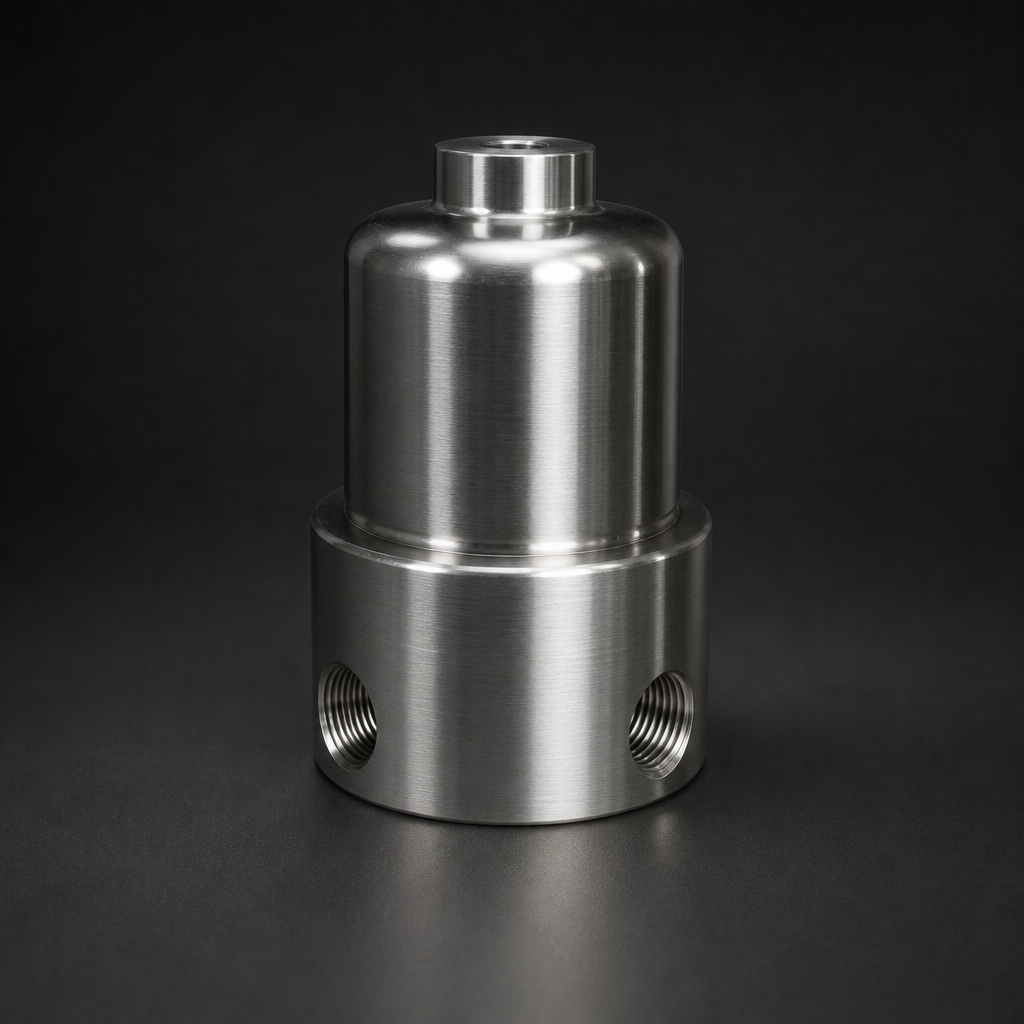
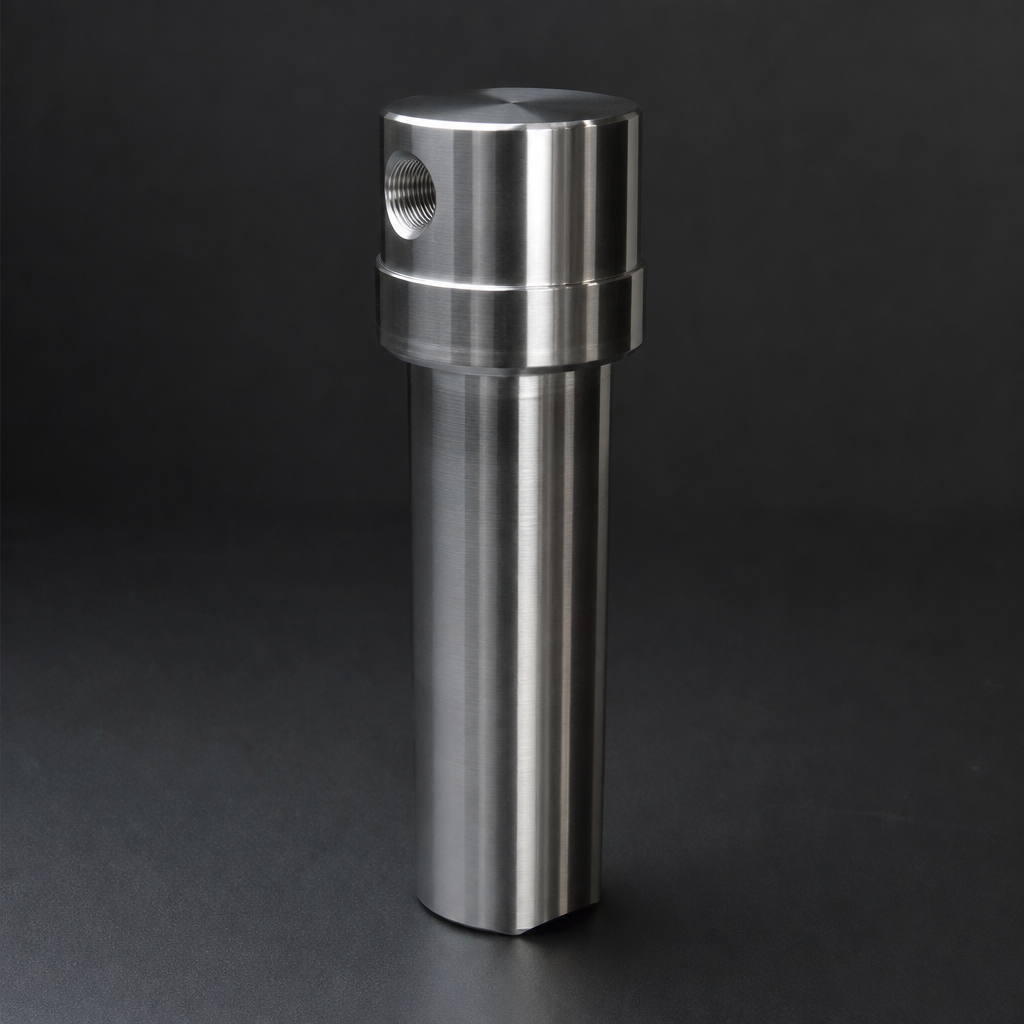
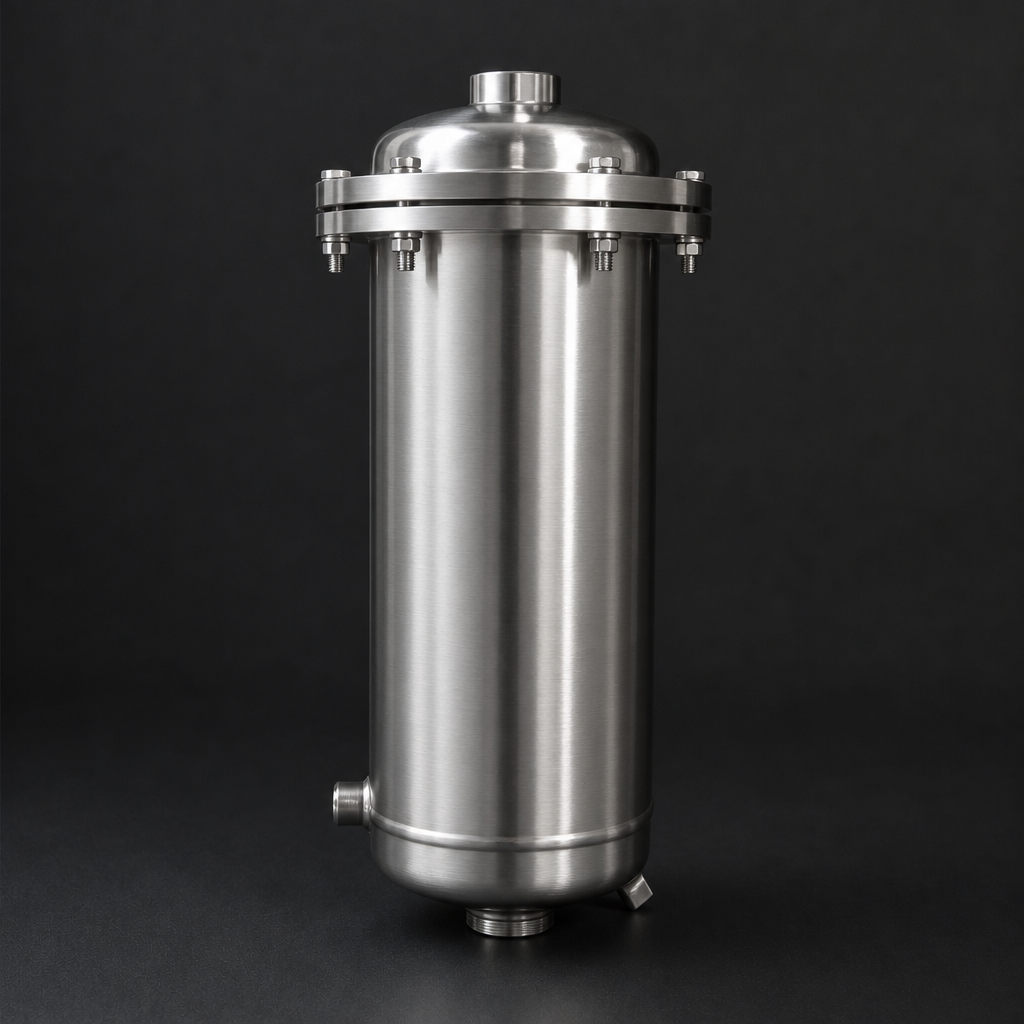
R+F FilterElements offers a range of filter housings suitable for vacuum pump inlet service. The key selection parameters are inlet/outlet connection size, maximum allowable pressure drop, and compatibility with the process fluid.
| Housing Series | Material | Max Pressure | Flow Range | Typical Application |
|---|---|---|---|---|
| RF-H-310 to RF-H-395 | Aluminium / Polycarbonate | 17 bar | 0–12,000 Nm³/h | General compressed air and process gas; also used for vacuum inlet on clean processes |
| RF-H-420 to RF-H-456 | Aluminium or 316L Stainless Steel | Vacuum-rated | 5–765 m³/h FAD | Vacuum pump exhaust; multi-element designs for high-flow pumps |
| RF-H-110 to RF-H-170 | 316L Stainless Steel | Up to 700 bar | Instrumentation flows | Analyser protection, sample conditioning, semiconductor process lines |
For most dry vacuum pump inlet applications, housings from the RF-H-310 to RF-H-395 series are appropriate when the process is clean and the operating pressure is near atmospheric. Where the process involves aggressive chemicals or where stainless steel construction is required, the RF-H-420 series in 316L stainless steel provides the necessary material compatibility. Use the online sizing wizard to generate a preliminary specification, or contact the technical team directly for complex applications.
exhaust-side filtration for dry pumps
RF-P Element Specifications for Dry Pump Inlet Duty
The RF-P particulate filter element is the workhorse of dry vacuum pump inlet protection. Its borosilicate glass microfibre construction delivers consistent sub-micron filtration efficiency without the risk of fibre migration that can affect some alternative media types.
| Element Code | Size Class | Filtration Efficiency | Max Temp (Standard) | Max Temp (S-Type) | Seal Options |
|---|---|---|---|---|---|
| RF-P-12032 | 12032 | 99.99% ≥ 0.3 µm | 100 °C | 200 °C | NBR, FKM, EPDM, PTFE |
| RF-P-12057 | 12057 | 99.99% ≥ 0.3 µm | 100 °C | 200 °C | NBR, FKM, EPDM, PTFE |
| RF-P-25064 | 25064 | 99.99% ≥ 0.3 µm | 100 °C | 200 °C | NBR, FKM, EPDM, PTFE |
| RF-P-25178 | 25178 | 99.99% ≥ 0.3 µm | 100 °C | 200 °C | NBR, FKM, EPDM, PTFE |
| RF-P-51230 | 51230 | 99.99% ≥ 0.3 µm | 100 °C | 200 °C | NBR, FKM, EPDM, PTFE |
| RF-P-51476 | 51476 | 99.99% ≥ 0.3 µm | 100 °C | 200 °C | NBR, FKM, EPDM, PTFE |
S-type variants are recommended where inlet gas temperature may exceed 100 °C. FKM seals suit most chemical process applications; PTFE seals are available for highly aggressive media. Browse the full range of R+F filter elements or explore the dedicated vacuum pump filtration range for exhaust-side solutions.
Use our free Engineering Tool to get a filtration recommendation for your specific application in under 2 minutes.
Differential Pressure Monitoring and Maintenance Intervals
One of the most common causes of dry pump failure in otherwise well-designed installations is neglect of the inlet filter. An element that has reached the end of its service life presents two distinct risks:
- Bypass risk: If the element becomes so heavily loaded that the differential pressure exceeds the element's structural rating, the element can collapse or bypass, releasing a slug of accumulated contamination directly into the pump.
- Flow restriction risk: Even before bypass occurs, a heavily loaded element restricts inlet flow, reducing pumping speed and causing the pump to run at elevated temperature. In scroll pumps, this can accelerate tip seal wear; in claw pumps, it can cause thermal distortion of the rotor profiles.
Best practice is to install a differential pressure indicator or transmitter across the inlet filter and to establish a change-out trigger point. For most dry pump applications, a differential pressure of 200–350 mbar across the inlet filter is a reasonable change-out threshold, but the pump manufacturer's recommendations should always be consulted.
Where continuous monitoring is not practicable, a time-based maintenance interval should be established based on the process dust burden. In clean laboratory environments, annual element changes may be sufficient. In dusty industrial environments, quarterly or even monthly changes may be required. Keeping a log of differential pressure readings at each maintenance visit allows the interval to be optimised over time.
Special Considerations for Scroll Pump Inlet Filtration
Scroll pumps deserve particular attention because their spiral-form compression geometry creates a specific vulnerability to hard particle ingress. The orbiting scroll tip — typically a polymer or PTFE-based material — traces a path that brings it into very close proximity with the fixed scroll wall on every revolution. A single hard particle of 100 µm or larger can score both surfaces, creating a leak path that permanently degrades ultimate vacuum performance.
For scroll pump inlet filtration, R+F FilterElements recommends:
- RF-P elements rated to 99.99% efficiency at ≥ 0.3 µm as the minimum specification
- Housing selection that allows element change without disturbing the inlet pipework — quick-release bowl designs are preferred
- A differential pressure gauge visible from the pump operating position, so operators can check filter condition during routine rounds
- Where the process involves polymer powders or other materials that can cake on the element surface, consideration of a pleated element design to maximise filtration area and extend service life
Claw Pump Filtration: Managing Pulsating Flow
Claw vacuum pumps generate a pulsating inlet flow due to the intermittent nature of the claw rotor geometry. This pulsation can cause mechanical fatigue in filter elements that are not designed to handle cyclic loading. When specifying inlet filters for claw pump filtration applications, it is important to select elements with robust end-cap construction and adequate radial support to resist the cyclic pressure differentials.
The RF-P element range from R+F FilterElements is constructed with reinforced end caps and a rigid inner support core, making it well suited to pulsating flow applications. For very high pulsation amplitudes — as encountered in large multi-lobe claw pumps — the use of a pulsation damper upstream of the filter housing should be considered.
- exhaust-side filtration for dry pumps
- The correct filtration strategy depends on the nature of the process, the pump type, and the operating environment.
- R+F FilterElements offers a range of filter housings suitable for vacuum pump inlet service.
- The RF-P particulate filter element is the workhorse of dry vacuum pump inlet protection.
Summary: Key Principles for Dry Pump Inlet Filtration
- Dry pumps have no oil buffer — inlet filtration must capture particles down to 0.3 µm to protect tight internal clearances
- Moisture management is as important as particulate removal — consider coalescing pre-filtration where condensation is a risk
- Pressure drop across the inlet filter must be monitored — a loaded element restricts flow and causes thermal stress in the pump
- Element selection should account for process temperature, chemical compatibility, and flow pulsation characteristics
- R+F FilterElements RF-P particulate elements and RF-C coalescing elements, fitted in appropriate RF-H series housings, provide a proven solution for dry pump inlet protection across a wide range of industrial applications
For a tailored recommendation based on your pump model and process conditions, use the R+F sizing wizard or speak directly with the technical team via the enquiry page.