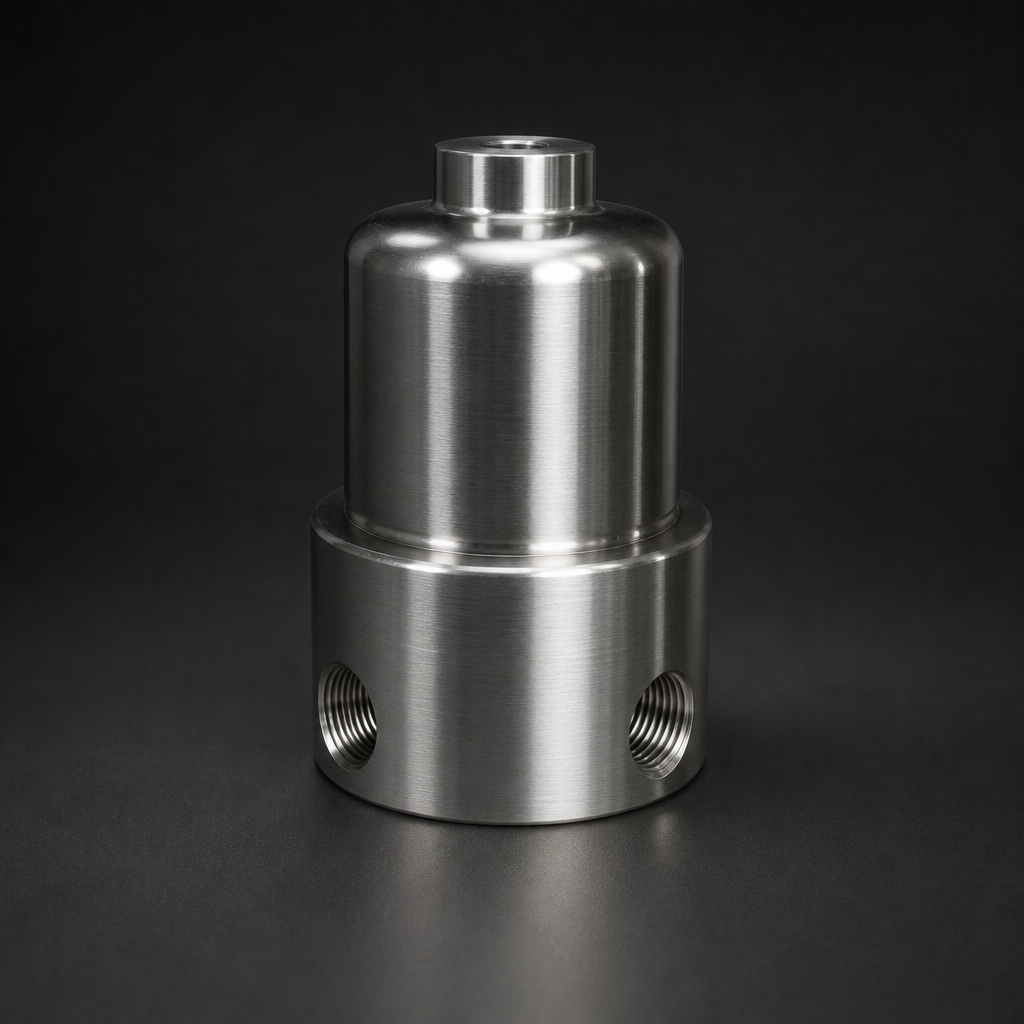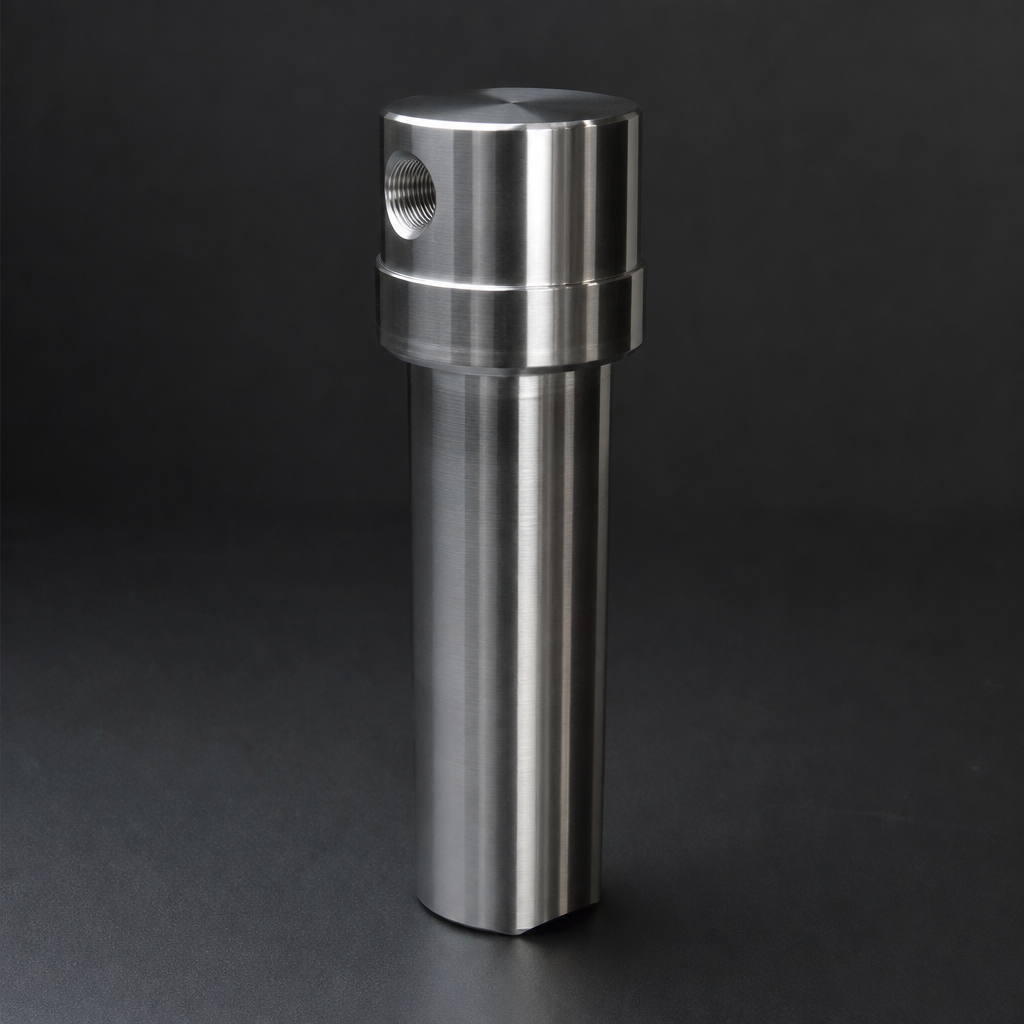
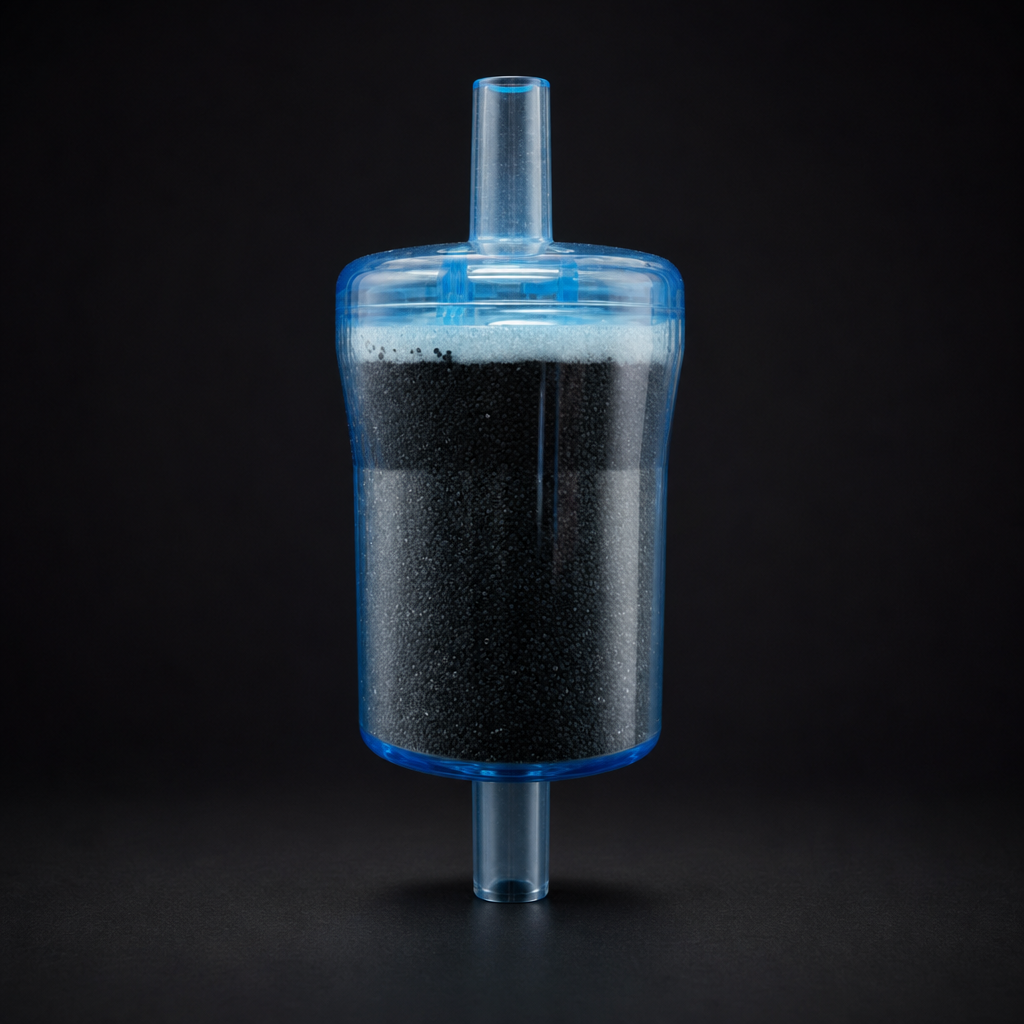
What are disposable inline adsorbers?
Unlike regenerable adsorption vessels that require periodic thermal or pressure-swing regeneration, disposable inline adsorbers are compact, single-use cartridges filled with a granular adsorbent medium. They screw or clamp directly into a gas line and are replaced once the medium is saturated. No regeneration skid, no heat source, no complex valve logic — just swap and go.
This simplicity makes them ideal for low-to-medium flow applications where the contaminant load is modest but the consequences of breakthrough are severe: analytical instrument feeds, calibration gas lines, carrier gas purification, and point-of-use protection in semiconductor fabs.
Key Takeaway
- Disposable inline adsorbers eliminate the complexity of regeneration systems for low-flow, high-consequence applications.
- Medium selection must match the target contaminant — activated carbon for hydrocarbons, molecular sieve for moisture, iron oxide for H₂S.
- Breakthrough monitoring (or conservative time-based replacement) is essential because adsorption capacity is finite and non-linear near saturation.
How inline adsorbers work
Gas flows through a packed bed of adsorbent granules contained within a cylindrical cartridge. Contaminant molecules are captured by one of three mechanisms, depending on the adsorbent type:
Physical Adsorption (Physisorption)
Van der Waals forces attract contaminant molecules to the vast internal surface area of the adsorbent (up to 1,200 m²/g for activated carbon). Effective for hydrocarbons, odours, and organic vapours.
Chemisorption
A chemical reaction binds the contaminant to the adsorbent surface. Iron-oxide pellets, for example, react with H₂S to form iron sulphide. This is irreversible and provides very high selectivity.
Molecular Sieving
Zeolite-based adsorbents with uniform pore diameters selectively admit molecules below a certain size. A 3 Å sieve captures water but excludes larger molecules — ideal for carrier-gas drying.
Selecting the right adsorbent medium
Choosing the wrong medium is the single most common cause of inline adsorber failure. The table below maps contaminants to their recommended adsorbents:
| Contaminant | Recommended Medium | Notes |
|---|---|---|
| Oil vapour / hydrocarbons | Activated carbon | Use coconut-shell carbon for highest capacity |
| Moisture (H₂O) | Molecular sieve 4A / silica gel | Silica gel for high RH; mol sieve for trace-level drying |
| H₂S / mercaptans | Iron-oxide pellets / impregnated carbon | Chemisorption — irreversible, high selectivity |
| CO₂ | Molecular sieve 13X / NaOH-impregnated carbon | 13X preferred for trace CO₂ in carrier gas |
| Ammonia (NH₃) | Acid-impregnated carbon / zeolite | pH-sensitive — verify compatibility with housing seals |
Watch out for competitive adsorption
When multiple contaminants are present, molecules compete for the same adsorption sites. Higher-concentration species can displace previously adsorbed lower-concentration contaminants — causing unexpected breakthrough. In mixed-contaminant streams, use a multi-layer cartridge or stage two adsorbers in series with different media.
Understanding capacity and breakthrough
Every adsorbent has a finite capacity, expressed as the mass of contaminant adsorbed per unit mass of medium. Once this capacity is consumed, contaminant molecules pass straight through — a phenomenon called breakthrough.
Breakthrough is not gradual. The outlet concentration remains near zero for most of the adsorber's life, then rises sharply once the mass-transfer zone reaches the outlet. This non-linear behaviour means you cannot simply assume “half the cartridge is used after half the predicted service time.”
Practical approaches to managing breakthrough:
- Indicator beds — Some media (e.g., colour-indicating silica gel) change colour when saturated. Visible through a transparent housing, this provides a simple visual alarm.
- Inline sensors — Moisture analysers, PID detectors, or electrochemical sensors downstream of the adsorber can trigger an alarm at a pre-set threshold.
- Conservative time-based replacement — Replace cartridges at 70–80 % of the predicted capacity to ensure a safety margin. Track replacement dates and correlate with process conditions.
Temperature matters
Adsorption capacity decreases as temperature rises. A cartridge rated for 1,000 hours at 20 °C may reach breakthrough in 600 hours at 35 °C. Always verify vendor capacity data against your actual operating temperature — not the lab test temperature.
Pressure drop considerations
Inline adsorbers add a small but measurable pressure drop to the gas line. For most cartridges in the RF-DIA series, clean ΔP is below 0.1 bar at rated flow. Key factors:
- Granule size — Finer granules provide more surface area (better capacity) but increase resistance to flow. A 2–4 mm pellet size is the typical balance point.
- Bed depth — Deeper beds capture more contaminant but raise ΔP. The cartridge length-to-diameter ratio should stay between 2:1 and 4:1 for optimal performance.
- Flow direction — Downward flow compacts the bed and slightly increases ΔP over time. Upward flow risks fluidising the bed and creating channels that bypass the adsorbent.
Find the right inline adsorber for your application
Our RF-DIA range covers activated carbon, molecular sieve, and specialty media in standard connection sizes. Use the Engineering Tool to calculate capacity and service life, or contact our applications team.
Installation best practices
- Pre-filter the gas. Always install a particulate or coalescing filter upstream of the adsorber. Liquid droplets and particles foul the adsorbent surface and drastically reduce capacity.
- Mount vertically where possible. Gravity keeps the bed packed and prevents channelling. If horizontal mounting is unavoidable, use a cartridge design with internal baffles.
- Label replacement dates. Attach a dated tag at commissioning showing the predicted replacement date and the operating conditions used for the calculation.
- Store spares sealed. Many adsorbents begin adsorbing ambient moisture and CO₂ as soon as they are exposed to air. Keep replacement cartridges in their sealed packaging until the moment of installation.
Related products
- Adsorption Media — Activated carbon, molecular sieve, and specialty media for inline and vessel-type adsorbers.
- Instrumentation Filters — Point-of-use filtration for gas analysers and calibration lines.
- Coalescing Elements — Pre-filtration stage to remove aerosols before the adsorber.