Why Nm³/h is not what the filter sees
Gas flows are usually specified as standard volume: Nm³/h (0 °C, 1.01325 bar) or Sm³/h (often 15 °C). A filter, however, is passed by the actual gas volume at operating pressure and temperature. At 200 bar this is around 200 times smaller — and that changes the filter size completely.
The conversion
Actual flow Qact = QN × (pN / p) × (T / TN) × Z
- QN = standard flow in Nm³/h
- pN = 1.01325 bar(a), TN = 273.15 K
- p = operating pressure in bar absolute (200 bar(g) ≈ 201 bar(a))
- T = operating temperature in K
- Z = real-gas compressibility factor at operating conditions
Worked example: 1000 Nm³/h methane at 200 bar(g)
| Gas temperature | Z (methane) | Actual flow |
|---|---|---|
| 0 °C | ≈ 0.76 | ≈ 3.8 m³/h |
| 15 °C | ≈ 0.80 | ≈ 4.3 m³/h |
| 30 °C | ≈ 0.84 | ≈ 4.7 m³/h |
With the ideal-gas law (Z = 1) the result would be about 5.0–5.5 m³/h — an overestimate of roughly 20–30 %. Natural gas behaves similarly to methane; depending on composition its actual flow is a few percent lower. If the flow is given in Sm³/h at 15 °C instead of Nm³/h, the actual flow is about 5 % lower.
Use our free Engineering Tool to get a filtration recommendation for your specific application in under 2 minutes.
What this means for the filter
- Small actual volume: at around 4.3 m³/h the gas velocity in a 1″ line is only about 2–2.5 m/s. The filter size is driven by pressure rating, element efficiency and service interval rather than by volume.
- High density: at 200 bar the gas is much denser than at atmospheric pressure. Differential pressure is therefore checked on actual conditions, not on air data at 7 bar.
- Viscosity: methane at 200 bar has a viscosity of about 0.020 mPa·s — close to air at ambient conditions (0.018 mPa·s).
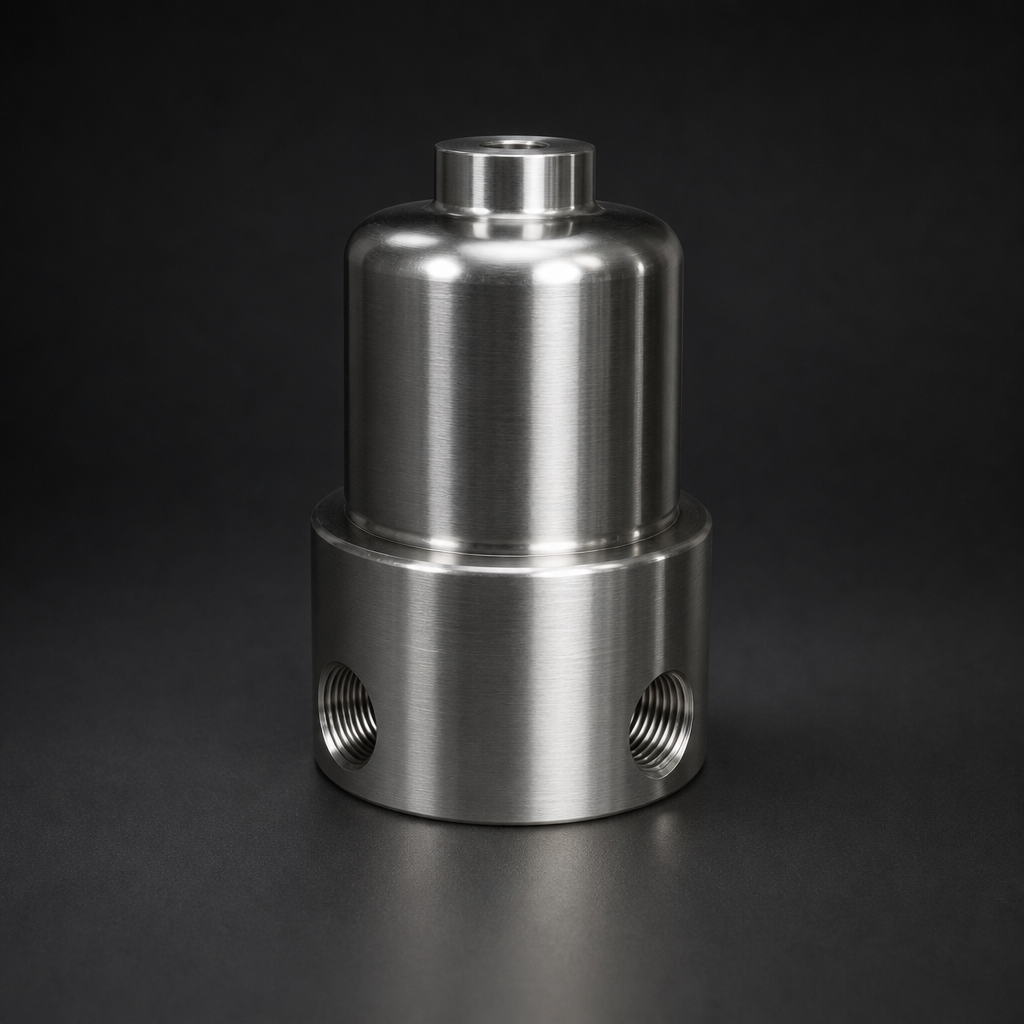
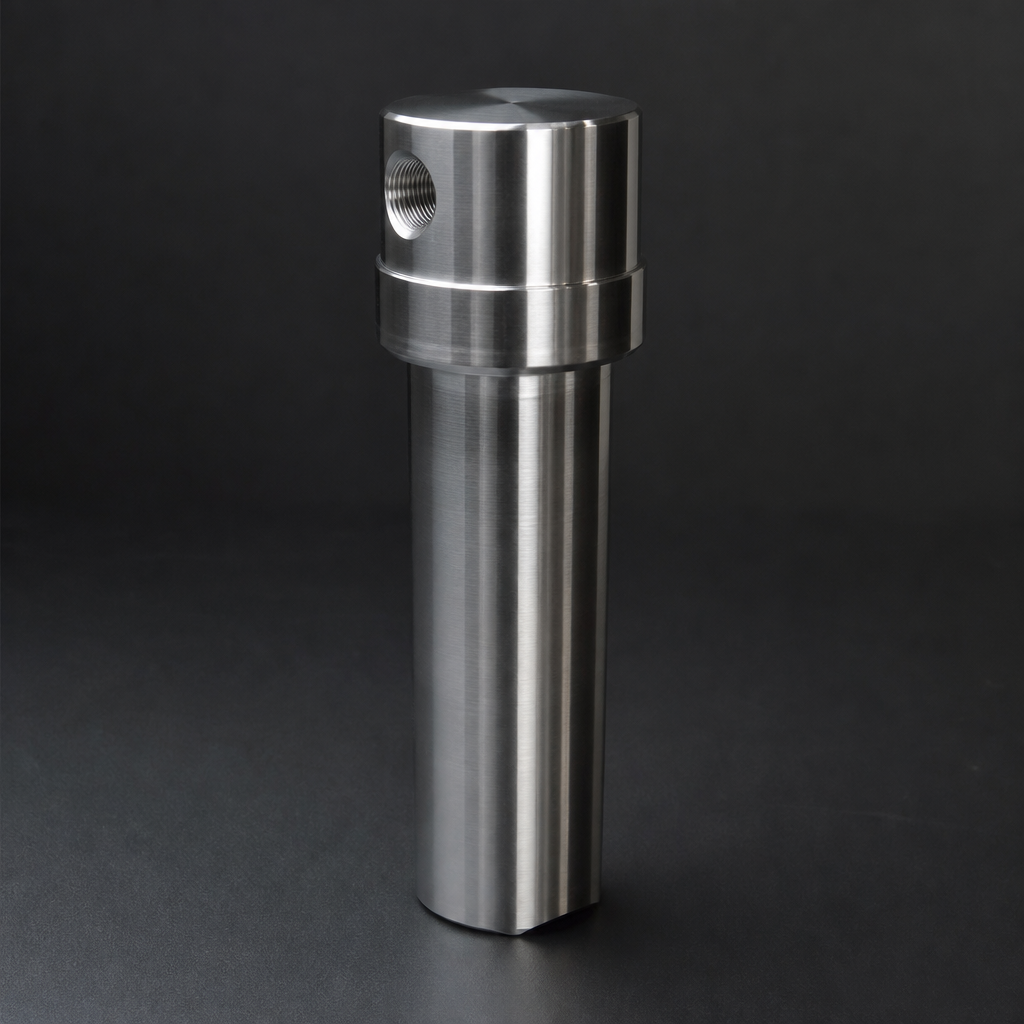
- Pressure rating first: for a 200 bar line choose RF-H-150HP (200 bar); where the pressure can exceed 200 bar, RF-H-150VP (400 bar). Both have 1″ NPT ports and take the RF-C-51230-HE coalescing element (99.99 % @ 0.01 µm).
- Actual flow Qact = QN × (pN / p) × (T / TN) × Z
- With the ideal-gas law (Z = 1) the result would be about 5.
- Pressure rating first:
Data we need for sizing
- Gas and composition (or at least: natural gas / biomethane / methane)
- Flow in Nm³/h or Sm³/h — with the reference conditions
- Minimum and maximum operating pressure, design pressure
- Operating temperature range
- Contaminants: compressor oil, particles, liquid
- Allowable differential pressure
Send us these values via our contact page and we will size the filter. More on sizing high-pressure gas filters, CNG & natural gas filtration and filtration in CNG stations.