
CNG & High-Pressure Natural Gas Filtration
Coalescing line filters for CNG stations, compressor discharge lines and high-pressure natural gas: removing compressor oil aerosol and particles at 200 or 400 bar — in 316L housings with 1″ NPT connections.
The Challenge
Natural gas for CNG is compressed in several stages to 200–250 bar. Lubricated piston compressors inevitably carry a small amount of oil into the gas — partly as a fine aerosol, partly as droplets that collect in the line. Together with particles from pipework, pulsation dampers and storage, this contamination reaches priority panels, dispensers, breakaway couplings and finally the vehicle tank.
The consequences are familiar to station operators: sticking valves and solenoids, inaccurate flow metering, leaking dispenser nozzles and complaints about oily residues at the vehicle. Many specifications therefore call for a high-pressure coalescing line filter — typically written as "DN25, 200 bar, grade 6 coalescing or equivalent".
Sizing is where many projects go wrong. A flow of 1000 Nm³/h sounds large, but at 200 bar the gas is compressed so far that only about 4 m³/h actually flows through the filter. Housings chosen by standard volume are often heavily oversized, while the real issues — pressure rating, seal material, drain management and element efficiency — get too little attention.
Our Solution
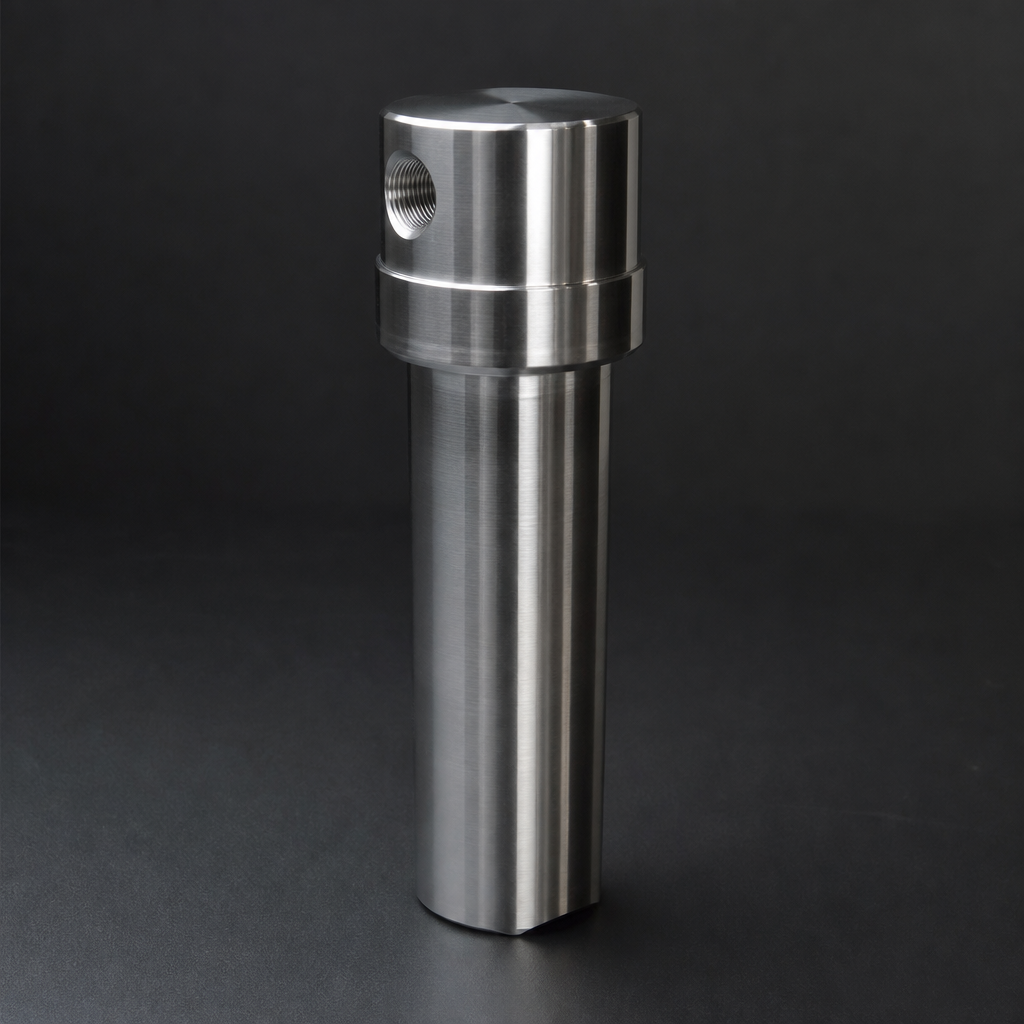
R+F supplies high-pressure line filters built for exactly this duty: the RF-H-150HP 316L housing rated 200 bar and the RF-H-150VP variant rated 400 bar, both with 1″ NPT connections, an internal volume of 1.5 L and FKM seals as standard (PTFE gasket on request). Flanged connections can be reviewed on request. Every housing is supplied with a matching element fitted.
Inside, the coalescing element RF-C-51230-HE is rated 99.99 % at 0.01 µm. It captures compressor oil aerosol and fine particles; coalesced oil drains to the bottom of the housing and is removed via the drain. Because grade designations differ between manufacturers, we compare against the rated efficiency in your specification rather than a grade number — send us the data sheet and we confirm the equivalent element.
200 or 400 bar
RF-H-150HP for 200 bar CNG lines, RF-H-150VP for 400 bar — the same element in both.
DN25 / 1″ NPT
Full-bore 1″ connections suit typical DN25 station pipework; flanges on request.
High-Efficiency Coalescing
RF-C-51230-HE: 99.99 % at 0.01 µm against compressor oil aerosol and fine particles.
Low Pressure Drop
At about 4 m³/h actual flow (≈ 1000 Nm³/h at 200 bar) the clean element shows only a few hundredths of a bar.
Clear Change Criterion
Change the element at 0.7 bar differential pressure — at least once a year as a recommendation.
Serviceable, Not Disposable
The 316L housing stays in the line; only the element is replaced at each service.
Typical Position in a CNG Station
Where the coalescing line filter sits in a CNG station. The exact layout depends on the compressor, storage and dispenser concept.
- 1
Stage 1 — Gas supply and inlet filter: pipeline gas enters the station; dryer and inlet filtration protect the compressor.
- 2
Stage 2 — Multi-stage compressor with interstage cooling: raises the pressure to 200–250 bar and adds traces of lubricating oil to the gas.
- 3
Stage 3 — Coalescing line filter after the final cooler: RF-H-150HP (200 bar) or RF-H-150VP (400 bar) with RF-C-51230-HE removes oil aerosol and particles while the gas is cool.
- 4
Stage 4 — Storage and priority panel: clean gas protects valves, cascade storage and control equipment.
- 5
Stage 5 — Dispenser: an optional point-of-use filter in front of the dispenser catches particles released by storage and pipework.
Recommended Products
Explore the filtration products most commonly specified for this application.
Industries Served
CNG Filling Stations
Line filters after the compressor and in front of the dispenser in public and fleet stations.
Compressor Packagers
Coalescing filters integrated into CNG compressor skids by OEMs and system integrators.
Bus & Fleet Depots
High-throughput depot stations where clean gas protects dispensers and vehicle systems.
Natural Gas Transmission
High-pressure filtration at compressor stations, metering and regulating skids.
Biomethane / Bio-CNG
Upgraded biogas compressed for vehicle fuel — the same oil and particle issues apply.
Industrial Gas Users
High-pressure natural gas supplies for burners, engines and test benches.
Need an application-specific recommendation?
Our engineers can recommend the optimal filtration configuration for your specific process conditions, flow rates, and contaminant profiles.