
SCR & DeNOx Emission Monitoring
Protecting NOx analysers from ammonia cross-sensitivity in selective catalytic reduction (SCR) systems — with acid-washed filter elements that neutralise NH₃ before it reaches the chemiluminescence detector.
The Challenge
Selective catalytic reduction (SCR) is the dominant technology for reducing nitrogen oxide (NOx) emissions from combustion processes. Urea solution or ammonia is injected into the exhaust stream where it reacts with NOx over a catalyst to form harmless nitrogen and water. However, imperfect mixing, catalyst ageing, or load transients inevitably cause some unreacted ammonia to pass through — this is known as ammonia slip.
The problem becomes critical at the measurement point. Continuous emission monitoring systems (CEMS) typically use chemiluminescence detectors (CLD) to measure NOx. Inside the CLD, a converter catalytically oxidises NO₂ to NO — but this same converter also partially oxidises NH₃ to NO. The analyser then reports this additional NO as if it were real NOx from the process, causing falsely elevated readings.
The consequences are serious: operators may report permit exceedances that never actually occurred, trigger unnecessary load reductions, or over-dose urea in a feedback loop that wastes reagent and increases particulate formation. Without removing NH₃ from the sample gas before the analyser, accurate NOx measurement downstream of an SCR system is impossible.
Our Solution
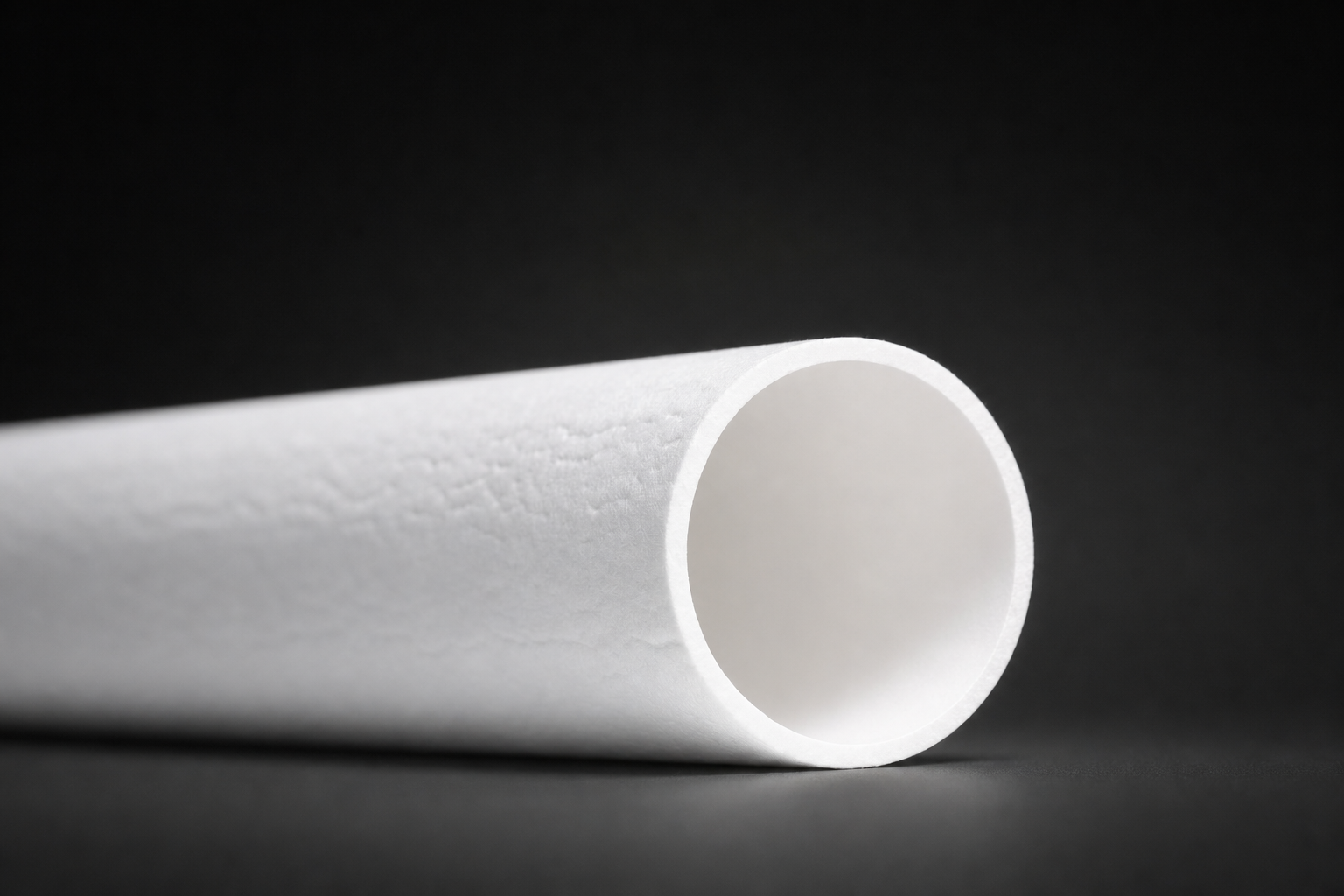
R+F FilterElements provides acid-washed (AW series) borosilicate microfibre filter elements specifically designed for this application. The filter medium is impregnated with phosphoric acid (H₃PO₄), which reacts with ammonia in the sample gas to form ammonium phosphate — a stable, non-volatile salt that remains bound in the element.
The result is simultaneous particle filtration and ammonia removal in a single disposable element that fits directly into your existing filter housing. No system modifications, no additional equipment, no heated reagent lines — simply replace the standard element with an AW element and the ammonia interference disappears.
Two binder variants cover the full temperature range: K-type (PVDF binder) for cooled sample streams up to 150 °C, and S-type (silica binder) for hot extractive systems up to 480 °C. Both achieve 99.99 % particle retention at 0.01 µm while selectively removing NH₃ without affecting NOx, CO, CO₂, SO₂, or any other measured component.
Eliminates CLD Cross-Sensitivity
Phosphoric acid reacts with NH₃ before it reaches the analyser’s NO₂-to-NO converter, preventing false-high NOx readings that cause phantom permit exceedances.
Drop-In Retrofit
Same physical dimensions as standard R+F particulate and K-type elements — fits all existing housings without system modification or additional hardware.
Dual Temperature Range
K-type (PVDF binder) for cooled sample lines up to 150 °C; S-type (silica binder) for hot extractive CEMS sampling up to 480 °C.
Selective Removal
The acid wash neutralises only NH₃ — it does not adsorb, react with, or interfere with NOx, CO, CO₂, SO₂, HCl, or other measured gas components.
Simultaneous Particle Filtration
Grade HE: 99.99 % efficiency at 0.01 µm. The element filters particles and scrubs ammonia in a single stage — no additional equipment needed.
Cost-Effective Disposable
Replace when ammonia capacity is exhausted. Low per-element cost compared to catalytic or wet-chemical scrubbing systems.
How SCR Creates the Measurement Problem
Understanding the ammonia-NOx measurement interference requires following the sample gas path from the SCR catalyst to the analyser detector:
- 1
Combustion: The engine, turbine, or furnace produces exhaust gas containing NOx (NO + NO₂).
- 2
SCR injection: Urea solution (AdBlue® / DEF) or gaseous ammonia is injected into the exhaust stream upstream of the SCR catalyst.
- 3
Catalytic reduction: Over the catalyst (typically V₂O₅/TiO₂ or zeolite), ammonia reacts with NOx: 4 NO + 4 NH₃ + O₂ → 4 N₂ + 6 H₂O. This removes typically 80–95 % of the NOx.
- 4
Ammonia slip: Unreacted NH₃ passes through the catalyst and enters the sample gas extraction point.
- 5
Sample conditioning: The gas sample is extracted, cooled (if cold-dry) or kept hot (if hot-wet), and transported to the analyser shelter.
- 6
AW element: An R+F acid-washed filter element in the sample line neutralises NH₃ before it can reach the analyser. NH₃ + H₃PO₄ → (NH₄)₃PO₄.
- 7
CLD analysis: The ammonia-free sample enters the chemiluminescence detector, which now measures only genuine NOx — free from NH₃ artefacts.
Recommended Products
Explore the filtration products most commonly specified for this application.
Industries Served
Power Generation
Coal, gas, and biomass power stations with SCR DeNOx systems. CEMS compliance monitoring for NOx, SO₂, CO, and particulate under 13./17. BImSchV and EN 14181.
Waste Incineration
Municipal and hazardous waste incinerators with SNCR/SCR DeNOx and complex flue gas compositions including HCl, HF, and heavy metals.
Cement & Glass
Rotary kilns and glass furnaces with high-temperature SCR catalysts. Hot-side sampling points requiring S-type (480 °C) AW elements.
Marine & Large Engines
Ship engines and stationary diesel/gas engines meeting IMO Tier III and TA Luft requirements. Compact SCR systems with high ammonia slip variability.
Biogas & CHP
Biogas combined heat and power plants (BHKW) with SCR catalysts for NOx reduction. Emission monitoring for operational permits.
Automotive Testing
Engine test cells and chassis dynamometers measuring NOx downstream of SCR-equipped diesel engines (Euro VI, Euro 7). Accurate real-driving emission (RDE) measurement.
Troubleshooting
Common Problems We Solve
Need an application-specific recommendation?
Our engineers can recommend the optimal filtration configuration for your specific process conditions, flow rates, and contaminant profiles.
SCR Process & Ammonia Cross-Sensitivity
Without an AW element, the CLD analyser reports ammonia as additional NO — resulting in falsely elevated NOx readings.