PET bottle blow-moulding is one of the most demanding compressed air applications in the food and beverage industry. Operating at pressures between 30 and 40 bar, the high-pressure air that stretches a preform into a finished bottle comes into direct contact with the internal surface of every container produced. When that air carries oil aerosols, moisture, or particulate contamination, the consequences are immediate and costly: hazy bottles, off-taste complaints, failed quality audits, and — in the worst case — a full production recall.
This article explains why compressed air quality is the single most critical variable in blow-moulding clarity, how ISO 8573-1 defines the purity classes that apply to product-contact air, and which R+F FilterElements products are engineered specifically for high-pressure beverage applications.
Why Compressed Air Touches Every Bottle You Produce
In a rotary stretch-blow-moulding machine, a PET preform is heated to roughly 100–120 °C and then inflated with high-pressure compressed air in two stages: a low-pressure pre-blow (around 8–12 bar) followed by a high-pressure final blow (30–40 bar). The air fills the mould cavity, pressing the softened PET against the mould wall to form the bottle's final shape. Once the bottle cools and the mould opens, the air is vented — but not before it has been in intimate contact with the entire inner surface of the container.
Any oil droplet, water aerosol, or solid particle carried in that air stream is deposited directly onto the bottle wall. Even at concentrations as low as 0.01 mg/m³, oil contamination can cause micro-hazing that is visible under polarised light and detectable by taste panels. At higher concentrations, the effect is obvious to the naked eye and will trigger rejection at the filling line or — worse — at the retailer.
ISO 8573-1 Class 1.2.1 — What It Actually Means
ISO 8573-1 is the international standard that classifies compressed air quality across three contamination categories: solid particles (Class 1–9), water (Class 1–9), and total oil content (Class 1–4). For beverage bottle blowing, the industry consensus — and the requirement of most major brand owners — is Class 1.2.1:
Achieving Class 1 oil content (≤ 0.01 mg/m³) requires a three-stage filtration train: a coalescing pre-filter to remove bulk oil aerosols, an activated carbon adsorber to strip residual oil vapour, and a final particulate filter to capture any carbon fines before the air enters the blow-moulding machine. All three stages must be rated for the operating pressure of the system — typically 40 bar or above to allow for pressure drops and safety margins.
The Challenge of High-Pressure Filtration
Standard compressed air filters are designed for utility air systems operating at 7–17 bar. Blow-moulding applications run at two to five times that pressure, which creates several engineering challenges that standard equipment cannot address:
- Housing pressure rating: Aluminium housings rated to 17 bar will fail catastrophically at 40 bar. Stainless steel construction with appropriate wall thickness and pressure-tested end caps is mandatory.
- Element integrity: Filter elements must maintain their structural integrity and filtration efficiency under high differential pressure. Borosilicate glass microfibre elements with sintered or welded end caps are required — not standard crimped designs.
- Seal compatibility: At elevated pressures, seal extrusion becomes a failure mode. FKM/Viton seals rated to 200 °C and 700 bar are the appropriate choice for high-pressure beverage filtration.
Need help selecting the right filter for your blow-moulding line?
Use our free Engineering Tool to get a filtration recommendation for your specific application in under 2 minutes.
R+F FilterElements Solution for Blow-Moulding Air
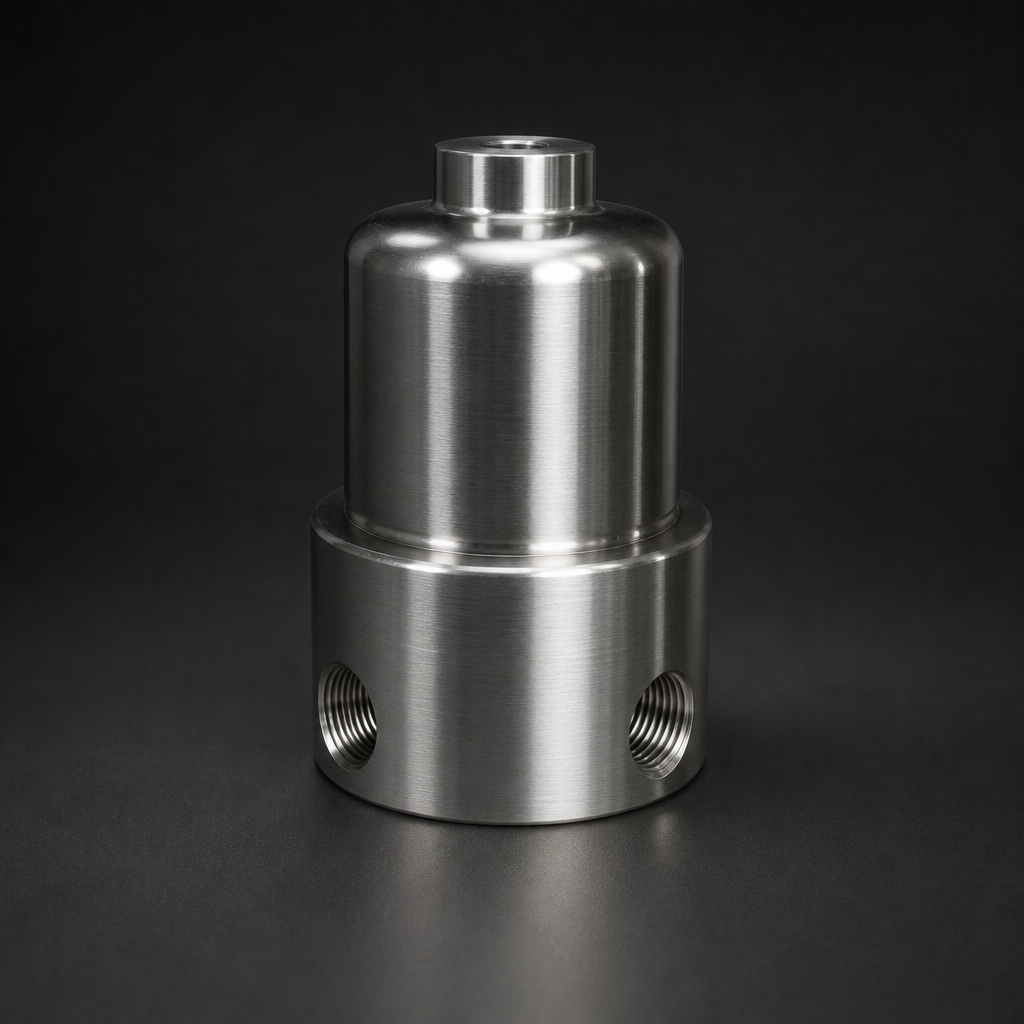
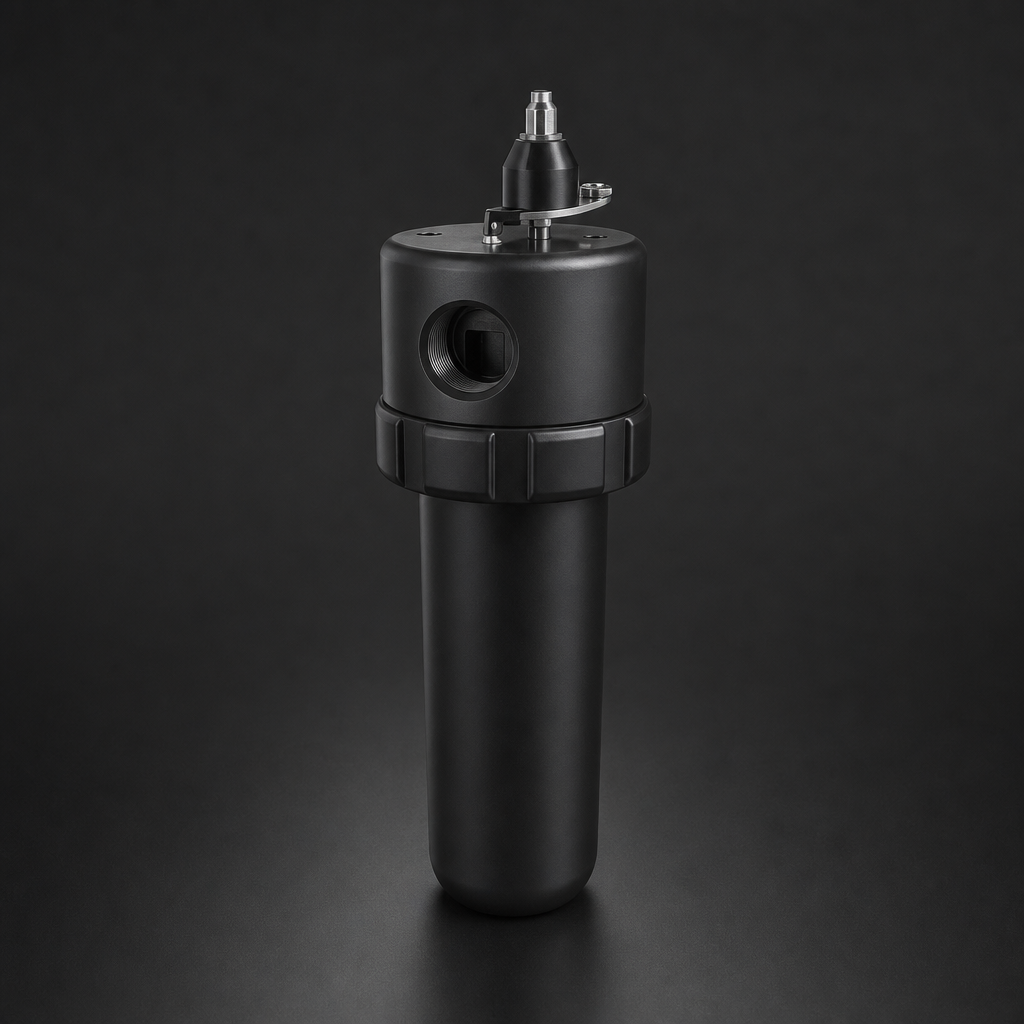
R+F FilterElements offers a dedicated range of high-pressure filtration products engineered for exactly this application. The instrumentation and high-pressure filter range covers operating pressures from 100 bar to 700 bar, making it well-suited to 40-bar blow-moulding systems with substantial safety margins.
For a typical beverage bottle blowing installation, R+F recommends the following three-stage train:
Stage 1 — Coalescing Pre-Filter: RF-H-150 with RF-C Element
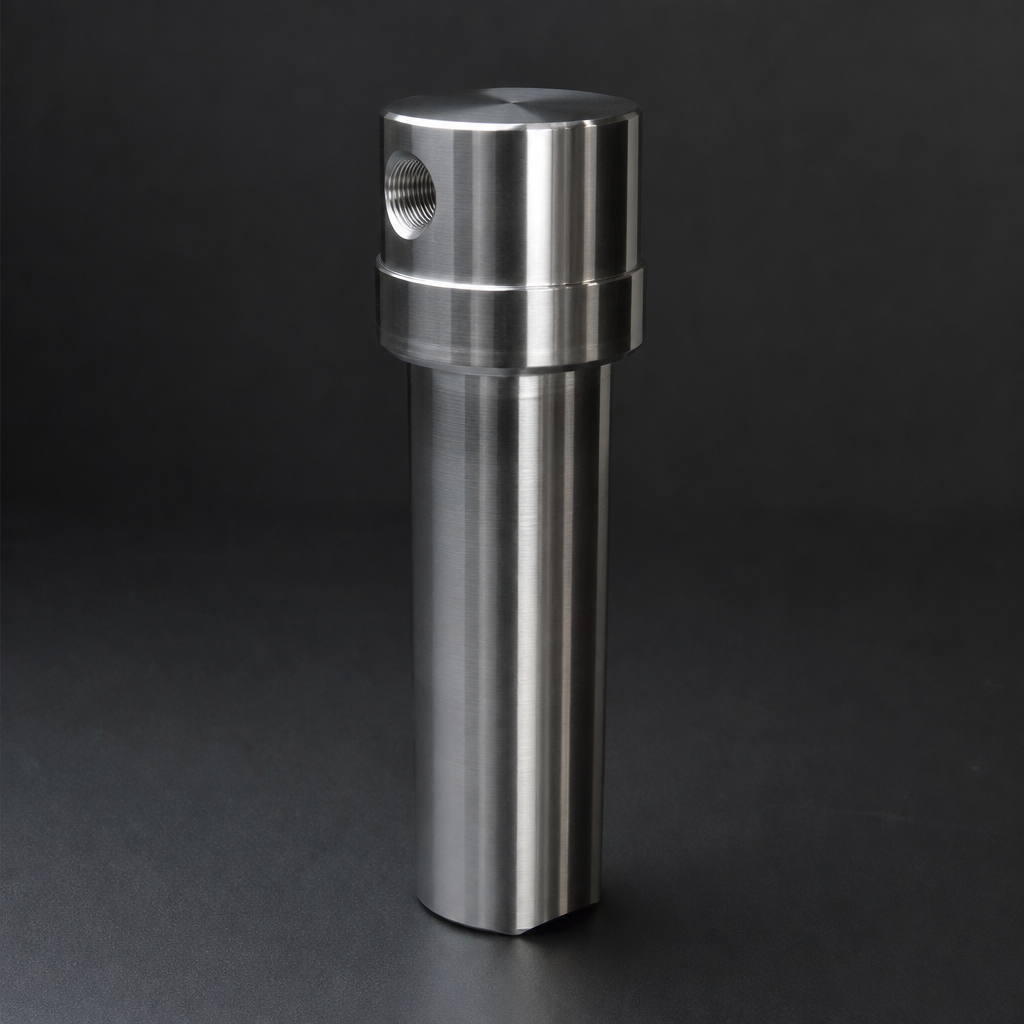
The RF-H-150 is a compact 316L stainless steel housing rated to 100 bar. Fitted with an RF-C coalescing element (borosilicate glass microfibre, 99.99% efficiency ≥ 0.1 µm), it removes bulk oil aerosols and liquid water droplets from the high-pressure air stream. The RF-C element's depth-loading structure ensures long service life even in high-flow applications. See the full filter elements range for available sizes.
Stage 2 — Activated Carbon Adsorber: RF-DIA
The RF-DIA disposable inline activated carbon adsorber strips residual oil vapour to below 0.003 mg/m³ — well within the ISO 8573-1 Class 1 oil limit of 0.01 mg/m³. The RF-DIA is available in high-pressure variants and requires no tools to replace, minimising maintenance downtime on a production line. Browse the inline filters and adsorbers range for sizing options.
Stage 3 — Final Particulate Filter: RF-H-150 with RF-P Element
A second RF-H-150 housing fitted with an RF-P particulate element (99.99% efficiency ≥ 0.3 µm) captures any activated carbon fines shed by the adsorber stage and provides a final barrier against particulate contamination before the air enters the blow-moulding machine. This stage is the last line of defence for bottle clarity and product safety.
Comparing Filtration Approaches for Blow-Moulding Air
| Approach | Oil Removal | Pressure Rating | ISO 8573-1 Class 1 Oil? | Suitable for Beverage? |
|---|---|---|---|---|
| Single coalescing filter only | Aerosols only (≥ 0.1 µm) | 17 bar (standard) | No — vapour remains | ❌ No |
| Coalescing + activated carbon (17 bar) | Aerosols + vapour | 17 bar | Yes — if sized correctly | ❌ Wrong pressure |
| 3-stage HP train (RF-H-150 + RF-DIA + RF-H-150) | Aerosols + vapour + fines | 100 bar rated | Yes — ≤ 0.003 mg/m³ | ✅ Yes |
| Oil-free compressor alone (no filtration) | Partial — no vapour trap | N/A | No — ambient oil vapour ingested | ❌ Insufficient |
Even oil-free compressors ingest ambient air containing oil vapour from the surrounding environment. Without an activated carbon adsorber downstream, an oil-free compressor cannot guarantee ISO 8573-1 Class 1 oil content at the point of use. The three-stage high-pressure filtration train remains the industry-standard solution for beverage blow-moulding.
- In a rotary stretch-blow-moulding machine, a PET preform is heated to roughly 100–120 °C and then inflated with high-pressure compressed air in two stages: a low-pressure pre-blow (around 8–12 bar) followed by a high-pressure final blow (30–40 bar).
- ISO 8573-1 is the international standard that classifies compressed air quality across three contamination categories: solid particles (Class 1–9), water (Class 1–9), and total oil content (Class 1–4).
- Housing pressure rating:
- R+F FilterElements offers a dedicated range of high-pressure filtration products engineered for exactly this application.
Maintenance and Validation
Filtration equipment is only as effective as its maintenance programme. For blow-moulding applications, R+F recommends the following practices:
- Element change intervals: Replace RF-C coalescing elements at the manufacturer's recommended interval or when differential pressure exceeds 0.5 bar — whichever comes first. Do not extend intervals to save cost; a saturated element can shed retained contamination downstream.
- Adsorber saturation: RF-DIA activated carbon adsorbers have a finite adsorption capacity. Replace on a time-based schedule (typically every 6–12 months depending on oil load) or install an oil vapour indicator downstream to detect breakthrough.
- Validation testing: Conduct periodic air quality testing at the blow-moulding machine inlet using a calibrated oil vapour analyser. Document results against ISO 8573-1 Class 1.2.1 limits for your quality management system.
For guidance on selecting the correct element size for your flow rate and pressure, use the R+F Engineering Sizing Tool, which calculates pressure drop and recommends the appropriate housing and element combination for your specific application parameters.
For further background on filtration element types and their selection, see our guide to coalescing vs particulate filter elements and our overview of ISO 8573-1 compressed air quality classes.
Related Reading
- Coalescing vs Particulate Filter Elements — Which Do You Need?
- ISO 8573-1 Compressed Air Quality — A Practical Guide
- Oxygen Filtration Safety — Why Standard Filters Are Not Enough
Try our Engineering Sizing Tool → or discuss your requirements with our team.