Carbon dioxide is one of the most widely handled industrial gases in the world — yet its filtration requirements are frequently underestimated. Whether you are carbonating beverages, supplying CO₂ to a greenhouse, or injecting captured carbon into a geological formation, the purity and dryness of the gas at every stage of the process directly affects product quality, equipment longevity, and regulatory compliance. This guide examines the specific challenges of CO₂ gas filtration across the full application spectrum, from food-grade beverage carbonation through to large-scale carbon capture, utilisation, and storage (CCUS) pipelines.
Why CO₂ Presents Unique Filtration Challenges
Carbon dioxide behaves differently from most industrial gases the moment moisture is present. When CO₂ dissolves in water it forms carbonic acid (H₂CO₃), a weak but persistent acid that attacks carbon steel, aluminium alloys, and many elastomers. Even trace quantities of free water — well below the levels that would concern an operator handling nitrogen or compressed air — can initiate corrosion inside filter housings, pipework, and downstream instrumentation.
This single chemical reality drives the two most important decisions in any CO₂ gas filtration system: material selection and moisture management. Get either wrong and you face accelerated corrosion, contaminated product, and unplanned downtime.
Beyond moisture, CO₂ streams can carry a range of contaminants depending on their source:
- Compressor lubricant aerosols and vapours — introduced during compression and liquefaction
- Particulate matter — pipe scale, rust particles, and catalyst fines in industrial CO₂
- Sulphur compounds — particularly in CO₂ recovered from combustion or fermentation
- Residual hydrocarbons — present in CO₂ sourced from natural gas processing
- Microbial contamination — a concern in food and beverage applications
Effective CO₂ gas filtration must address all relevant contaminant classes for the specific application, not simply particulate removal alone.
Food-Grade CO₂: The Beverage Carbonation Standard
The beverage industry is the largest single consumer of purified CO₂. Carbonated soft drinks, sparkling water, beer, and cider all depend on CO₂ that meets food-grade purity specifications — most commonly the EIGA (European Industrial Gases Association) CO₂ Food Grade specification or equivalent national standards.
Food-grade CO₂ must be free of oil, particulate, odour-causing compounds, and any substance that could affect taste or safety. The filtration train for a beverage carbonation system typically comprises three stages:
- Bulk particulate removal — capturing pipe scale and coarse contamination upstream of sensitive equipment
- Coalescing filtration — removing compressor oil aerosols and liquid water droplets to sub-micron levels
- Activated carbon adsorption — eliminating residual hydrocarbon vapours and odour compounds
Because the gas contacts food and drink, all wetted materials must be food-safe. This rules out standard aluminium housings with certain coatings and makes 316L stainless steel the preferred choice for the filter housing body, end caps, and internal components. Seal materials must also be selected carefully: EPDM and PTFE are generally acceptable for food contact; standard NBR is not.
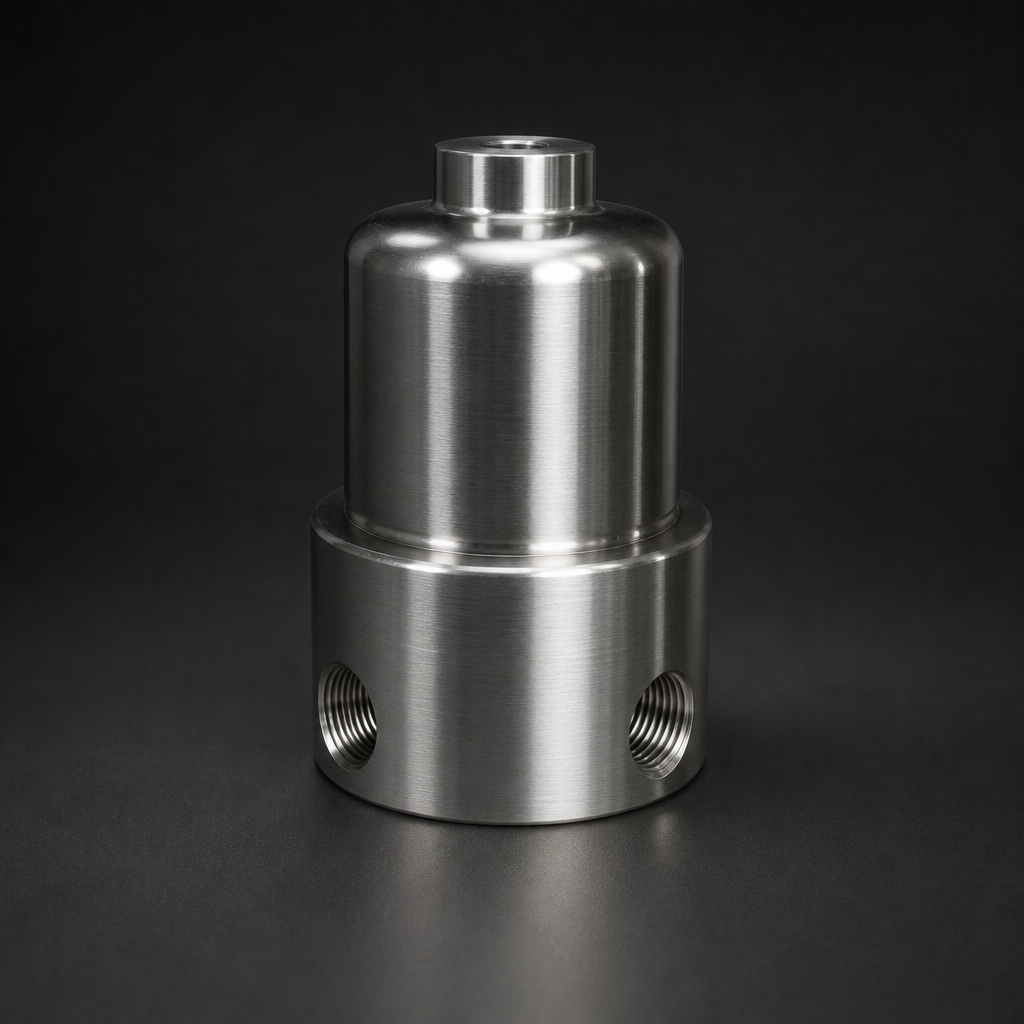
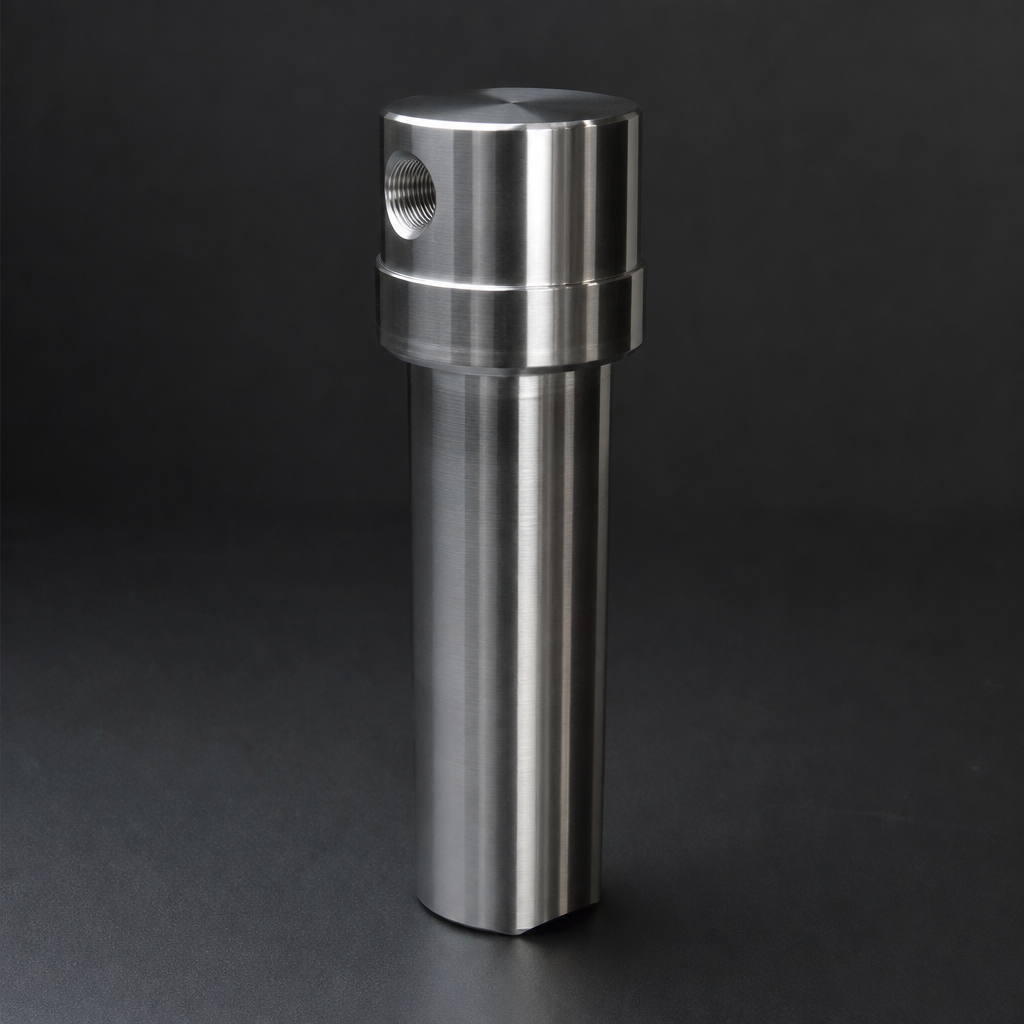
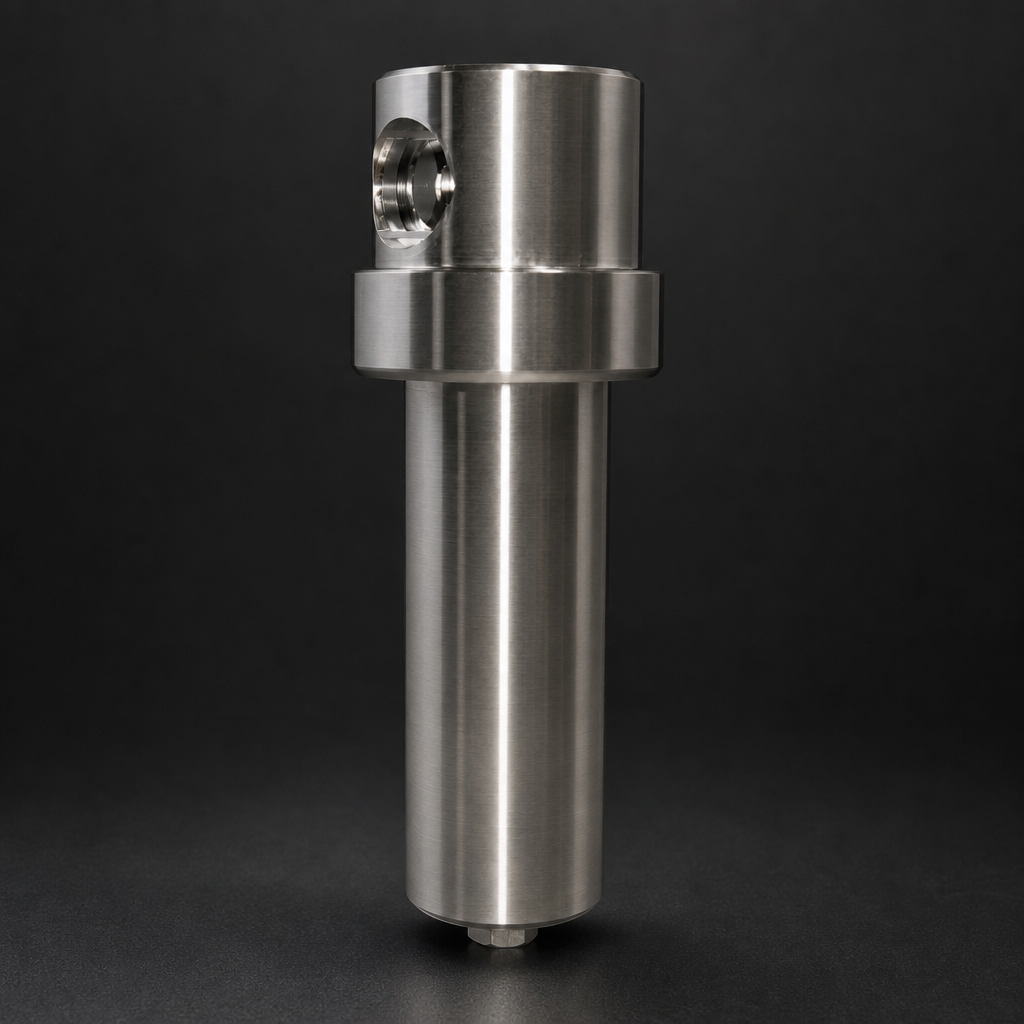
R+F FilterElements offers its own range of 316L stainless steel process gas housings specifically suited to food-grade CO₂ duty. The RF-H-150 compact housing handles pressures to 100 bar and is available with PTFE seals, making it appropriate for point-of-use filtration close to the carbonation head. For higher-flow installations, the RF-H-160 medium-pressure housing (rated to 250 bar) accommodates larger filter elements and can be configured with multiple element positions to reduce maintenance frequency.
Technical Specification: R+F Process Gas Housings for CO₂ Service
| Model | Max Pressure | Body Material | Seal Options | Typical CO₂ Application |
|---|---|---|---|---|
| RF-H-150 | 100 bar | 316L Stainless Steel | FKM, PTFE, EPDM | Beverage carbonation, point-of-use |
| RF-H-160 | 250 bar | 316L Stainless Steel | FKM, PTFE | Industrial CO₂ supply, CCUS injection |
| RF-H-170 | 400 bar | 316L Stainless Steel | FKM, PTFE | High-pressure CCUS, analyser protection |
All three housings are manufactured from 316L stainless steel, which provides the corrosion resistance necessary for wet CO₂ service. The low carbon content of 316L (≤0.03% C) is particularly important: it minimises sensitisation during welding and reduces the risk of intergranular corrosion in the presence of carbonic acid.
Compressor lubricant aerosols and vapours
Greenhouse and Horticultural CO₂: Purity Without Compromise
Commercial greenhouses use CO₂ enrichment to accelerate plant growth, typically targeting concentrations of 800–1,200 ppm in the growing environment. The CO₂ source is often a boiler flue gas recovery system or a bulk liquid CO₂ supply. In either case, filtration is essential.
Flue gas-derived CO₂ can contain nitrogen oxides (NOₓ), sulphur dioxide (SO₂), and particulate matter — all of which are phytotoxic at elevated concentrations. Even bulk liquid CO₂, which arrives at high purity, picks up contamination during vaporisation and distribution through the greenhouse pipework.
For horticultural applications, a two-stage approach combining a RF-C coalescing element (borosilicate glass microfibre, 99.99% efficiency at ≥0.1 µm) with a downstream RF-AC activated carbon adsorption element provides effective removal of both aerosol contamination and trace odour or hydrocarbon compounds. The activated carbon stage reduces residual oil content to below 0.003 mg/m³, well within the limits required for plant-safe CO₂.
Industrial CO₂ Processing: Protecting Compressors and Heat Exchangers
In industrial CO₂ production — whether from ammonia plant off-gas, fermentation, or direct air capture — the gas passes through multiple compression stages before reaching its final purity specification. Each compression stage introduces the risk of lubricant carryover, and the inter-stage coolers create conditions where liquid water can condense.
Upstream filtration at each compression stage protects the compressor valves and seals from particulate damage. Downstream coalescing filtration removes the oil aerosols and condensed water before the gas enters the next stage or a drying system. Without effective inter-stage CO₂ gas filtration, oil accumulates in the drying beds, reducing their capacity and shortening their service life.
The R+F process gas filter range is designed for exactly this duty. The housings are rated for the elevated pressures found in multi-stage CO₂ compression trains, and the 316L stainless steel construction resists the carbonic acid environment that forms whenever moisture and CO₂ coexist. Element change-out is straightforward, minimising the time the compression train is offline during maintenance.
Use our free Engineering Tool to get a filtration recommendation for your specific application in under 2 minutes.
Carbon Capture, Utilisation, and Storage (CCUS): The Emerging Frontier
CCUS represents the fastest-growing application area for industrial CO₂ gas filtration. In a CCUS system, CO₂ is captured from a point source (power station, cement plant, steel mill) or from the atmosphere, compressed to supercritical conditions, transported by pipeline, and injected into a geological formation for permanent storage — or utilised as a feedstock for synthetic fuels, chemicals, or building materials.
Each stage of the CCUS chain presents distinct filtration challenges:
Post-Capture Filtration
Immediately after the capture process — whether amine scrubbing, pressure swing adsorption, or membrane separation — the CO₂ stream contains amine degradation products, particulate from the sorbent bed, and residual moisture. Coalescing and particulate filtration at this stage protects the downstream compression train and prevents contamination of the transport pipeline.
Pipeline Injection Filtration
CO₂ pipelines for CCUS operate at supercritical pressures, typically above 74 bar. At these conditions, CO₂ is a dense-phase fluid with very different properties from the gas phase. Any free water present will form carbonic acid that attacks the pipeline steel from the inside. Filtration and dehydration upstream of the pipeline injection point are therefore critical to pipeline integrity and the long-term economics of the project.
The RF-H-160 (250 bar) and RF-H-170 (400 bar) housings from R+F FilterElements are rated for the pressures encountered in CCUS injection systems. Their 316L stainless steel construction and PTFE seal options make them compatible with the demanding chemical environment of high-pressure, potentially wet CO₂.
Utilisation Applications
Where captured CO₂ is used as a feedstock — for example in the production of synthetic methane, methanol, or e-fuels — the purity requirements are set by the downstream catalyst or reaction system. Catalyst poisoning by sulphur compounds or particulate is a major concern, and the filtration specification must be designed around the catalyst's sensitivity rather than a generic purity standard.
For analyser protection in CCUS quality monitoring systems, the R+F instrumentation filter range provides the fine filtration and corrosion resistance needed to protect sensitive analytical instruments from the aggressive CO₂ environment. The RF-H-170 analyser filter housing, rated to 400 bar, is particularly suited to high-pressure sample conditioning in CCUS applications.
Material Selection: Getting It Right for CO₂ Service
The corrosive nature of wet CO₂ makes material selection the most consequential engineering decision in any CO₂ gas filtration system. The following principles apply across all application areas:
Housing Materials
316L stainless steel is the standard choice for CO₂ service. It offers good resistance to carbonic acid corrosion and is compatible with the full range of CO₂ purity grades from food-grade to industrial. Carbon steel is not suitable for wet CO₂ service. Aluminium alloys can be used in dry CO₂ applications but should be avoided where any risk of moisture ingress exists.
Seal and O-Ring Materials
- PTFE — excellent chemical resistance, suitable for food contact, rated to 260 °C; preferred for food-grade and high-purity CO₂
- FKM/Viton — good resistance to CO₂ and hydrocarbons, rated to 200 °C; suitable for industrial CO₂ and CCUS
- EPDM — acceptable for food-grade CO₂ where PTFE is not required; not suitable for hydrocarbon-contaminated streams
- NBR — not recommended for CO₂ service due to swelling and degradation in the presence of CO₂ and carbonic acid
Filter Element Media
Borosilicate glass microfibre elements (RF-C coalescing series) are chemically inert to CO₂ and carbonic acid. They are the correct choice for liquid aerosol removal in CO₂ service. Activated carbon elements (RF-AC series) are effective for vapour-phase hydrocarbon and odour removal but should be specified with a stainless steel support cage rather than a carbon steel cage in wet CO₂ applications.
Sizing and Pressure Drop Considerations
CO₂ is significantly denser than air or nitrogen at the same temperature and pressure. This affects filter sizing in two important ways. First, the volumetric flow rate through the filter is lower for a given mass flow rate, which can make the filter appear smaller than expected. Second, the higher density means that liquid aerosol droplets are more easily separated by inertial impaction, which can improve coalescing efficiency at a given face velocity.
For accurate sizing of CO₂ gas filtration systems, R+F FilterElements recommends using the online sizing wizard, which accounts for gas density, viscosity, and operating pressure when calculating the required element size and housing configuration. Alternatively, the R+F technical team can provide a detailed sizing calculation based on your specific operating conditions.
Selecting the Right CO₂ Filtration System
The diversity of CO₂ applications — from a small beverage carbonation unit to a multi-million-tonne CCUS project — means that there is no single standard filtration solution. The correct system depends on:
- The CO₂ source and its typical contamination profile
- The operating pressure and temperature
- The required outlet purity specification
- The flow rate and duty cycle
- Regulatory requirements (food contact, ATEX, PED)
- Maintenance access and element change-out frequency targets
R+F FilterElements, a German-based filtration specialist, works with operators across the food and beverage, industrial gas, and energy sectors to specify CO₂ gas filtration systems that meet these requirements. The process gas filter range covers pressures from ambient to 400 bar and flow rates from laboratory scale to full industrial throughput, all in 316L stainless steel construction suitable for wet CO₂ service.
For applications requiring a complete filtration train — particulate removal, coalescing, and activated carbon adsorption — R+F can supply all three stages from a single source, simplifying procurement and ensuring compatibility between housings and elements.
- Compressor lubricant aerosols and vapours
- Bulk particulate removal
- All three housings are manufactured from 316L stainless steel, which provides the corrosion resistance necessary for wet CO₂ service.
- Commercial greenhouses use CO₂ enrichment to accelerate plant growth, typically targeting concentrations of 800–1,200 ppm in the growing environment.