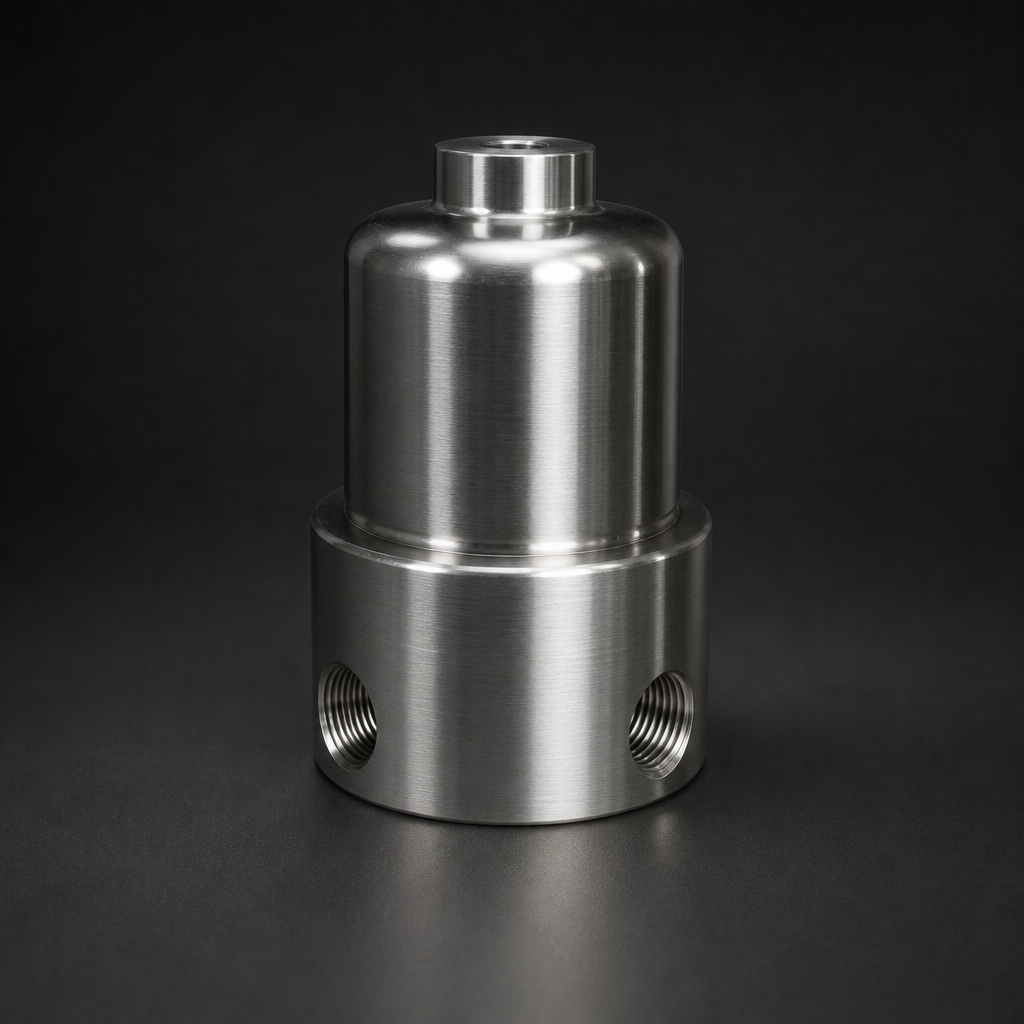
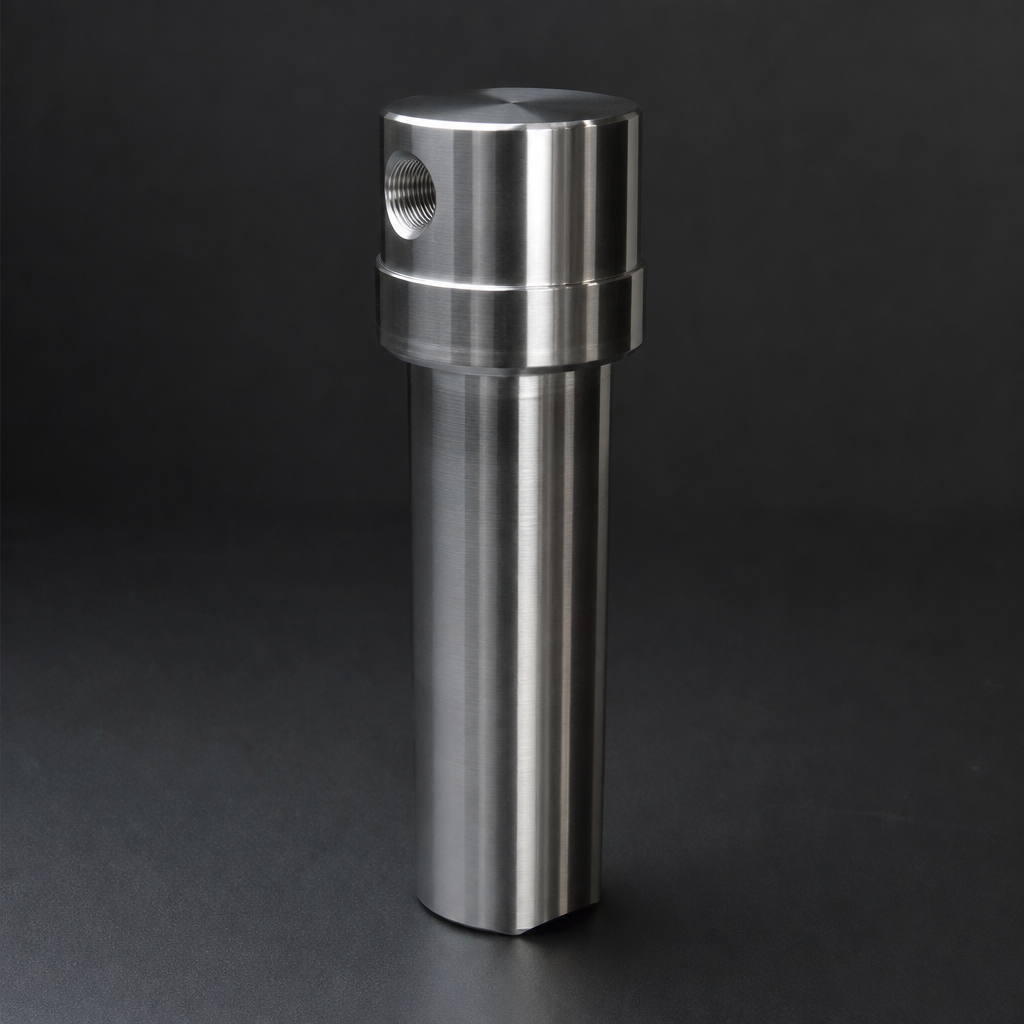
Choosing the wrong connection type for a filter housing is one of the most avoidable commissioning problems in process gas and compressed air systems. A BSP-threaded housing installed into an NPT-tapped manifold will appear to thread in — and then leak. A flanged housing bolted to a threaded line will require an adapter that introduces dead volume and potential leak paths. Getting the connection type right from the outset saves time, money, and the risk of a gas release.
This guide covers the four main filter housing connection types used in industrial filtration: BSP threaded, NPT threaded, flanged, and tube/compression fittings. It explains where each is used, how to identify which you need, and which R+F FilterElements housings are available in each configuration.
BSP vs NPT: The Thread That Matters Most
The majority of filter housings in the small-to-medium flow range use either BSP (British Standard Pipe) or NPT (National Pipe Thread) connections. Both are tapered or parallel threaded standards, but they are not interchangeable — the thread form, pitch, and taper angle differ enough that cross-threading is possible and sealing is unreliable.
BSP (G-thread / BSPP / BSPT) is the European standard and is used throughout the UK, Germany, and most of continental Europe. Parallel BSP (BSPP, also called G-thread) relies on a face seal or bonded washer; tapered BSP (BSPT) seals on the thread itself with PTFE tape or thread sealant. Most R+F FilterElements housings for the European market — including the compressed air filter range — are supplied with BSP connections as standard.
NPT is the American standard, used throughout North America and in many export markets that follow ASME/ANSI specifications. NPT is always tapered and seals on the thread with sealant or PTFE tape. If your plant was built to American standards, or if you are supplying equipment for export to the US, NPT connections are required.
Flanged Connections: When and Why
Flanged filter housings are used when flow rates are large, pressures are high, or when the installation requires a connection that can be broken and remade repeatedly without thread wear. Flanges are specified to standards such as EN 1092-1 (European) or ASME B16.5 (American), and the flange rating (PN10, PN16, PN40, Class 150, Class 300, etc.) must match the system design pressure.
For process gas applications — natural gas, hydrogen, biogas, or industrial gases — flanged connections are often mandatory above DN50 or above 40 bar. The R+F process gas housing range, including the RF-H-150 (rated to 100 bar) and RF-H-160 (rated to 250 bar), can be supplied with flanged inlet/outlet connections to EN 1092-1 or ASME B16.5 as required by the application.
Flanged housings also simplify maintenance in large installations. Rather than unscrewing a threaded housing from the line — which may require rotating the entire body — a flanged housing can be unbolted and slid out axially, making element changes faster and safer in confined spaces.
Tube and Compression Fittings: Instrumentation Applications
For instrumentation and analyser protection filters, the connection is typically a compression fitting (Swagelok-type or equivalent) in 6 mm, 12 mm, or ¼″ / ½″ tube sizes. These fittings are used because instrumentation lines are small-bore, high-pressure, and require leak-tight connections that can be made and remade without thread sealant.
The RF-H-110 to RF-H-170 series of stainless steel instrumentation housings are designed for exactly this application. The RF-H-150, for example, accepts 12 mm or ½″ compression fittings and is rated to 100 bar — suitable for sample conditioning lines, gas chromatograph protection, and analyser inlet filtration. The RF-H-170 extends this to 400 bar for ultra-high-pressure applications.
Where the gas being filtered is corrosive or ultra-pure — semiconductor process gases, for instance — SilcoNert-coated variants of these housings are available, with the same compression fitting connections but an inert internal surface that prevents adsorption and contamination of the sample stream. See the ISO 8573-1 compressed air quality guide for context on purity classes that drive these requirements.
Need help selecting the right filter housing connection?
Use our free Engineering Tool to get a filtration recommendation for your specific application in under 2 minutes.
Comparison: Connection Types at a Glance
| Connection Type | Standard | Typical Size Range | Best For |
|---|---|---|---|
| BSP (G-thread) | ISO 228 / EN 10226 | G¼″ – G2″ | European compressed air, general industrial |
| NPT | ASME B1.20.1 | ⅛″ – 2″ | North American plants, ASME-spec systems |
| Flanged (EN 1092-1) | EN 1092-1 | DN50 – DN200+ | High flow, high pressure, process gas |
| Flanged (ASME B16.5) | ASME B16.5 | ½″ – 24″ NPS | ASME piping, export to North America |
| Compression (tube) | Swagelok / ISO 8434 | 6 mm – 25 mm / ¼″ – 1″ | Instrumentation, analysers, sample lines |
Matching Your Connection to Your Piping System
The practical rule is straightforward: match the filter housing connection to the existing piping standard. If your plant uses metric BSP throughout, order BSP housings. If it uses NPT, order NPT. If the line is flanged to EN 1092-1 PN16, the housing flanges must be PN16 to the same standard.
Where a system mixes standards — for example, a European plant with an imported American compressor — adapters are available, but they should be treated as a last resort. Every adapter is an additional potential leak point, and in gas service, leak points are safety risks. The better solution is to specify the correct connection type at the time of ordering the filter housing.
R+F FilterElements supplies housings across all four connection types. The RF-C coalescing elements and RF-P particulate elements fit the same housing bodies regardless of connection type — so if you need to change from BSP to NPT in a future plant expansion, only the housing head needs to change, not the element. For natural gas filtration or hydrogen applications, flanged stainless steel housings with full material traceability are available on request.
If you are unsure which connection type your system uses, the quickest check is the thread pitch gauge: BSP threads have a 55° flank angle and metric pitch (e.g. 14 TPI for G½″), while NPT threads have a 60° flank angle and slightly different pitch (14 TPI for ½″ NPT, but the taper and form differ). When in doubt, consult the original piping isometric or P&ID — the connection standard is always specified there.
- BSP (G-thread / BSPP / BSPT)
- Flanged filter housings are used when flow rates are large, pressures are high, or when the installation requires a connection that can be broken and remade repeatedly without thread wear.
- For instrumentation and analyser protection filters, the connection is typically a compression fitting (Swagelok-type or equivalent) in 6 mm, 12 mm, or ¼″ / ½″ tube sizes.
- The practical rule is straightforward: match the filter housing connection to the existing piping standard.
Related Reading
- Coalescing vs Particulate Filter Elements — Which Do You Need?
- ISO 8573-1 Compressed Air Quality Classes Explained
- Filtration for Hydrogen Electrolysis Systems
Try our Engineering Sizing Tool → or discuss your requirements with our team.