Modified atmosphere packaging (MAP) is one of the most effective tools the meat processing industry has for extending shelf life without preservatives. By replacing the air inside a sealed tray with a precisely controlled mixture of carbon dioxide (CO₂), nitrogen (N₂), and sometimes oxygen (O₂), processors can suppress bacterial growth, maintain colour, and deliver product to retail shelves days — sometimes weeks — later than conventional packaging allows.
But MAP only works when the gas is clean. Compressor oil aerosols, particulate contamination, and microbial carry-over in the gas supply can transfer directly into the sealed package, accelerating spoilage, triggering off-flavours, and — in the worst case — causing a food-safety incident that leads to a costly recall. The gas mixing station is the critical control point, and filtration is the safeguard that most processors either underspecify or overlook entirely.
Why Gas Purity Matters in MAP Applications
Food-grade CO₂ and N₂ are typically supplied as bulk liquid or high-pressure cylinders and are themselves very pure at the point of manufacture. The contamination risk is introduced downstream: in the pressure-reducing and mixing equipment, in the pipework, and — critically — in any compressed air or nitrogen generated on-site by a compressor or PSA generator.
The three contaminant classes that matter most in MAP gas streams are:
- Oil aerosols and vapour — from oil-lubricated compressors or booster pumps. Even trace levels (above 0.01 mg/m³) can taint flavour and accelerate lipid oxidation in red meat.
- Solid particulates — pipe scale, rust, valve debris, and compressor wear particles. Particles above 1 µm can carry microbial contamination and block the fine orifices of MAP packaging machines.
- Moisture — liquid water or high relative humidity promotes microbial growth in pipework and can cause condensation inside sealed packs, diluting the protective gas atmosphere.
Applicable Standards and Regulatory Context
There is no single global standard that mandates a specific gas purity class for MAP in meat processing, but several frameworks converge on the same practical requirements:
| Standard / Framework | Relevance to MAP Gas | Recommended Purity Class |
|---|---|---|
| ISO 8573-1 | Compressed air / on-site N₂ quality classes | Class 1.2.1 (particles, water, oil) |
| EU Regulation 1333/2008 | Food additives — CO₂ and N₂ as packaging gases | Food-grade purity at point of use |
| EIGA Doc 70 / IGC Doc 70 | Food-grade CO₂ specification | Oil ≤ 0.1 mg/kg, particles ≤ 1 µm |
| HACCP / BRC / IFS | Food safety management — gas as a process input | Documented CCP with filter validation |
For processors operating under BRC Global Standard or IFS Food certification, the gas mixing station must be treated as a Critical Control Point (CCP). This means documented filter specifications, defined change-out intervals, and records of filter element replacement — not just a filter housing bolted to the wall with no maintenance schedule.
The Recommended Filter Train for MAP Gas Mixing Stations
A robust MAP gas filtration train typically comprises three stages, each targeting a specific contaminant class. The exact configuration depends on whether the gas is supplied from bulk liquid (lower contamination risk) or generated on-site by a compressor or PSA unit (higher risk).
Stage 1 — Coalescing Filtration (RF-H-150 with RF-C Element)
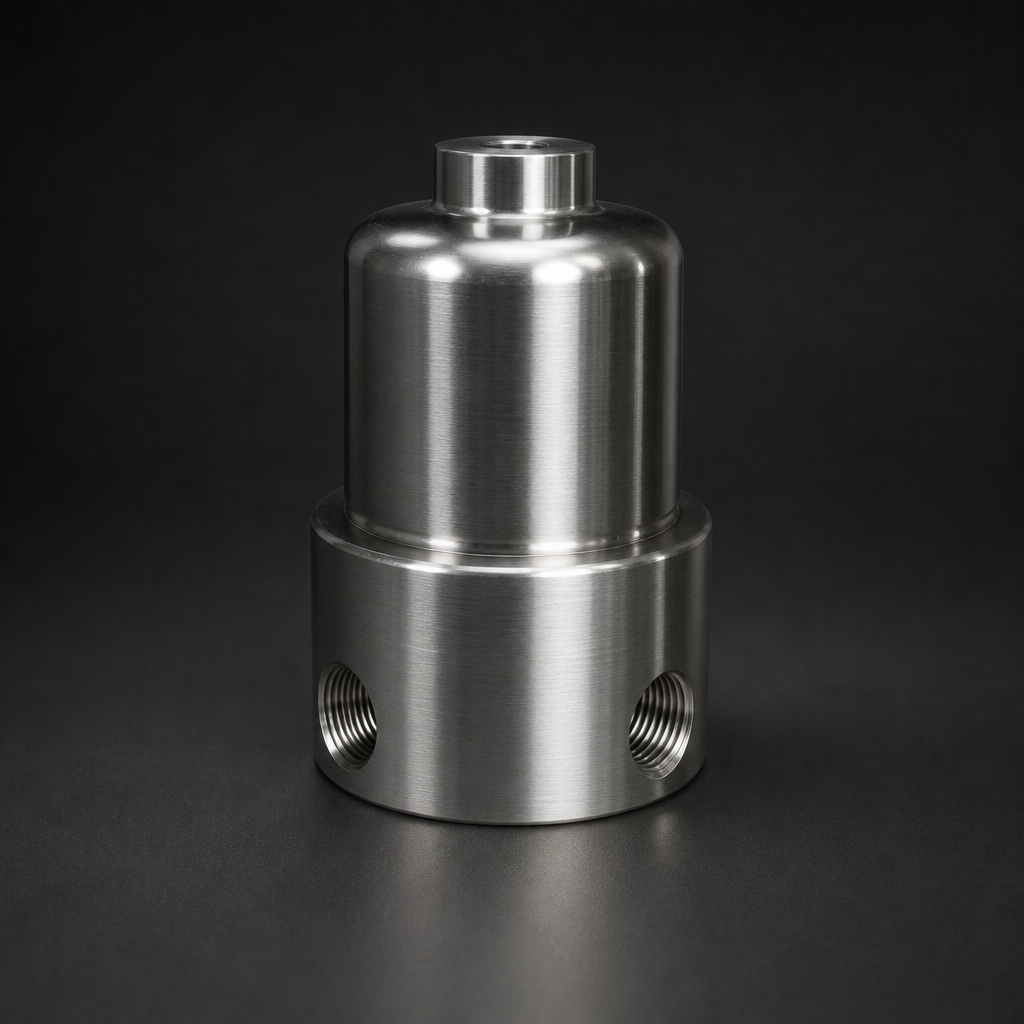
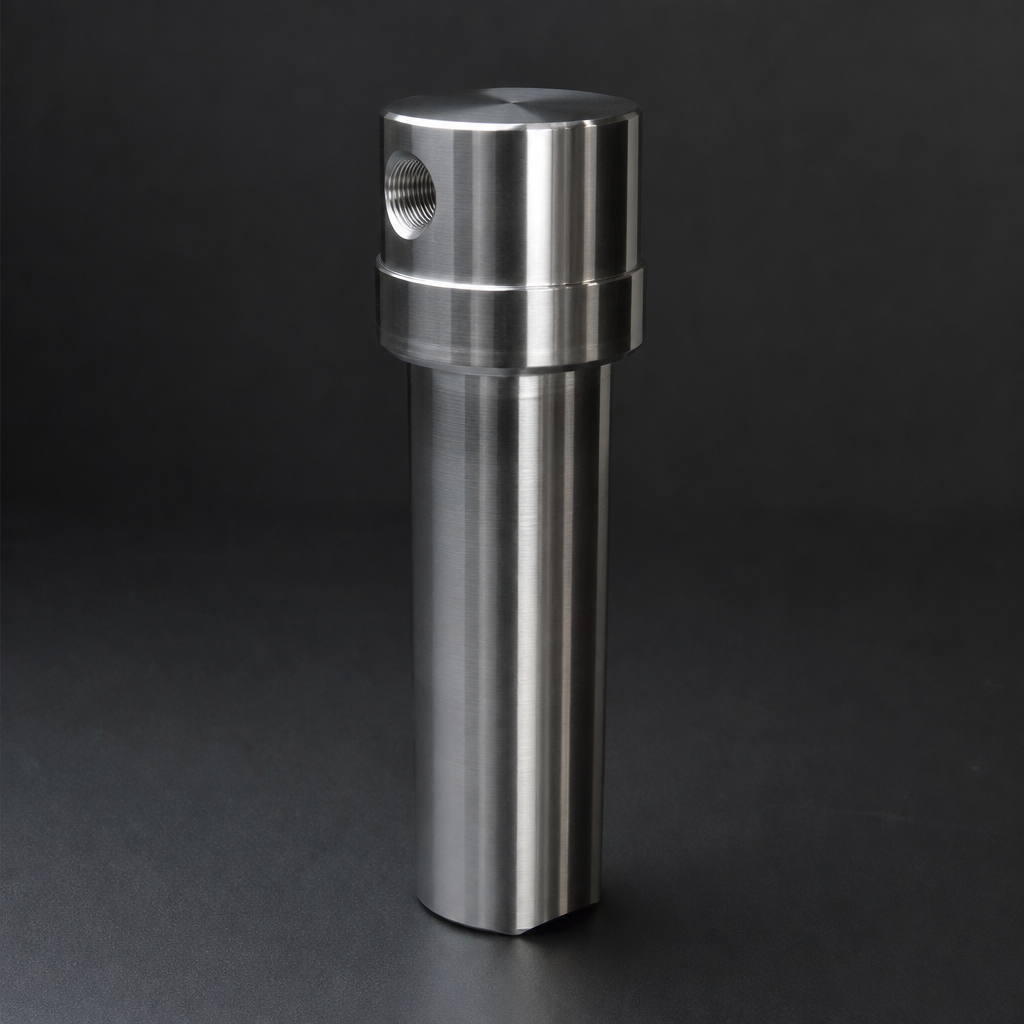
The first stage removes liquid oil aerosols and fine water droplets. For MAP gas mixing stations operating at pressures up to 100 bar, the RF-H-150 compact process gas housing fitted with an RF-C coalescing element is the recommended solution. The RF-C element uses borosilicate glass microfibre media to achieve 99.99% efficiency at ≥ 0.1 µm, reducing oil aerosol content to below 0.01 mg/m³ — well within food-grade requirements.
The 316L stainless steel construction of the RF-H-150 is compatible with CO₂, N₂, and O₂ service and meets the material requirements of EU food-contact regulations. FKM seals are standard for CO₂ service; EPDM seals are available for oxygen-enriched MAP mixtures used in fresh red meat packaging.
Stage 2 — Activated Carbon Adsorption (RF-AC Element)
Where oil vapour (as opposed to aerosol) is a concern — typically with reciprocating compressors or older equipment — a second stage using an RF-AC activated carbon adsorption element reduces residual oil vapour to below 0.003 mg/m³. This stage is particularly important for processors seeking to demonstrate compliance with EIGA Doc 70 oil limits at the point of use.
Stage 3 — Point-of-Use Inline Filtration (RF-DIL)
The final stage is a point-of-use particulate filter installed as close as possible to the MAP packaging machine inlet. The RF-DIL disposable inline filter provides a last line of defence against particles shed by downstream pipework, valve seats, and flexible hoses. With a 0.3 µm absolute rating, it ensures that no particles above this size reach the packaging head — protecting both the gas atmosphere and the mechanical components of the MAP machine.
The RF-DIL is a single-use, tool-free replacement unit, making it ideal for food-processing environments where hygiene and speed of maintenance are priorities. Its compact form factor allows installation in tight spaces directly at the machine connection point.
Need help selecting the right filter for your MAP gas mixing station?
Use our free Engineering Tool to get a filtration recommendation for your specific application in under 2 minutes.
Sizing Considerations for MAP Gas Mixing Stations
MAP gas flow rates are typically modest compared to industrial compressed air systems — a single packaging line may consume 5–50 Nm³/h of mixed gas — but the pressure and gas composition introduce specific sizing constraints:
- Pressure drop: MAP machines are sensitive to supply pressure variation. Filter pressure drop must be minimised, particularly at the point-of-use stage. The RF-DIL is designed for low differential pressure at typical MAP flow rates.
- Gas compatibility: CO₂ at high concentrations can cause stress corrosion in certain aluminium alloys. The 316L stainless steel RF-H-150 housing avoids this risk entirely.
- O₂ service: Where the MAP mixture contains oxygen above 25%, all filter components — housing, element, seals, and lubricants — must be oxygen-compatible. Specify EPDM-O₂ seals and confirm element compatibility before installation.
For multi-line facilities, a centralised filter train at the gas mixing manifold (using the RF-H-150) combined with individual RF-DIL units at each packaging machine provides the most cost-effective and auditable solution. See our natural gas and process gas solutions page for further application guidance, or explore the full filter elements range to compare element grades.
Maintenance, Documentation, and HACCP Compliance
For BRC- and IFS-certified facilities, the filter train must be included in the HACCP plan as a CCP or control measure. This requires:
- A written filter specification (housing model, element grade, rated efficiency, and maximum differential pressure)
- A defined element replacement interval (time-based or differential-pressure-triggered)
- Records of each element change, including batch number and date
- Periodic verification that the filter is performing as specified (e.g., oil-in-gas measurement downstream)
R+F FilterElements can supply filter elements with full material traceability documentation, supporting your audit requirements. Replacement RF-C and RF-DIL elements are available from stock for rapid replenishment. Learn more about ISO 8573-1 compressed air quality classes and how they map to food-grade gas requirements, or read our guide on coalescing vs particulate filter elements to understand which stage does what.
- Oil aerosols and vapour
- There is no single global standard that mandates a specific gas purity class for MAP in meat processing, but several frameworks converge on the same practical requirements:
- A robust MAP gas filtration train typically comprises three stages, each targeting a specific contaminant class.
- MAP gas flow rates are typically modest compared to industrial compressed air systems — a single packaging line may consume 5–50 Nm³/h of mixed gas — but the pressure and gas composition introduce spe
Related Reading
- ISO 8573-1 Compressed Air Quality — A Practical Guide
- Coalescing vs Particulate Filter Elements — Which Do You Need?
- Oxygen Filtration Safety — What Every Engineer Must Know
Try our Engineering Sizing Tool → or discuss your requirements with our team.