Why Sub-ppb Gas Purity Is Non-Negotiable in Semiconductor Fabs
Modern semiconductor fabrication operates at technology nodes where a single metallic particle or trace moisture molecule can ruin an entire wafer batch. As device geometries shrink below 5 nm, the tolerance for contamination in process gases — nitrogen, argon, hydrogen, oxygen, and specialty gases — has collapsed to the sub-parts-per-billion (ppb) level. Achieving that purity at the point of use, not merely at the cylinder outlet, is the central challenge of ultra-high-purity (UHP) gas delivery.
The problem is rarely the gas itself. Bulk-fill nitrogen or argon from a reputable supplier typically arrives at 99.9999 % (6N) purity. Contamination is introduced downstream — by the distribution tubing, fittings, regulators, and, critically, the filters that are supposed to protect the process. Conventional compressed-air or industrial-grade filters are wholly inadequate: their polymer housings outgas volatile organic compounds (VOCs), their carbon-steel internals shed iron and chromium particles, and their elastomeric seals leach plasticisers into the gas stream.
The Three Contamination Pathways in UHP Gas Lines
Understanding where contamination enters the gas stream is the first step to eliminating it. In semiconductor fab environments, three pathways dominate:
1. Metallic Particle Shedding
Standard 316L stainless steel, while corrosion-resistant, has a surface roughness (Ra) of 0.8–1.6 µm in its mill-finished state. At these roughness levels, the oxide layer is mechanically unstable and sheds sub-micron iron, chromium, and nickel particles under gas flow. Electropolishing reduces Ra to below 0.25 µm and creates a passive chromium-oxide layer that is chemically stable even in reactive gas service. For the most demanding applications — silane, phosphine, arsine — an additional SilcoNert® coating (a chemically inert silicon layer) is applied to all wetted surfaces, reducing surface reactivity to near zero.
2. Moisture and Oxygen Ingress
Even a single elastomeric O-ring can transmit moisture at rates of 10–100 ng/min through permeation. At ppb concentration targets, this is catastrophic. All-metal face-seal fittings (VCR® or equivalent) and metal-seated valves eliminate polymer permeation paths entirely. Where seals are unavoidable, PTFE — with its near-zero permeability — is the only acceptable material.
3. Adsorption and Desorption Cycling
Rough internal surfaces adsorb moisture and trace hydrocarbons during idle periods, then release them as a burst of contamination when gas flow resumes. Electropolished, SilcoNert-coated surfaces have dramatically lower adsorption capacity, enabling faster purge times and more stable baseline purity.
Key Performance Metrics for UHP Semiconductor Gas Filters
The RF-H-110-SN: Engineered for UHP Semiconductor Service
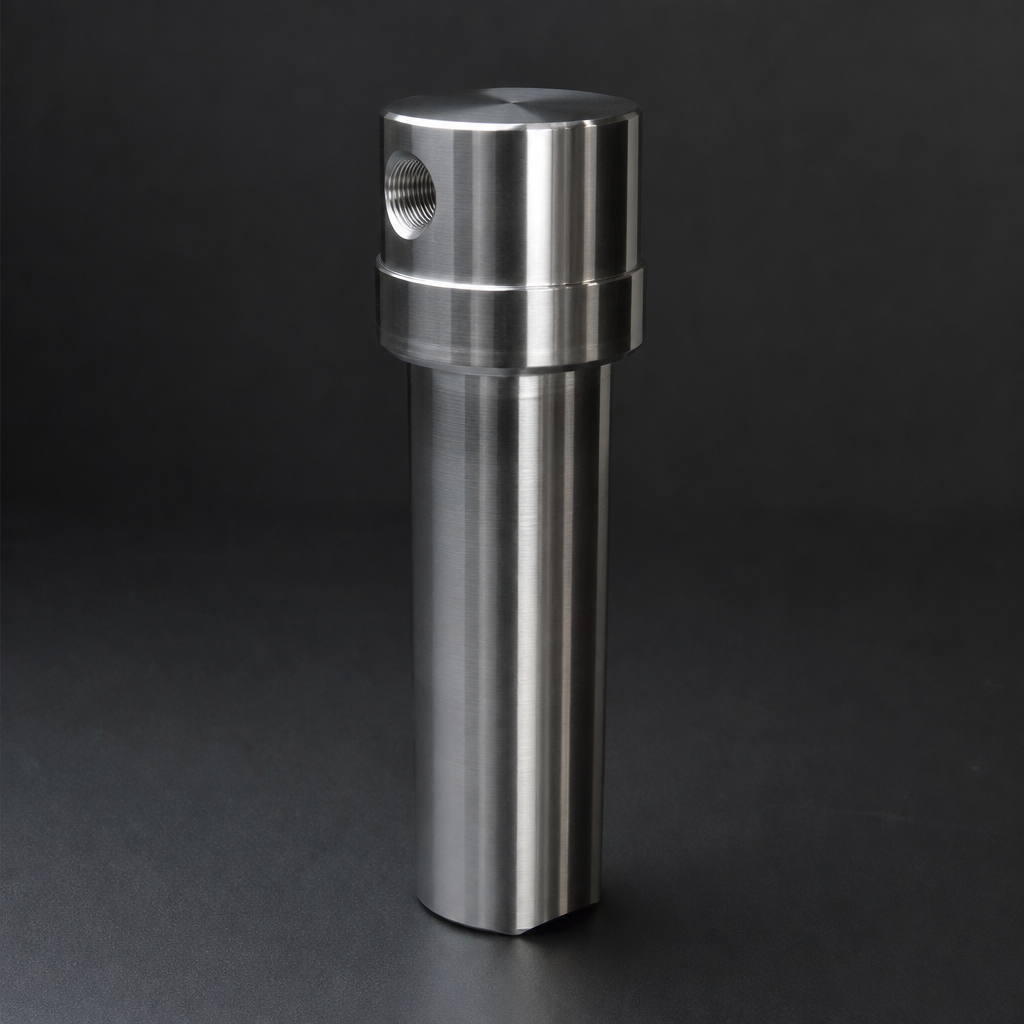
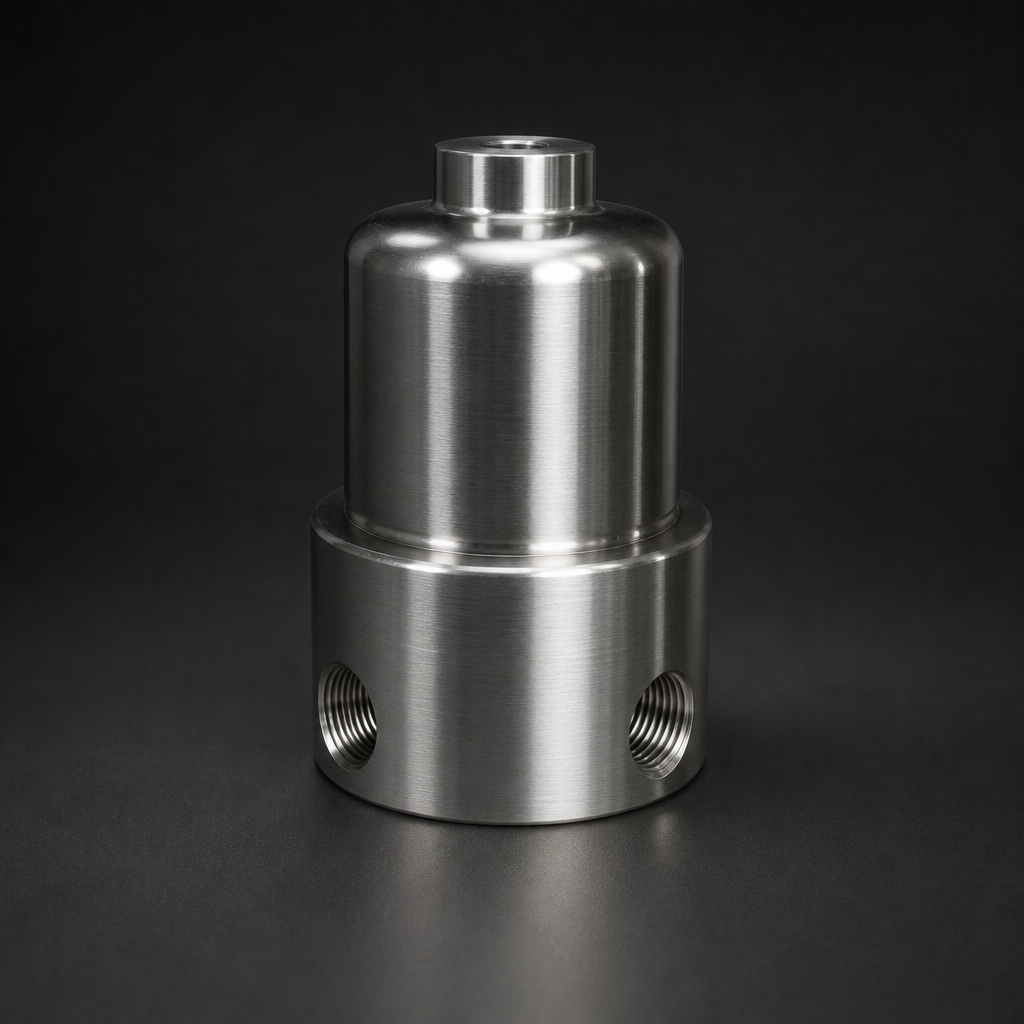
The RF-H-110-SN is R+F FilterElements' purpose-built solution for semiconductor and other ultra-high-purity gas applications. It belongs to the RF-H-110 to RF-H-170 instrumentation and high-pressure filter series — all-metal, 316L stainless steel housings designed for sample conditioning, analyser protection, and UHP gas delivery.
The "-SN" suffix denotes the SilcoNert® coating variant. Every wetted surface — the housing bore, the element seat, the inlet and outlet ports — is first electropolished to Ra < 0.25 µm, then coated with a chemically inert silicon layer via chemical vapour deposition (CVD). The result is a surface that is:
- Inert to reactive gases including silane, HCl, HF, and halogen compounds
- Non-adsorptive for moisture, hydrocarbons, and trace metals
- Mechanically stable under thermal cycling from −40 °C to +200 °C
- Compatible with all-metal VCR face-seal fittings (standard on UHP variants)
The housing accepts sintered metal filter elements rated to 450 °C — the only element type suitable for high-temperature reactive gas service. For ambient-temperature UHP nitrogen or argon distribution, RF-C coalescing elements with borosilicate glass microfibre achieve 99.9999 % efficiency at ≥ 0.003 µm, removing sub-micron particles and aerosols that would otherwise reach the process chamber.
Need help selecting the right UHP filter for your semiconductor fab?
Comparing Filter Housing Options for Semiconductor Gas Service
| Parameter | Industrial Grade | RF-H-110 (Standard) | RF-H-110-SN (UHP) |
|---|---|---|---|
| Housing material | Aluminium / polymer | 316L stainless steel | 316L SS + SilcoNert® |
| Surface finish (Ra) | 0.8–1.6 µm (mill) | 0.4–0.8 µm (pickled) | <0.25 µm (electropolished) |
| Max pressure | 17 bar | 350 bar | 350 bar (700 bar HP) |
| Seal material | NBR / EPDM | FKM / PTFE | PTFE / metal VCR |
| Outgassing | High (polymer) | Low | Near-zero |
| Suitable for UHP semiconductor | No | Marginal | Yes |
Use our free Engineering Tool to get a filtration recommendation for your specific application in under 2 minutes.
Point-of-Use Filtration: The Last Line of Defence
Even with a correctly specified distribution system, point-of-use (POU) filtration is essential. Particles generated by valve actuation, pressure transients, and thermal cycling accumulate in the gas lines and are released in bursts. A RF-DIL disposable inline filter installed immediately upstream of each process tool provides a final barrier, capturing particles ≥ 0.003 µm before they reach the chamber.
For moisture-critical applications — epitaxial growth, metal-organic CVD (MOCVD), atomic layer deposition (ALD) — a RF-DIA inline adsorber loaded with molecular sieve can reduce moisture to below 1 ppb at the point of use. These disposable units are changed on a scheduled basis, eliminating the risk of breakthrough contamination from a saturated bed.
For a broader overview of how filtration grades interact with gas purity standards, see our guide on ISO 8573-1 compressed air quality classes — the same classification logic applies to inert gas distribution in semiconductor environments.
Specifying the Right Filter: A Practical Checklist
When specifying gas filtration for a semiconductor fab, work through the following parameters before selecting a housing:
- Gas type and reactivity: Inert (N₂, Ar) vs. reactive (SiH₄, HCl, HF). Reactive gases require SilcoNert® or equivalent inert coating.
- Operating pressure: Cylinder pressure (200–300 bar) vs. distribution pressure (2–10 bar) vs. tool inlet pressure (<1 bar). Select the appropriate RF-H-110 variant accordingly.
- Purity target: Define the maximum allowable particle count (particles/m³ at ≥ 0.1 µm) and moisture level (ppb H₂O) at the point of use.
- Flow rate: Size the housing to maintain face velocity below the element's rated maximum — oversizing is preferable to undersizing in UHP service.
- Fitting standard: Specify VCR face-seal fittings for all UHP connections. Avoid compression fittings, which can trap contamination in the ferrule gap.
Our Engineering Sizing Tool can assist with housing and element selection based on your specific gas, pressure, and flow parameters. For complex multi-gas distribution systems, our team can review your P&ID and recommend a complete filtration strategy.
- Understanding where contamination enters the gas stream is the first step to eliminating it.
- The RF-H-110-SN is R+F FilterElements' purpose-built solution for semiconductor and other ultra-high-purity gas applications.
- Even with a correctly specified distribution system, point-of-use (POU) filtration is essential.
- Gas type and reactivity:
Related Reading
- Coalescing vs Particulate Filter Elements — Which Do You Need?
- Hydrogen Electrolysis Filtration — Protecting Electrolyser Stacks
- Oxygen Filtration Safety — Why Standard Filters Are Not Enough
Try our Engineering Sizing Tool → or discuss your requirements with our team.