Druckverlust ist kein Defekt — er ist Physik
Jeder Gasfilter erzeugt Druckverlust. Wenn Gas durch ein poröses Medium geleitet wird — sei es Borosilikat-Glasmikrofaser, gesinterter Edelstahl oder Aktivkohle — geht dabei ein Teil des Drucks verloren. Dieser Verlust ist der Preis der Filtration.
Das Problem ist nicht der Druckverlust an sich. Das Problem entsteht, wenn er übermäßig hoch ist — denn jeder unnötige Millibar Druckverlust schlägt sich direkt in verschwendeter Kompressorenergie nieder. Bei einem Druckluftsystem mit 7 bar verursacht ein um 0,5 bar erhöhter Druckverlust über einem verstopften Filter rund 7 % Mehrenergieverbrauch. Im industriellen Maßstab bedeutet das tausende Euro pro Jahr.
Was bestimmt den Druckverlust?
Fünf Faktoren bestimmen den Druckverlust über einem Gasfilter. Ihr Verständnis ist der Schlüssel zur Minimierung von Energieverlusten:
Volumenstrom
Eine höhere Gasgeschwindigkeit durch das Element erhöht den ΔP proportional. Dies ist der mit Abstand größte Einflussfaktor — und der einzige, den Sie durch korrekte Auslegung direkt steuern können.
Mediumsdichte des Elements
Feinere Filtrationsklassen (HE, UX) verwenden dichtere Medien, die einen höheren Strömungswiderstand erzeugen als gröbere Vorfilterklassen (PF, ST).
Verschmutzungsbeladung
Mit zunehmender Ansammlung von Partikeln und Aerosolen im Element verringert sich der freie Porenraum, und der ΔP steigt kontinuierlich an, bis ein Elementwechsel erforderlich wird.
Gaseigenschaften
Temperatur, Druck, Gasart und Feuchtegehalt beeinflussen Dichte und Viskosität des Gases — und damit den Druckverlust bei einem gegebenen Volumenstrom.
Sauber-ΔP vs. Betriebs-ΔP — ein wichtiger Unterschied
Jedes Filtergehäuse hat einen Sauber-Druckverlust — den ΔP bei fabrikneuem Element und sauberem Gas. Dieser beträgt typischerweise 0,05–0,1 bar bei einem korrekt ausgelegten Koaleszenzfilter und liegt bei Partikelfiltern noch darunter.
Im Betrieb steigt der ΔP mit zunehmender Beladung des Elements durch Verunreinigungen. Der Betriebs-ΔP zu einem bestimmten Zeitpunkt spiegelt wider, wie viel der Elementkapazität bereits verbraucht ist. Wenn er den Austauschwert erreicht (typischerweise 0,7 bar bei Druckluft-Koaleszenzfiltern, 0,3 bar bei Vakuumpumpen-Abgasfiltern), muss das Element gewechselt werden.
Die Kosten eines verzögerten Elementwechsels
Ein Weiterbetrieb über den Austauschwert hinaus spart kein Geld — er kostet Geld. Ein stark beladenes Element mit 1,0 bar ΔP zwingt den Kompressor zu höherer Leistung und verbraucht dabei weit mehr Energie, als ein Ersatzelement kosten würde. Im Extremfall kann ein übermäßiger ΔP zum Elementkollaps und zum Durchbruch von Verunreinigungen führen.
Druckverlust messen und überwachen
Der Druckverlust sollte über das Filtergehäuse gemessen werden — nicht anhand der Betriebsdauer geschätzt. Die Verschmutzungsbeladung variiert je nach Betriebsbedingungen erheblich, sodass ein zeitbasierter Elementwechsel unzuverlässig ist.
Differenzdruckanzeiger
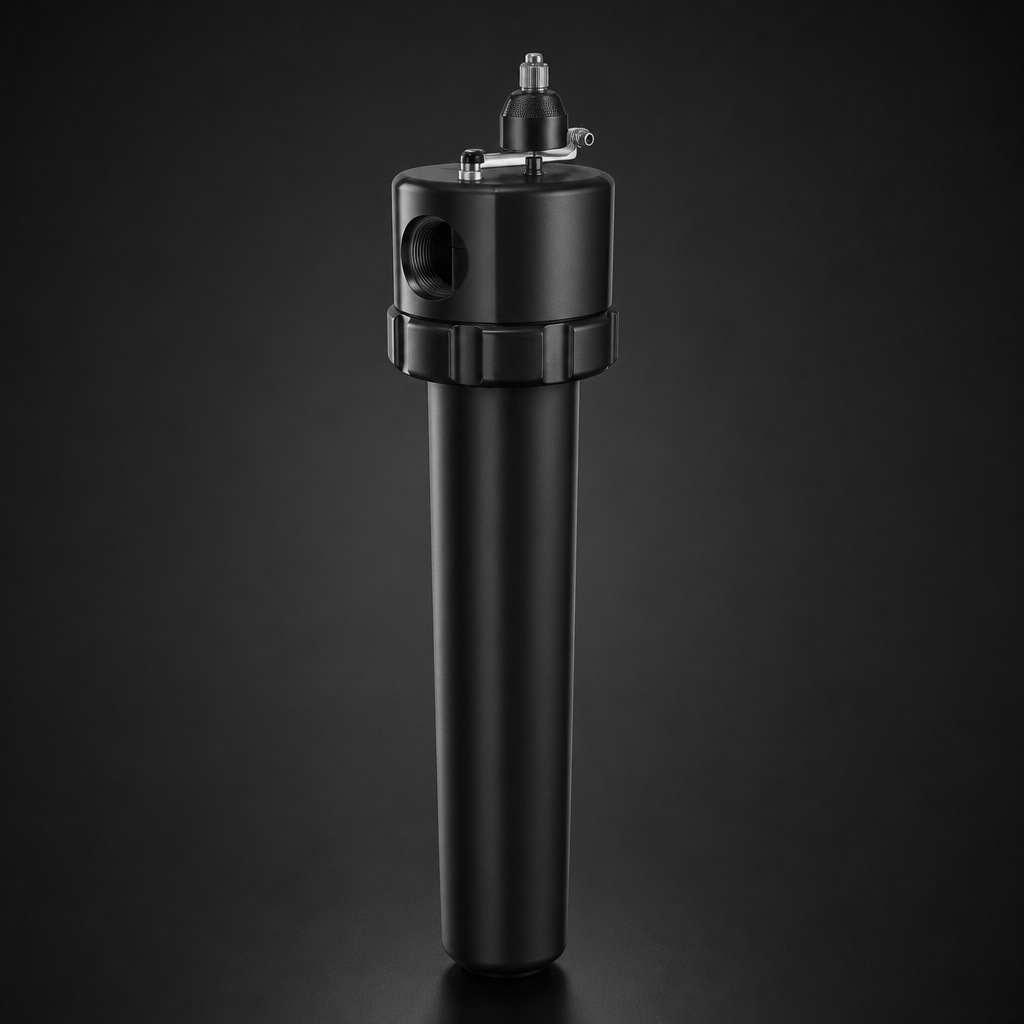
Viele R+F-Filtergehäuse sind mit integrierten Differenzdruckanzeigers erhältlich (Modelle mit Suffix I, z. B. RF-H-370FI, RF-H-383I). Diese ermöglichen eine direkte visuelle Anzeige des Elementzustands. Für kritische Anwendungen erlauben elektronische ΔP-Transmitter eine Fernüberwachung mit konfigurierbaren Alarmschwellen.
Wie korrekte Auslegung den Druckverlust minimiert
Die wirksamste Maßnahme zur Minimierung des Druckverlusts ist die korrekte Auslegung des Filtergehäuses auf den tatsächlichen Volumenstrom. Ein unterdimensioniertes Gehäuse zwingt das Gas mit höherer Geschwindigkeit durch das Element, erzeugt von Anfang an unnötigen ΔP und verkürzt die Elementstandzeit.
Das Auslegungsprinzip ist einfach:
- Wählen Sie ein Gehäuse, dessen Nennvolumenstrom dem tatsächlichen Volumenstrom entspricht oder diesen überschreitet
- Planen Sie einen Sicherheitszuschlag von 20–30 % über dem Nennvolumenstrom ein, um Systemspitzen und Elementbeladung zu berücksichtigen
- Bei stark verschmutzten Gasströmen empfiehlt sich eine Überdimensionierung um 50 % oder der Einsatz einer vorgeschalteten Vorfiltrationsstufe
Mehrelement-Gehäuse für hohe Volumenströme
Bei Volumenströmen über 75 Nm³/h verteilen Mehrelement-Gehäuse (3, 7 oder 16 Elemente) das Gas auf eine größere Filtermediumsfläche. Dadurch sinkt die Anströmgeschwindigkeit je Element, was zu einem deutlich niedrigeren Sauber-ΔP führt — und zu längeren Standzeiten zwischen den Elementwechseln.
Druckverlust und Elementauswahl
| Elementklasse | Typischer Sauber-ΔP | Austausch-ΔP | Anwendung |
|---|---|---|---|
| PF (Vorfilter) | 0,02–0,04 bar | 0,3 bar | Grobabscheidung vorgeschaltet |
| ST (Standard) | 0,03–0,06 bar | 0,5 bar | Allgemeine Partikelabscheidung, Rohrleitungsfiltration |
| HE (Hochleistung) | 0,05–0,10 bar | 0,7 bar | Ölaerosol, Instrumentenschutz |
| CC (Aktivkohle) | 0,03–0,05 bar | Zeitbasiert / Prüfung | Öldampf, Geruch, chemische Spuren |
Zweistufige Filtration spart Energie
Der Einsatz eines groben Vorfilters (Klasse PF) vor einem Hochleistungs-Koaleszenzfilter (Klasse HE) reduziert häufig den Gesamt-ΔP des Systems — weil der Vorfilter die Hauptverschmutzung bei niedrigem ΔP abscheidet und der Feinkoaleszenzer dadurch langsamer belädt und länger auf niedrigem ΔP-Niveau bleibt.
Praxisempfehlungen
- ΔP stets überwachen — entweder mit integrierten Anzeigers oder separaten Manometern. Ein zeitbasierter Elementwechsel verschwendet entweder Geld (zu früh) oder Energie (zu spät).
- Auslegung auf den tatsächlichen Volumenstrom, nicht auf die Kompressorleistung — es sei denn, die Hauptleitung wird gefiltert.
- Vorfiltration bei verschmutzten Gasströmen in Betracht ziehen — der Schutz feiner Elemente verlängert deren Standzeit und hält den ΔP niedrig.
- Höhenlage und Temperatur berücksichtigen — niedrigerer Atmosphärendruck und höhere Temperatur erhöhen beide den Volumenstrom am Filter.
- ΔP-Verläufe dokumentieren — ein plötzlicher Anstieg weist auf ein vorgelagertes Problem hin (defekter Abscheider, Ölmitnahme aus dem Kompressor) und nicht auf normale Elementbeladung.
Fazit
Druckverlust ist unvermeidlich — übermäßiger Druckverlust jedoch nicht. Korrekte Filterauslegung, geeignete Elementauswahl, Vorfiltration bei verschmutzten Gasströmen und ΔP-Überwachung stellen gemeinsam sicher, dass die erforderliche Filtrationsleistung bei geringstmöglichem Energieaufwand erreicht wird.
Filter korrekt auslegen — unnötigen ΔP vermeiden
Geben Sie Volumenstrom, Druck und Temperatur ein. Das Engineering-Tool empfiehlt das Gehäusemodell mit der passenden Kapazität für Ihre Anwendung.