
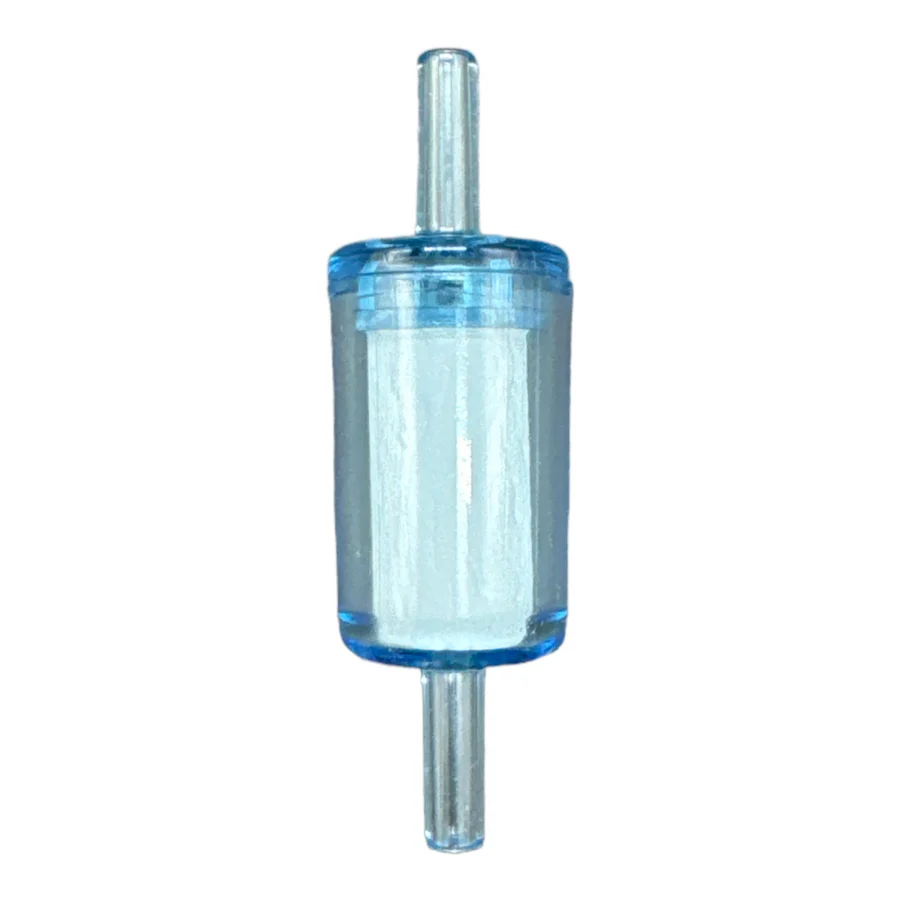
When Is a Disposable In-Line Filter Spent? — Visual Change Indicator (New: RF-DIF-BN50SI)
A disposable in-line filter looks the same on the day it is fitted and on the day oil starts passing through it. Fixed change intervals waste filters or let contamination reach analysers and instruments. The new RF-DIF-BN50SI (formerly RF-N05-CK-SI) carries an indicating dye in its silica-bonded element: when red appears on the outside of the element, the filter is spent and must be replaced. The silica-bonded element stays white when heated or oven-dried.
Reconocer los síntomas
- Disposable filters are changed on a fixed interval "to be safe" — many are still good when they are thrown away
- Oil film or droplets appear downstream of a disposable filter although it was changed recently
- Analysers, sensors or valves downstream show contamination before the next planned change
- Nobody knows when the small in-line filter at the analyser was last changed
- Different operators judge the condition of the same transparent filter differently
Causas
No objective end-of-life signal
a loaded microfibre element looks almost the same as a new one, especially at low liquid loads
Change interval not matched to the real contaminant load
compressor wear, season and duty cycle change the oil and aerosol load
Liquid breakthrough
once the depth media is saturated with liquid, coalesced oil is carried to the outside and downstream
Wrong flow direction
disposable elements designed for inside-to-out flow lose efficiency and life when installed the wrong way round
Differential-pressure monitoring is not practical on small push-on in-line filters
Lista de comprobación de diagnóstico
- 1Use RF-DIF-BN50SI where liquid contaminants such as oil aerosol are expected: replace the filter when red is visible on the outside of the element
- 2Install with flow from the inside of the element to the outside and mark the flow direction on the line; fit the replacement in the same orientation
- 3Keep a change interval for dry, dusty gas — the indicator shows liquid loading, not blocking by dry particles
- 4Check the rating: 110 °C @ 0 bar to 50 °C @ 8.5 bar, nylon body — check chemical compatibility with your gas
- 5For higher pressures, higher temperatures or larger flows use a stainless steel housing with differential-pressure gauge
- 6Ask us for other efficiency grades with indicator — grade 50 is 99.99 % @ 0.01 µm (borosilicate glass microfibre)
Encontrar el filtro adecuado para este problema
Introduzca sus datos de operación — nuestras herramientas le guiarán al elemento y carcasa adecuados. O envíenos sus datos para una recomendación a medida.
Buscador de elementos
RecomendadoEl elemento filtrante adecuado para el medio y la operación en menos de 60 segundos — punto de partida recomendado.
Encontrar elementoUtilizar selección de carcasa
Seleccionar la carcasa adecuada — material, nivel de presión, conexiones y purga.
Seleccionar carcasaSolicitar asesoramiento
¿Prefiere atención personal? Envíe sus datos de operación y le recomendaremos la configuración adecuada.
Enviar solicitudLectura complementaria
Problemas relacionados
Describa su situación — encontraremos la solución adecuada
Cada problema de filtración tiene causas específicas que requieren soluciones específicas. Envíenos sus condiciones de operación y elaboraremos una recomendación a medida.