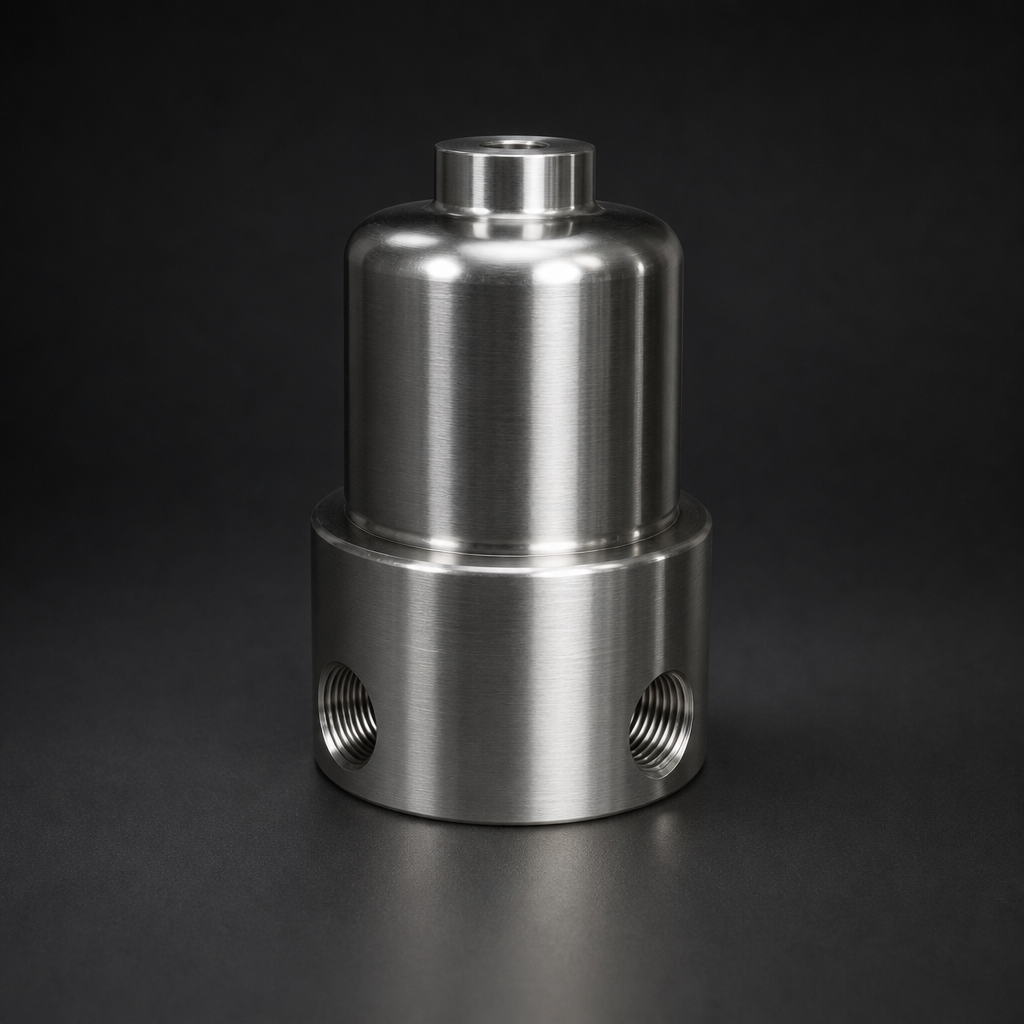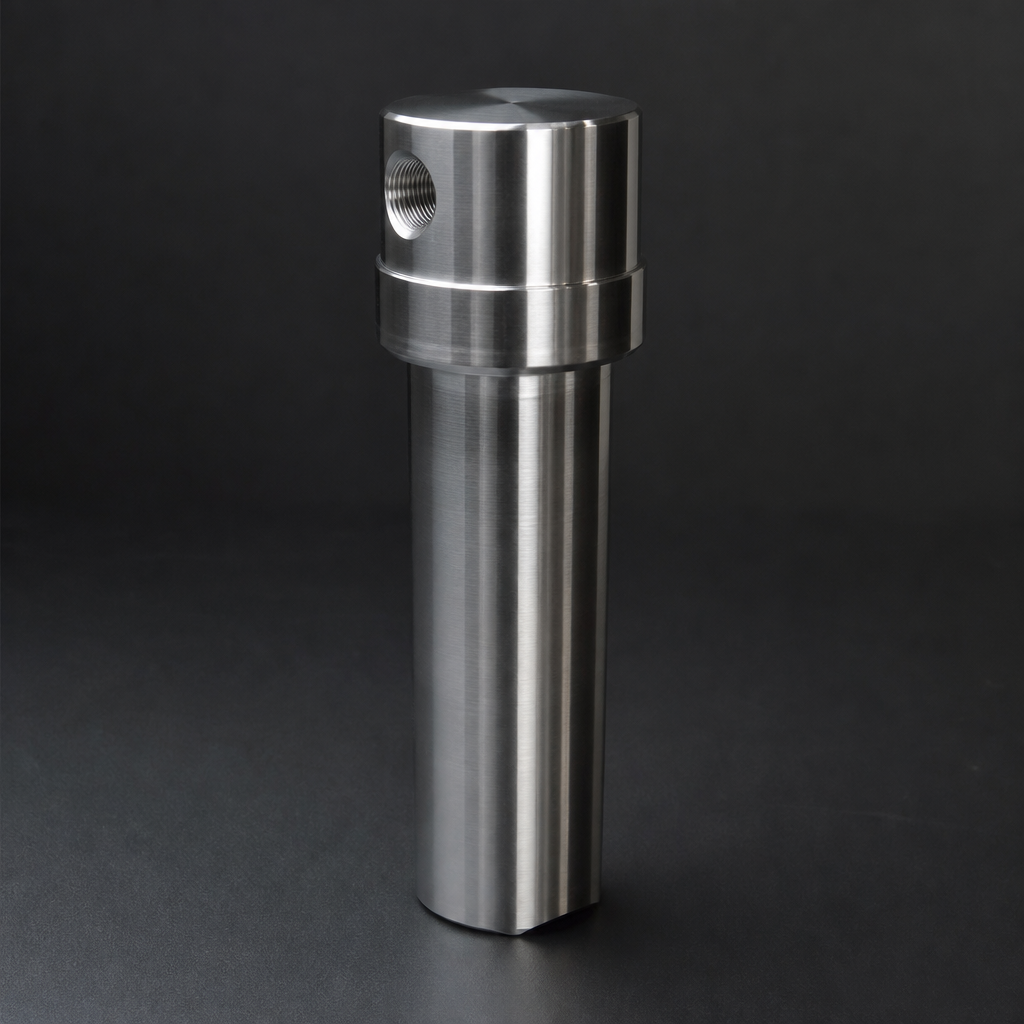
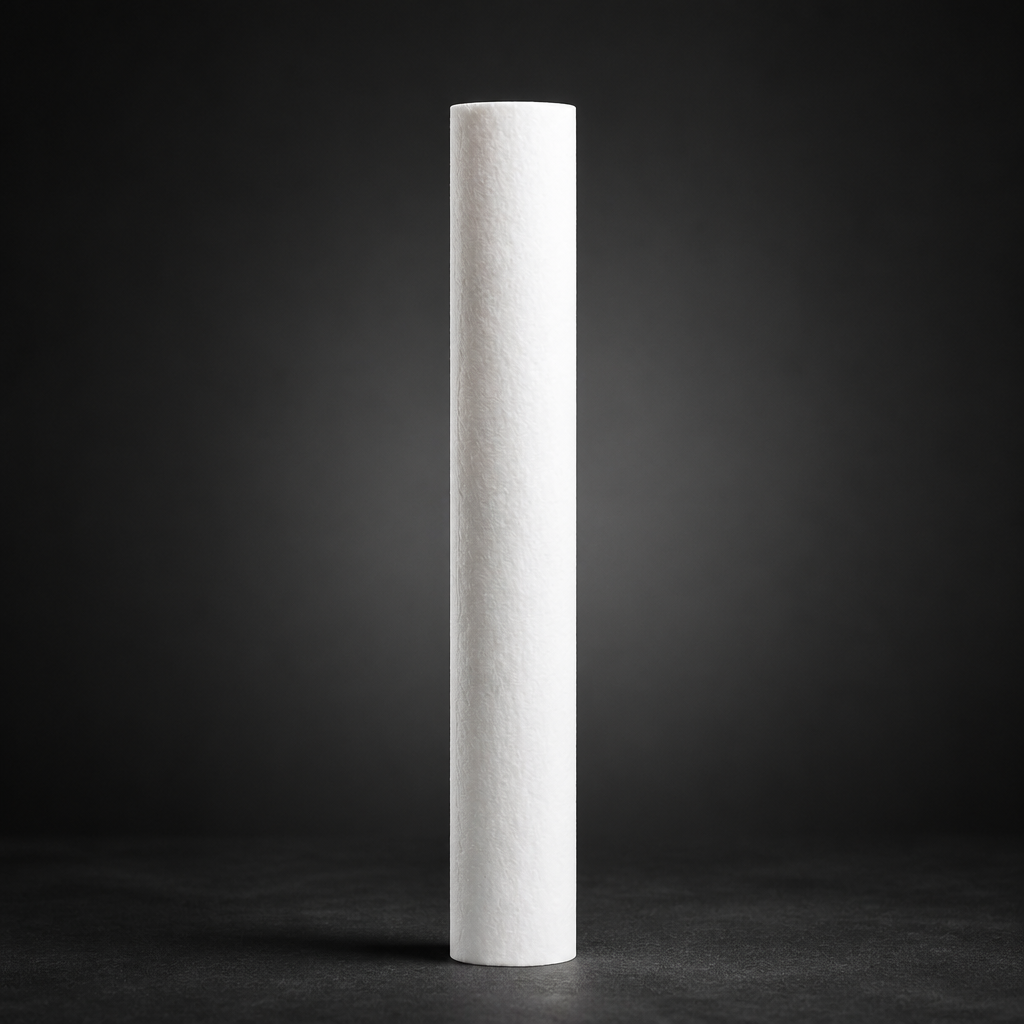
Glass microfibre media are made of in-depth layers of fibres laid down in a random fashion. As aerosols move through the media, they are captured on the fibres. There is no single "hole size" doing the work — four separate physical mechanisms bring droplets and particles into contact with a fibre. Each one is strongest in a different particle-size range, and together they allow borosilicate glass microfibre to remove aerosols from above 50 µm to below 0.01 µm.
1. Gravitational settling
When velocities inside the filter element are very low, larger aerosols — usually 20 to 50 µm in diameter — may fall out of the gas stream before reaching the media. If they do reach the media, they continue to fall as they pass through it. This vertical motion increases the likelihood that they bump into a fibre and are captured.
2. Inertial impaction
Aerosols larger than about 1 µm develop enough momentum that they do not follow the gas around a fibre. The gas bends away; the droplet carries straight on and impacts the fibre. Impaction becomes more effective as particle size and gas velocity increase.
3. Direct interception
Particles in the range of roughly 0.3 to 1 µm follow the gas streamlines. Some of these streamlines pass very close to a fibre. If a particle comes within half its own diameter of a fibre, it touches it and is held — this is interception.
Need help selecting the right element grade?
Use our free Engineering Tool to get a filtration recommendation for your specific application in under 2 minutes.
4. Diffusion (Brownian motion)
Particles smaller than about 0.3 µm no longer behave like small droplets. Their mass is so small that they do not obey the conventional laws governing moving bodies; they are knocked around by gas molecules and travel in random directions. This Brownian motion makes contact with a fibre more likely — and the smaller the particle, the stronger the effect. Where diffusion and interception overlap, around 0.3 µm, lies the most penetrating particle size.
| Mechanism | Typical size range | Gets stronger with |
|---|---|---|
| Gravitational settling | ≈ 20–50 µm | Low velocity, large droplets |
| Inertial impaction | > 1 µm | Higher velocity, larger particles |
| Direct interception | ≈ 0.3–1 µm | Fine fibres, dense media |
| Diffusion | < 0.3 µm | Smaller particles, longer residence time |
Why velocity matters for sizing
The size ranges above shift with gas velocity. As velocity increases, gravitational settling plays a smaller role for large droplets, which stay suspended, while impaction becomes stronger. Diffusion needs residence time, so very fine particles are captured less well at excessive media velocity. Higher velocity also raises differential pressure and can re-entrain coalesced liquid. This is why housings and elements are sized on the actual flow at operating pressure — not on a catalogue figure in Nm³/h. Our Engineering Sizing Tool does this conversion for you.
- When velocities inside the filter element are very low, larger aerosols — usually 20 to 50 µm in diameter — may fall out of the gas stream before reaching the media.
- Aerosols larger than about 1 µm develop enough momentum that they do not follow the gas around a fibre.
- Particles in the range of roughly 0.
- Particles smaller than about 0.
From mechanism to product
All R+F coalescing and particulate elements use this borosilicate microfibre principle. The standard final coalescer RF-C-51230-HE is rated at 99.99 % @ 0.01 µm; the matching particulate element RF-P-51230-HE protects against dry particles. For the 51 × 230 and 51 × 476 sizes the outer diameter is 62.5 ± 1.5 mm for coalescing and 58 ± 1.5 mm for particulate elements; standard coalescing elements operate from −50 to +150 °C, within the limit of the housing.
Download the Technical Note "Why borosilicate glass microfibre?" (PDF) for a two-page summary, or find all datasheets in the download library.
Try our Engineering Sizing Tool → or send us your operating data — we reply with a concrete R+F configuration.