
CNG Station Filtration Train
From pipeline gas to a clean fuel at the nozzle: where compressor oil and particles enter a CNG station, where the coalescing line filter belongs, and how to choose between 200 bar and 400 bar housings.
The station, stage by stage
Click a stage to see what happens to the gas and which R+F components fit.
3. Coalescing line filter
Removes compressor oil aerosol and fine particles after the final cooler.
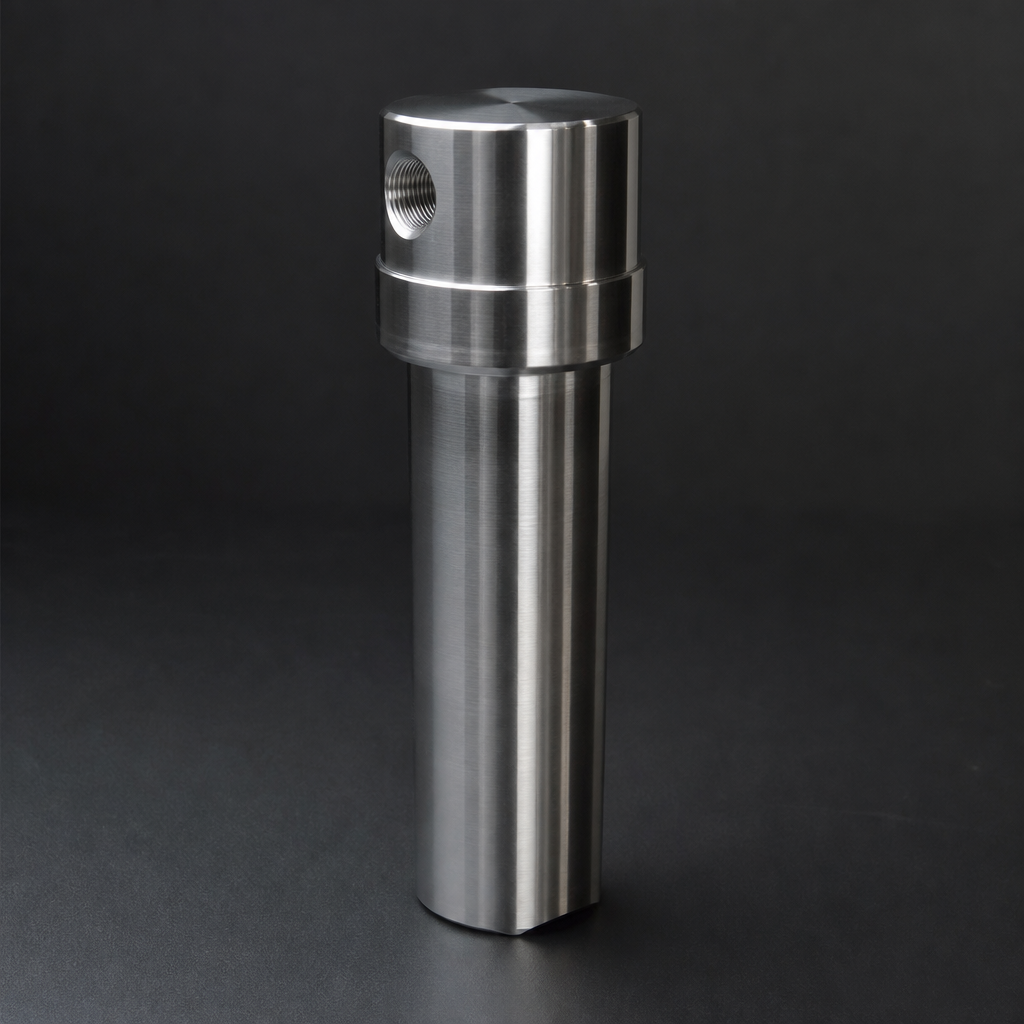
- RF-H-150HP: 316L, 1″ NPT, 200 bar. RF-H-150VP: 316L, 1″ NPT, 400 bar. Internal volume 1.5 L, FKM seals as standard, PTFE gasket on request.
- Coalescing element RF-C-51230-HE: 99.99 % at 0.01 µm. Fine oil droplets merge into larger drops, drain to the bottom of the housing and are removed through the drain.
- Install after the final cooler: the cooler the gas, the more oil is present as liquid aerosol that a coalescer can capture.
- Change the element at 0.7 bar differential pressure — at least once a year as a recommendation.
Why the coalescer sits after the final cooler
The position of the line filter decides how much oil it can actually capture.
Cool gas, liquid oil
A coalescer captures liquid aerosol. After the final cooler, more of the oil is liquid and can be separated; hot gas carries more oil as vapour that passes any mechanical filter.
Separator first
Bulk liquid belongs in the compressor’s separators. A coalescing element is designed for aerosol, not for slugs of liquid.
Drain management
Coalesced oil collects in the housing bowl. Drain it regularly — a full bowl lets oil be re-entrained into the gas.
Point of use last
A compact filter in front of the dispenser catches particles released downstream of the main filter.
Operating window: 200 bar or 400 bar housing?
Both housings use the same coalescing element RF-C-51230-HE. Choose by design pressure and safety margin.
| Parameter | RF-H-150HP | RF-H-150VP |
|---|---|---|
| Max. operating pressure | 200 bar | 400 bar |
| Connections | 1″ NPT | 1″ NPT |
| Material | 316L stainless steel | 316L stainless steel |
| Internal volume | 1.5 L | 1.5 L |
| Seals | FKM (PTFE gasket on request) | FKM (PTFE gasket on request) |
| Element | RF-C-51230-HE, 99.99 % @ 0.01 µm | RF-C-51230-HE, 99.99 % @ 0.01 µm |
| Typical use | CNG lines at standard station pressure | Higher design pressure, extra margin |
The housing is rated for 200 °C; the permissible operating temperature of the element depends on the element type. Flanged connections and pressure-equipment documentation on request.
Frequently asked questions
Grade numbers are manufacturer-specific and not directly comparable. What counts is the rated efficiency. RF-C-51230-HE is rated 99.99 % at 0.01 µm. Send us the data sheet of the specified element and we confirm the equivalent.
Data we need for a proposal
With these values we can confirm the housing, element and position in your station.
- Gas composition (natural gas, biomethane) and source
- Flow in Nm³/h or Sm³/h — and the reference conditions
- Operating and design pressure (bar g)
- Gas temperature at the filter inlet
- Compressor type (lubricated / oil-free) and position of the coolers
- Required efficiency or element grade from your specification
- Connection type and size (e.g. DN25 / 1″ NPT, flanges)
- Number of filters and required documentation
Planning a CNG station or replacing line filters?
Send us your specification or operating data. We propose the housing, element and position — including the equivalent to the element grade in your specification.