
Hydrogen Drying & Conditioning Train
From wet hydrogen to a dry, particle-free gas for metal hydride storage, fuel cells or mass flow controllers: catch pot, coalescer, molecular sieve dryer and after-filter — matched as one train from one source.
The train, stage by stage
Click a stage to see its task and the matching R+F components.
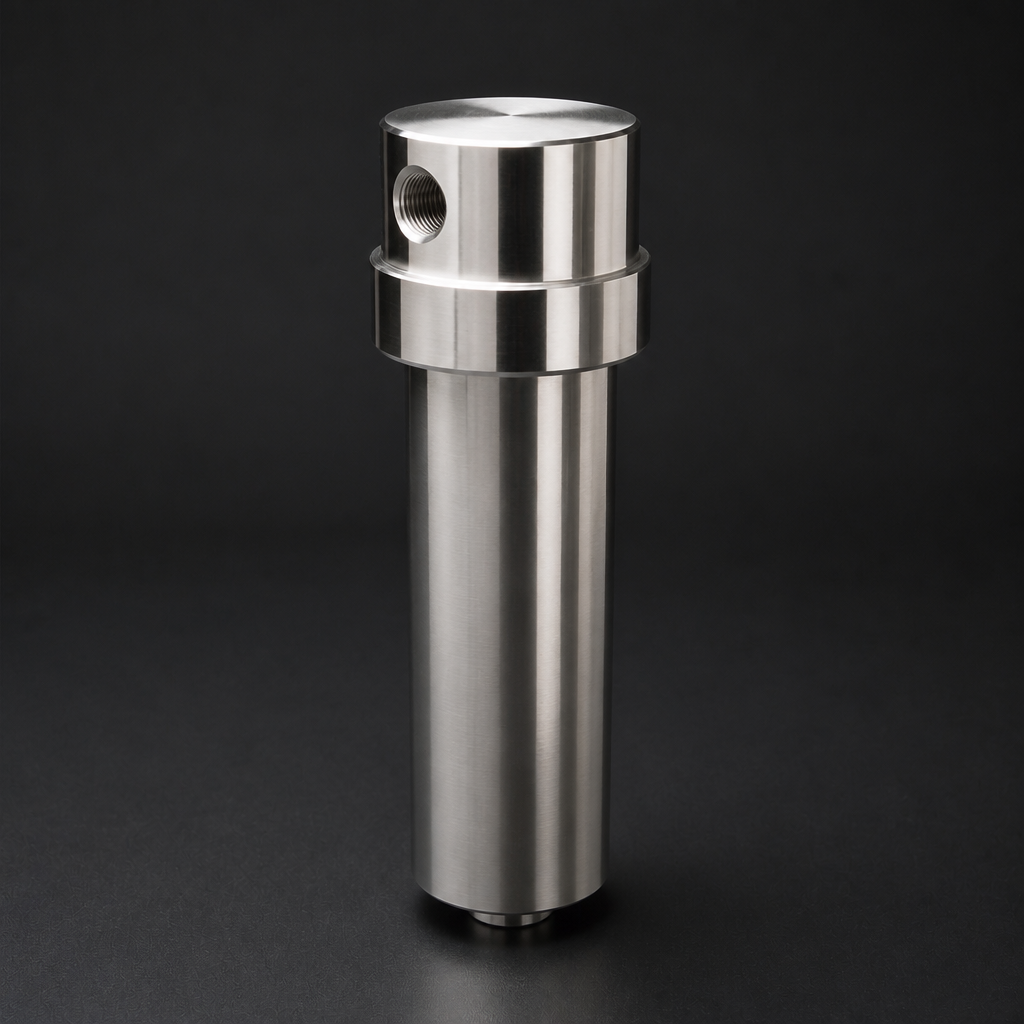
2. Catch Pot
Separates water slugs and bulk liquid.
- A catch pot collects free liquid and slugs of condensate in its bowl, without a filter element.
- Compact 316L stainless steel housing, ¼″ NPT, rated to 340 bar, with manual drain.
- It protects the coalescer from bulk liquid it is not designed to handle.
Why this order matters
Each stage protects the next one. Swapping or omitting a stage shifts the load to a component that is not designed for it.
Liquid first
Bulk water and slugs are removed by the catch pot. A coalescing element is designed for aerosol and would be flooded by slugs.
Aerosol second
The coalescer removes fine droplets that pass the catch pot, so they do not occupy adsorbent capacity.
Only vapour into the dryer
The molecular sieve takes up water vapour. Liquid water in the bed would load it far faster than planned.
Dust last
The after-filter sits downstream of the dryer because the adsorbent itself is a source of fine particles.
Operating window
The same arrangement is used on laboratory test benches and in larger plants — only the sizes change.
| Laboratory / test bench | Industrial | |
|---|---|---|
| Pressure | Typically up to 30 bar | Sized on request |
| Flow | Small flows | Sized on request |
| Housings | Compact 316L housings, ¼″ NPT, 340 bar | Process gas housings, 1″ to 2″ NPT |
| Tubing | 6 mm or ¼″ tube via standard adapters | Pipe connections per project |
| Dryer | Refillable adsorber, sized on request | Sized on request |
Pressure ratings refer to the housings. The suitable configuration always depends on your operating data.
Frequently asked questions
Yes. The compact housings have ¼″ NPT female ports. A standard stainless steel male connector (¼″ NPT × 6 mm tube compression fitting) connects them to 6 mm tubing. Please state your tube diameter in your inquiry.
What we need for sizing
Send us these values — we will propose the complete train.
- Gas and composition (e.g. hydrogen, purity, other components)
- Operating pressure (min. / max.)
- Flow rate (min. / normal / max.)
- Gas temperature before and after the cooler
- Inlet moisture or expected amount of condensate
- Required outlet dew point or moisture level
- Desired media change interval
- Tube diameter and connection type
- Consumer downstream (metal hydride, fuel cell, MFC, analyser)
Planning a hydrogen drying train?
Send us your operating data. We will propose catch pot, coalescer, dryer and after-filter as one matched train.