
Gas Drying & Adsorption (Molecular Sieve)
Removing water vapour from hydrogen, process gas and analyser sample gas with molecular sieve 3A, 4A, 13X or silica gel — in refillable stainless steel adsorbers, protected by coalescing pre-filtration and supplied with matching refill media.
The Challenge
Many gases leave their source saturated with water vapour — hydrogen from an electrolyser, process gas after a scrubber, or sample gas drawn from a wet process. Filters remove liquid droplets and aerosols, but water vapour passes through any mechanical filter. Where a low dew point is required, the vapour has to be removed by adsorption.
Choosing the wrong adsorbent is a common cause of disappointing results. Silica gel has a high capacity at higher relative humidity, but its capacity drops sharply at low humidity and at elevated temperature — it is not the right choice for very low dew points. Molecular sieves keep their capacity at low humidity and are used where very low dew points are needed. Within the molecular sieves, pore size matters: a sieve that also adsorbs the product gas or its components can reduce selectivity.
Adsorbents are also sensitive to liquids. Liquid water, oil or electrolyte aerosol reaching the bed occupies capacity and can damage the beads, causing dust and early breakthrough. And every adsorbent is a consumable: once saturated it must be regenerated or replaced — otherwise the dew point rises unnoticed.
Our Solution
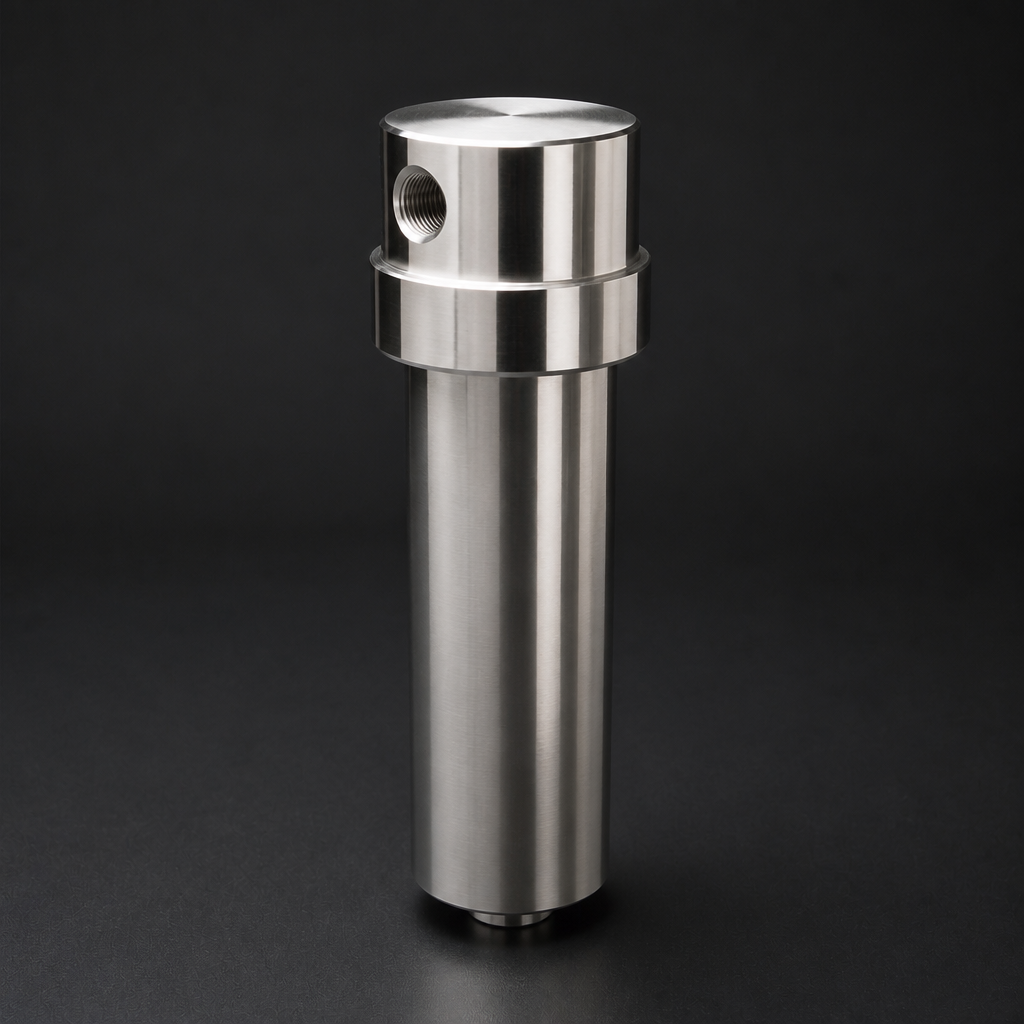
R+F supplies the complete drying train from one source: coalescing and particulate pre-filtration to keep liquids and solids away from the bed, a refillable stainless steel adsorber housing filled with the adsorbent that suits your gas, and a particulate after-filter to catch media dust. We select the housing size individually from your gas, flow, pressure, temperature, inlet moisture and the change interval you want — send us your operating data and we will propose a suitable adsorber.
We offer all common drying media as loose fill: Molecular Sieve 3A, which admits water (kinetic diameter approx. 2.8 Å) but excludes larger molecules and is typically used for drying hydrogen, olefins and polar gases; Molecular Sieve 4A for general gas drying; 13X for combined removal of water and CO₂; and silica gel for bulk pre-drying. When the media is spent, we supply the matching refill charge — the housing stays in place.
Right Adsorbent for the Gas
Molecular Sieve 3A, 4A, 13X or silica gel — selected by pore size and operating conditions, not by habit.
Very Low Dew Points
Molecular sieves retain their water capacity at low relative humidity, where silica gel loses effectiveness.
Housing Sized on Request
Refillable stainless steel adsorbers in several sizes — matched to your flow, pressure and service interval.
Refill Media from One Source
Replacement charges for every media type including Molecular Sieve 3A — no regeneration equipment needed.
Protected Adsorbent Bed
Coalescing pre-filtration keeps liquid water, oil and electrolyte aerosol away from the bed and extends its life.
Dust-Free Outlet
A particulate after-filter catches adsorbent fines before they reach valves, analysers or fuel cells.
Typical Adsorption Drying Train
A proven arrangement for drying gas by adsorption. The exact media, housing size and change interval are defined for each application.
- 1
Stage 1 — Liquid separation and coalescing filter: removes liquid water, oil and aerosol so that only water vapour reaches the adsorbent.
- 2
Stage 2 — Optional pre-drying with silica gel: takes up the bulk of the moisture at higher humidity and relieves the molecular sieve stage.
- 3
Stage 3 — Molecular sieve adsorber: Molecular Sieve 3A (e.g. hydrogen, polar gases), 4A (general drying) or 13X (water + CO₂) in a refillable stainless steel housing sized to your application.
- 4
Stage 4 — Particulate after-filter: catches adsorbent dust released by the bed.
- 5
Monitoring and service: a dew point or moisture measurement downstream shows when the media is saturated. Spent media is replaced with a refill charge; thermal regeneration of molecular sieves requires approx. 175–315 °C (depending on type) with dry purge gas.
Recommended Products
Explore the filtration products most commonly specified for this application.
Industries Served
Hydrogen & Electrolysis
Drying of hydrogen downstream of the electrolyser and coalescing stage — typically with Molecular Sieve 3A.
Laboratories & Research
Small adsorbers for test rigs and pilot plants, where replacing the media charge is simpler than regeneration.
Gas Analysis
Removing moisture from sample gas ahead of analysers where water interferes with the measurement.
Petrochemicals
Drying of cracked gas and olefins such as ethylene and propylene with Molecular Sieve 3A.
Natural Gas & Biogas
Dehydration with molecular sieve 4A; 13X where H₂S or mercaptans must also be removed.
Instrument Air & Industrial Gases
Drying of air and inert gases with 4A or 13X, with silica gel for bulk pre-drying.
Need an application-specific recommendation?
Our engineers can recommend the optimal filtration configuration for your specific process conditions, flow rates, and contaminant profiles.