When engineers design filtration systems for water electrolysis, the hydrogen side typically receives all the attention. Coalescing filters, particulate guards, and desiccant dryers are specified in detail for the H₂ outlet — yet the oxygen line is often left with minimal or no filtration at all. This oversight can prove costly: unprotected analytical instruments fail prematurely, control valves stick, and safety-critical sensors give false readings.
This guide focuses on the oxygen side of alkaline and AEM (anion exchange membrane) electrolysers — what contaminants appear, why they matter, and how to select the right filtration to protect your HTO sensors, OTH analysers, and downstream equipment.
Why the Oxygen Side Is Often Overlooked
The hydrogen outlet carries the product gas and is therefore subject to rigorous purity specifications. The oxygen stream, by contrast, is frequently vented or used only as a secondary process gas. This leads many system designers to treat O₂-side filtration as optional — a mistake that becomes apparent only after instrument failures begin to accumulate.
In alkaline electrolysers, the electrolyte is a concentrated potassium hydroxide (KOH) solution — typically 25–30 wt%. During operation, KOH mist is entrained in both the hydrogen and oxygen gas streams. On the O₂ side, this mist is particularly aggressive: it attacks sensor membranes, deposits on valve seats, and corrodes instrument fittings not rated for caustic service.
Contaminants on the Oxygen Side
Understanding what you are filtering is the first step to selecting the correct equipment. The oxygen stream from an alkaline or AEM electrolyser typically carries three categories of contamination:
- KOH mist and aerosols — sub-micron droplets of caustic electrolyte entrained from the gas–liquid separator. These are the primary threat to analytical instruments and are best removed by coalescing filtration.
- Liquid water droplets — bulk water carry-over from the separator, particularly during start-up transients or at high current densities. A coalescing filter with a liquid drain handles this effectively.
- Particulates from stack degradation — membrane fragments, electrode corrosion products, and diaphragm fibres that shed over the lifetime of the stack. These require particulate filtration rated to ≤ 1 µm.
Protecting HTO and OTH Analysers
The most sensitive instruments on the O₂ line are the binary gas sensors used to detect hydrogen-in-oxygen — a critical safety measurement. If the H₂ concentration in the O₂ stream exceeds the lower explosive limit (LEL), the system must shut down immediately. These sensors are typically thermal conductivity detectors (TCD) or electrochemical cells, both of which are highly sensitive to contamination.
A two-stage filtration approach is recommended upstream of any HTO or OTH analyser:
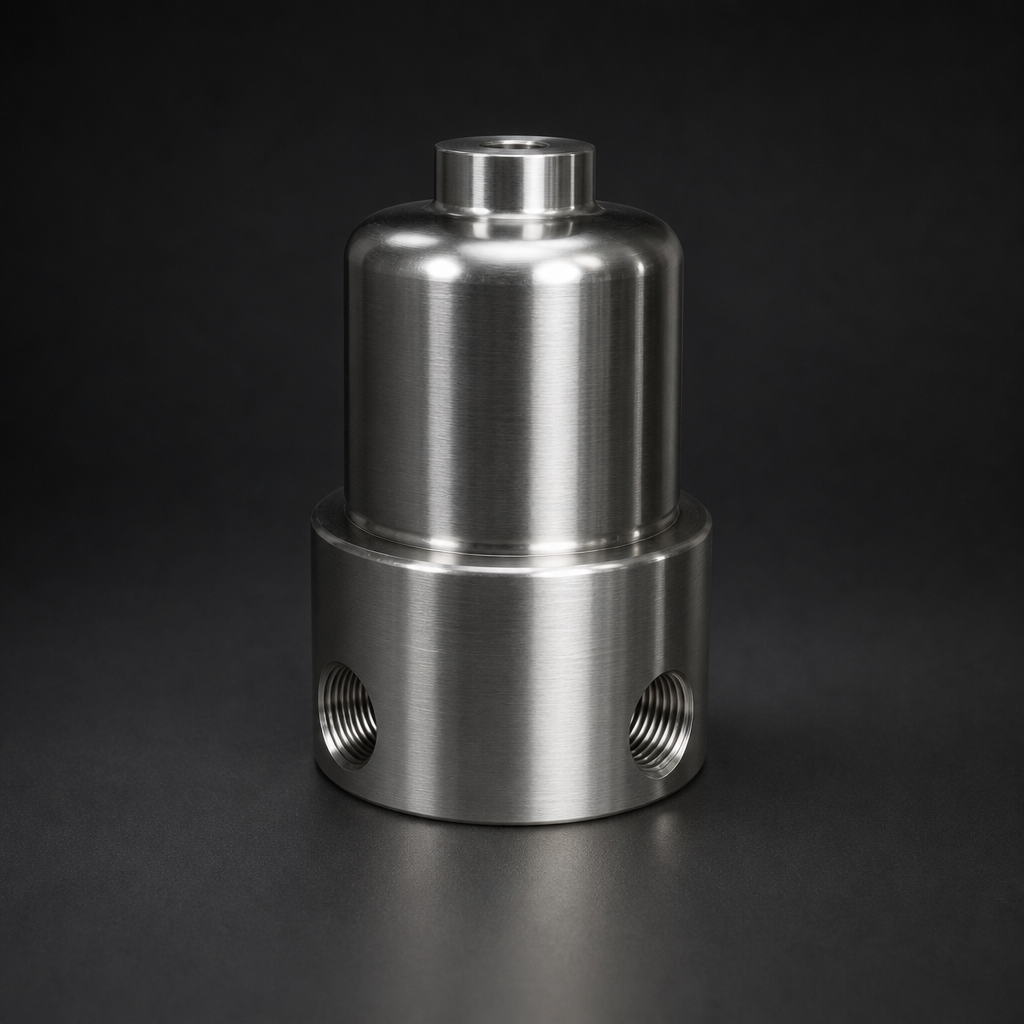
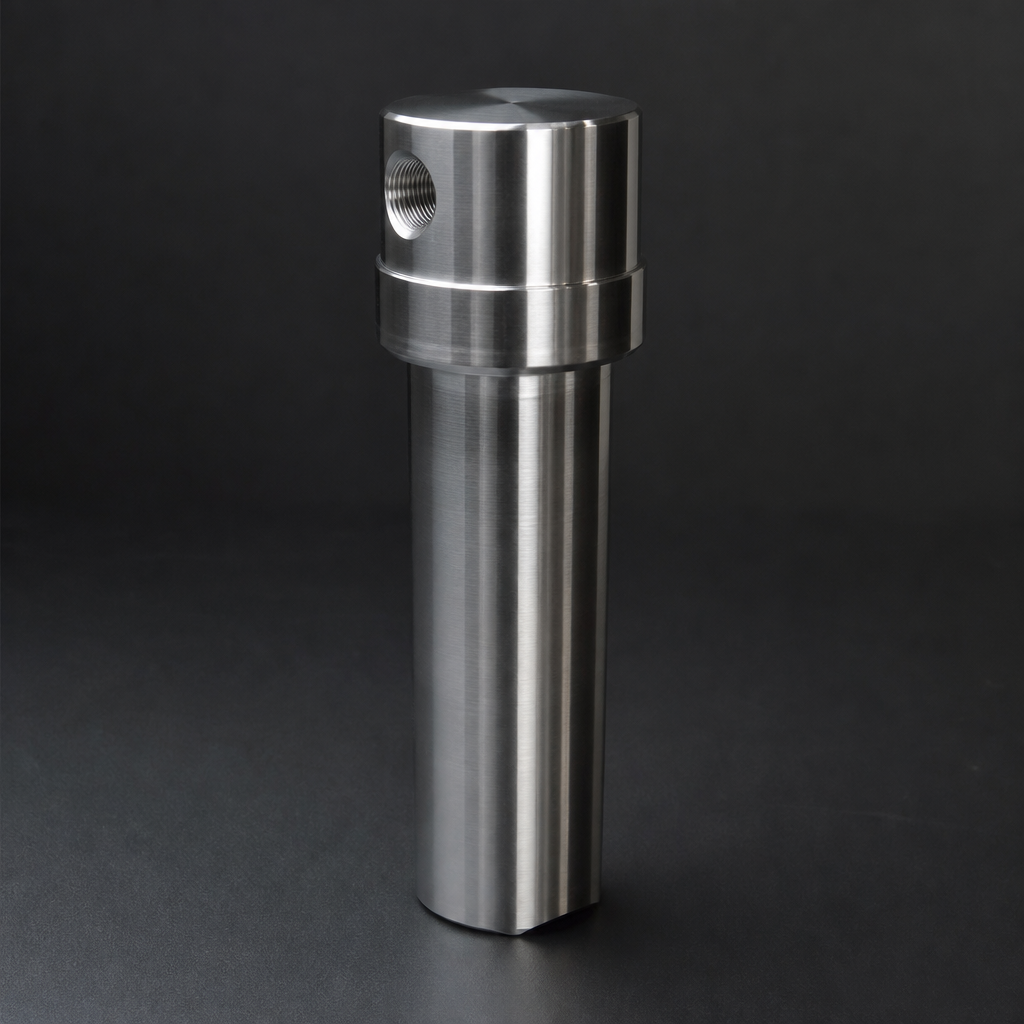
- Stage 1 — Coalescing filter: Removes KOH mist and water droplets. The RF-H-150 process gas housing fitted with an RF-C coalescing element is well suited to this duty, rated to 100 bar and constructed entirely in 316L stainless steel with EPDM-O₂ seals.
- Stage 2 — Particulate filter: Removes sub-micron solid particles that pass through the coalescing stage. An RF-DIL inline filter at 0.3 µm absolute provides a final guard layer immediately upstream of the analyser.
For systems where space is constrained, the RF-H-110 to RF-H-170 instrumentation filter range offers compact stainless steel housings designed specifically for analyser protection duty. The RF-H-150 is the standard choice for O₂-side electrolyser applications at pressures up to 100 bar.
Gas velocity through the element
Use our free Engineering Tool to get a filtration recommendation for your specific application in under 2 minutes.
Material Compatibility for Oxygen Service
Selecting the wrong seal or housing material for O₂ service is not merely a performance issue — it is a safety issue. Oxygen dramatically accelerates combustion, and any hydrocarbon contamination in the gas stream or on wetted surfaces can ignite under pressure. The following rules apply to all O₂-side filtration components:
| Component | Acceptable for O₂ Service | Not Acceptable |
|---|---|---|
| Housing material | 316L stainless steel, brass (cleaned) | Aluminium alloys (risk of ignition) |
| Seal material | EPDM-O₂, PTFE | NBR, standard FKM (hydrocarbon-based) |
| Filter media | Borosilicate glass microfibre (RF-C), sintered 316L | Cellulose, polyester (flammable) |
| Lubricants | PTFE-based, Krytox, Molykote 111 | Petroleum-based greases and oils |
| Cleaning standard | Oxygen-cleaned per ASTM G93 / EIGA IGC 33 | Standard industrial cleaning |
R+F FilterElements supplies the RF-H-150 housing with EPDM-O₂ seals as standard for oxygen service, and all wetted components are oxygen-cleaned before despatch. The RF-C coalescing elements use borosilicate glass microfibre media — inert, non-flammable, and compatible with concentrated KOH.
Filter Sizing for O₂ Flow Rates in Alkaline and AEM Systems
Oxygen flow rates on the O₂ side of an electrolyser are approximately half the hydrogen flow rate by volume (stoichiometric ratio 1:2). For a 1 MW alkaline electrolyser operating at 70% efficiency, the O₂ output is typically in the range of 100–200 Nm³/h at pressures of 10–30 bar. For larger multi-MW systems, flow rates can reach 500–1,000 Nm³/h.
When sizing the coalescing filter, the key parameters are:
- Operating pressure — higher pressure reduces volumetric flow and allows a smaller housing
- Gas velocity through the element — must remain below the rated face velocity to maintain coalescence efficiency
- Liquid loading — KOH mist concentration determines drain sizing and element change interval
For most MW-scale alkaline electrolyser O₂ lines, the RF-H-150 with a single RF-C-25178 element covers flow rates up to approximately 350 Nm³/h at 30 bar. For higher flows, the RF-H-160 (250 bar rated) or multi-element configurations are available. Use the R+F Engineering Sizing Tool to calculate the correct element size for your specific operating conditions.
For the final analyser guard duty, the RF-DIL disposable inline filter requires no sizing calculation — it is installed directly in the ¼" or ⅛" instrument tubing upstream of the sensor and replaced at each scheduled maintenance interval.
- The hydrogen outlet carries the product gas and is therefore subject to rigorous purity specifications.
- KOH mist and aerosols
- Stage 1 — Coalescing filter:
- Selecting the wrong seal or housing material for O₂ service is not merely a performance issue — it is a safety issue.
Recommended Filtration Configuration
A complete O₂-side filtration train for a typical alkaline electrolyser should include, in order from the gas–liquid separator outlet:
- RF-H-150 + RF-C coalescing element — primary KOH mist and water droplet removal, with automatic float drain
- RF-H-150 + RF-P particulate element (1 µm) — secondary particulate guard for stack degradation products
- RF-DIL (0.3 µm) — final point-of-use guard immediately upstream of the HTO/OTH analyser
This three-stage approach mirrors best practice on the hydrogen side and ensures that analytical instruments receive a clean, dry, particle-free sample. It also protects downstream control valves and pressure regulators from KOH deposits that would otherwise cause sticking and premature wear.
For further reading on related filtration topics, see our guides on hydrogen electrolysis filtration, oxygen filtration safety considerations, and coalescing vs particulate filter elements.
Try our Engineering Sizing Tool → or discuss your requirements with our team.