Compact sample conditioning systems demand filtration components that can handle aggressive moisture, condensate, and trace contaminants — all within a minimal footprint. When a standard coalescing housing is simply too large, or when liquid carryover would destroy a downstream analyser, a PTFE membrane housing becomes the correct engineering choice. This guide explains how to select and specify the right membrane housing for your sample conditioning loop.
Why Sample Conditioning Systems Need Dedicated Membrane Housings
Process analysers — gas chromatographs, moisture analysers, CEMS units — are sensitive instruments that require a clean, dry, representative gas sample. The sample conditioning system (SCS) is responsible for delivering that sample at the correct pressure, temperature, and cleanliness. Within the SCS, the membrane separator sits at a critical junction: it must remove all entrained liquid whilst allowing the gas phase to pass with minimal pressure drop.
Conventional coalescing filters are effective for bulk liquid removal, but they rely on a drainage mechanism that can fail if the housing floods or if the liquid load is intermittent and unpredictable. A hydrophobic PTFE membrane, by contrast, is an absolute barrier — liquid simply cannot pass through the membrane pores, regardless of how much condensate accumulates on the upstream face. This is the fundamental reason why membrane housings are specified in sample conditioning rather than standard coalescing housings.
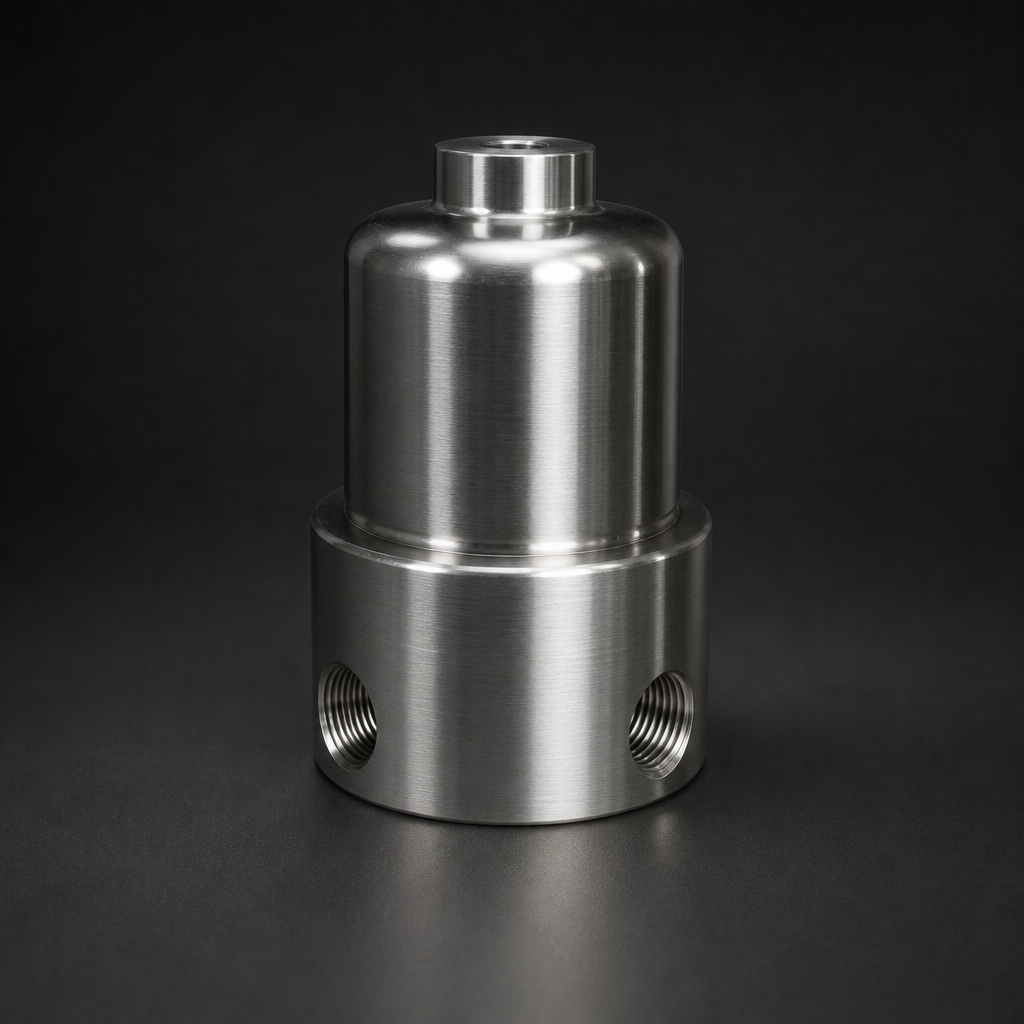
For engineers designing compact SCS panels, the physical size of the housing matters as much as its performance. A three-port membrane housing — inlet, outlet, and drain — can be mounted directly in-line on a 6 mm or 12 mm tube fitting, occupying a fraction of the space of a conventional filter body. The R+F membrane separator range is designed specifically for this application, with the RF-GMS-170 offering a PTFE hydrophobic membrane in a compact 316L stainless steel body.
Understanding Membrane Grades: Hydrophobic vs Oleophobic
Not all PTFE membranes are equal. The two principal grades used in sample conditioning are hydrophobic and oleophobic, and the distinction matters for your application:
- Hydrophobic PTFE: Repels water and aqueous solutions. The membrane surface energy is low enough that water cannot wet the pores, so liquid water is blocked whilst water vapour (below dew point) passes freely. This is the standard grade for most natural gas, biogas, and compressed air sample lines.
- Oleophobic PTFE: Repels both water and hydrocarbon liquids (oils, condensate, glycol). Required when the sample stream contains liquid hydrocarbons or when the upstream process uses glycol dehydration. Oleophobic membranes have a modified surface treatment that raises the critical surface tension above that of most organic liquids.
Key Performance Parameters
Need help selecting the right membrane housing?
Three-Port Configuration: How It Works in Practice
The three-port design is the standard configuration for inline membrane separators in sample conditioning. The three ports serve distinct functions:
- Gas inlet: Wet sample gas enters the housing and contacts the upstream face of the membrane.
- Gas outlet: Dry gas permeates through the membrane and exits to the analyser or next conditioning stage.
- Liquid drain: Accumulated condensate on the upstream face drains by gravity or is purged via a manual or automatic drain valve.
This configuration allows continuous operation without flooding, even when condensate load is high. The drain port can be connected to a sight glass for visual monitoring, or to an automatic level-controlled drain for unattended operation. In compact SCS panels, the housing is typically mounted vertically with the drain at the bottom, allowing gravity drainage without operator intervention.
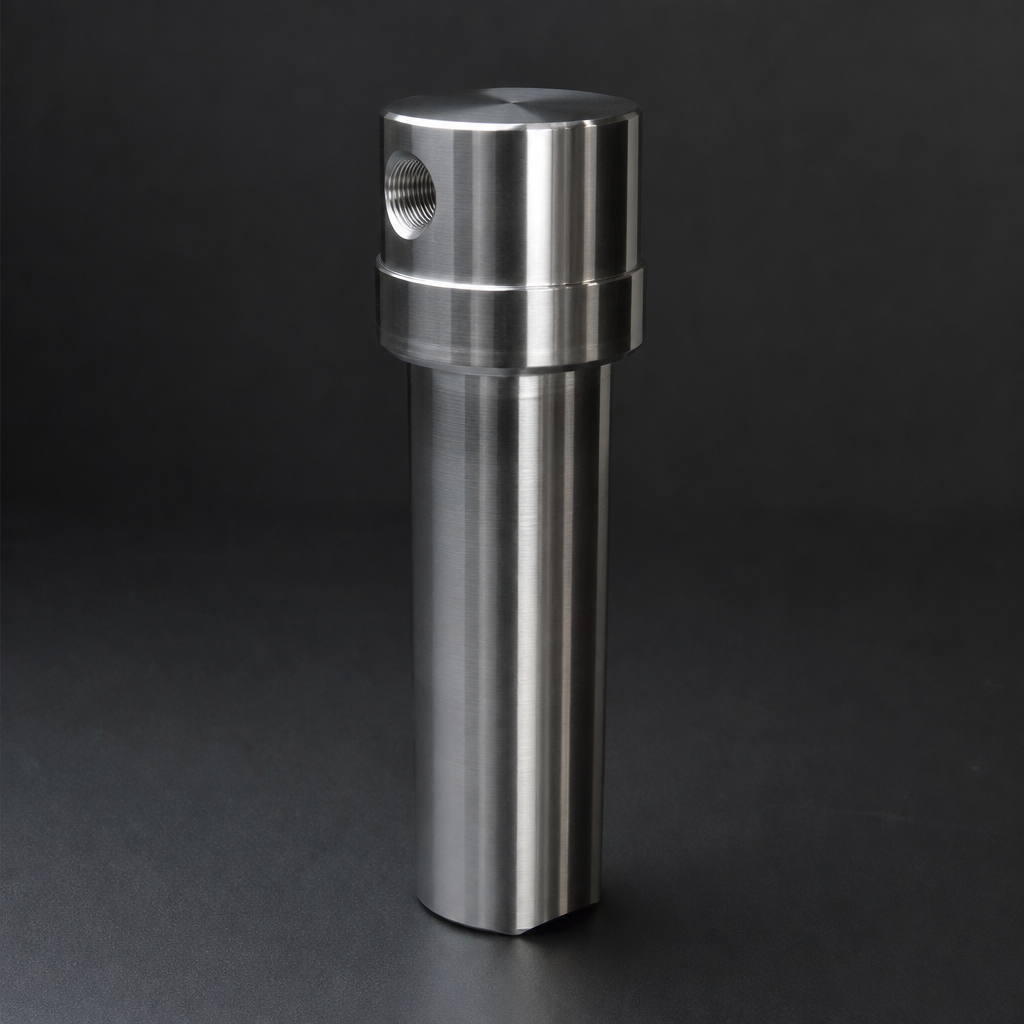
The RF-H-150 and RF-H-160 instrumentation housings from R+F FilterElements are compatible with membrane element inserts for applications where a higher-pressure rating is required alongside membrane separation. For dedicated membrane separation at lower pressures, the RF-GMS-170 is the purpose-built solution.
Use our free Engineering Tool to get a filtration recommendation for your specific application in under 2 minutes.
Screw-Cap Element Replacement
One of the practical advantages of modern compact membrane housings is the screw-cap design, which allows membrane element replacement without tools and without disturbing the tube connections. The cap unscrews to expose the membrane cartridge, which can be withdrawn and replaced in under two minutes. This is a significant maintenance advantage in SCS panels where access is restricted and downtime must be minimised.
R+F FilterElements supplies replacement membrane cartridges for the RF-GMS-170 in both hydrophobic and oleophobic grades. The cartridges are individually packaged and integrity-tested before despatch. For applications requiring traceability, batch certificates are available on request.
Exotic Materials for Aggressive Sample Streams
Standard 316L stainless steel housings are suitable for most natural gas, biogas, and compressed air sample streams. However, some applications demand more chemically resistant materials:
| Application | Recommended Housing Material | Seal Material | Notes |
|---|---|---|---|
| Natural gas / biogas | 316L stainless steel | FKM/Viton | Standard configuration |
| Sour gas (H₂S > 50 ppm) | 316L SS + NACE MR0175 | PTFE | K-type element required |
| Chlorinated compounds | Hastelloy C-276 | PTFE | Available on request |
| Semiconductor / ultra-pure | 316L SS + SilcoNert coating | PTFE | Inert surface for trace analysis |
| Oxygen service | 316L SS, oxygen-cleaned | EPDM-O₂ | See oxygen filtration safety guide |
For semiconductor and ultra-pure gas applications, SilcoNert-coated variants eliminate adsorption of trace analytes onto the housing walls — a critical requirement when measuring ppb-level contaminants. These variants are available from R+F FilterElements as part of the process gas filtration range.
Integration with Broader Sample Conditioning Architectures
A membrane housing rarely operates in isolation. In a complete sample conditioning system, it typically sits downstream of a primary coalescing stage (which handles bulk liquid) and upstream of a pressure regulator and flow controller. This arrangement protects the membrane from liquid slugs that would otherwise overwhelm it, whilst the membrane provides the final absolute liquid barrier before the analyser.
For applications where the sample gas also contains particulate contamination, a disposable inline filter such as the RF-DIL can be installed upstream of the membrane housing to protect the membrane from fouling. The RF-DIL is available in pore sizes from 0.3 µm to 40 µm and is compatible with all common tube fitting standards.
Where moisture removal must be combined with trace hydrocarbon adsorption, the RF-DIA inline adsorber — loaded with activated carbon or molecular sieve — can be installed in series with the membrane housing. This combination is commonly used in CEMS (Continuous Emission Monitoring Systems) where both moisture and organic interference must be eliminated before the analyser.
For a complete overview of how these components fit together, the ISO 8573-1 compressed air quality guide provides a useful framework for understanding cleanliness classes and the filtration stages required to achieve them.
- Process analysers — gas chromatographs, moisture analysers, CEMS units — are sensitive instruments that require a clean, dry, representative gas sample.
- Not all PTFE membranes are equal.
- The three-port design is the standard configuration for inline membrane separators in sample conditioning.
- One of the practical advantages of modern compact membrane housings is the screw-cap design, which allows membrane element replacement without tools and without disturbing the tube connections.
Specifying the Right Housing: A Practical Checklist
When specifying a PTFE membrane housing for your sample conditioning system, work through the following parameters:
- Operating pressure: Confirm maximum and minimum — the membrane must be rated above the maximum system pressure.
- Temperature: Both process temperature and ambient temperature affect membrane performance and seal selection.
- Flow rate: Membrane housings have a maximum gas flow rate above which pressure drop becomes excessive. Size accordingly.
- Liquid phase composition: Determines hydrophobic vs oleophobic membrane grade.
- Gas composition: Aggressive components (H₂S, chlorine, ammonia) drive material selection.
- Drain arrangement: Manual, automatic, or continuous — depends on condensate load and maintenance access.
- Connection standard: Swagelok, Parker, or metric compression fittings — confirm compatibility with existing panel connections.
Try our Engineering Sizing Tool → or discuss your requirements with our team.