If your facility handles food, beverages, or pharmaceuticals, the compressed air that touches — or even comes near — your product is subject to the same scrutiny as any other ingredient or process input. BRC Global Standard for Food Safety, IFS Food, and the internationally recognised ISO 8573-1 all set explicit requirements for compressed air quality. Failing an audit because of inadequate air filtration is entirely avoidable, yet it remains one of the most common non-conformances inspectors raise. This guide explains what the standards actually demand, how to achieve the required cleanliness classes, and which R+F FilterElements products will get you there.
Why Compressed Air Quality Matters in Food and Beverage Production
Compressed air is used throughout food and beverage manufacturing — blowing off packaging, conveying ingredients, operating pneumatic actuators, purging filling heads, and more. Unlike water or steam, compressed air is invisible, which makes contamination easy to overlook until an auditor or, worse, a product recall forces the issue.
The three main contaminants of concern are:
- Solid particles — pipe scale, compressor wear debris, and atmospheric dust drawn in at the compressor inlet.
- Water and liquid aerosols — condensed moisture that promotes microbial growth and corrodes equipment.
- Oil aerosols and vapour — lubricant carry-over from oil-lubricated compressors, or trace hydrocarbons even from oil-free machines.
Each of these can contaminate product directly (direct-contact air) or indirectly through surface contamination, packaging integrity failures, or equipment malfunction (non-contact air). The distinction between direct and indirect contact is central to how BRC and IFS frame their requirements.
Direct vs Indirect Contact Air — What the Standards Say
Both BRC Issue 9 and IFS Food Version 8 require a documented risk assessment for compressed air. The outcome of that assessment determines the quality class you must achieve and maintain.
Direct contact air is any air that touches the product, its surface, or open packaging. Examples include air used to blow off fruit, purge filling nozzles, or convey powders. This is the highest-risk category and demands the most stringent filtration.
Indirect contact air drives pneumatic cylinders, operates valves, or is used in areas where product is enclosed. The risk is lower, but it is not zero — a seal failure or unexpected discharge can still result in contamination.
BRC Clause 4.6.2 states that compressed air used in direct product contact must be of suitable quality and monitored. IFS Food Clause 4.9.8 similarly requires that compressed air quality be defined, monitored, and documented. Neither standard specifies an exact ISO class by name, but both expect you to justify your chosen class through a risk assessment — and in practice, auditors expect direct-contact air to meet ISO 8573-1 Class 1 for particles and oil, and Class 2 or better for water.
Understanding ISO 8573-1 — The Quality Class Framework
ISO 8573-1:2010 defines compressed air purity in three dimensions: solid particulate, water (pressure dew point), and total oil content. Each dimension is assigned a class number from 0 (most stringent) to 9 (least stringent), and the three numbers are written together — for example, Class 1.2.1.
| ISO 8573-1 Class | Particles ≥ 0.1 µm (per m³) | Pressure Dew Point | Total Oil (mg/m³) |
|---|---|---|---|
| Class 0 | As specified by user | As specified | < 0.01 |
| Class 1 | ≤ 20,000 | ≤ −70 °C PDP | ≤ 0.01 |
| Class 2 | ≤ 400,000 | ≤ −40 °C PDP | ≤ 0.1 |
| Class 3 | ≤ 90,000,000 | ≤ −20 °C PDP | ≤ 1.0 |
| Class 4 | ≤ 10,000,000 (≥ 1 µm) | ≤ +3 °C PDP | ≤ 5.0 |
For food-grade direct-contact applications, the industry benchmark is ISO 8573-1 Class 1.2.1 — Class 1 for particles, Class 2 for water (pressure dew point ≤ −40 °C), and Class 1 for oil (≤ 0.01 mg/m³). Some customers and certification bodies push for Class 1.4.1 where a refrigerant dryer is already installed, accepting a higher dew point for non-chilled environments. Your risk assessment should justify whichever class you select.
Differential pressure monitoring logs
How to Achieve ISO 8573-1 Class 1.2.1 in Practice
Achieving Class 1.2.1 requires a correctly sequenced filtration and drying train. No single component can do it alone. A typical installation for food-grade direct-contact air looks like this:
- Pre-filter (coalescing, 1 µm grade) — removes bulk liquid water and large aerosols before the dryer, protecting the dryer bed and extending its service life.
- Refrigerant or desiccant dryer — reduces pressure dew point. A refrigerant dryer achieves approximately +3 °C PDP (Class 4 water); a desiccant dryer achieves −40 °C or lower (Class 2 or Class 1).
- High-efficiency coalescing filter (0.01 µm grade) — removes sub-micron oil aerosols and fine particles to meet Class 1 oil and particle requirements.
- Activated carbon adsorber — removes oil vapour (gaseous hydrocarbons) that coalescing filters cannot capture, bringing total oil to ≤ 0.01 mg/m³.
- Final particulate filter — a downstream sterile-grade or 0.01 µm particulate filter protects the point of use from any carbon fines or downstream contamination.
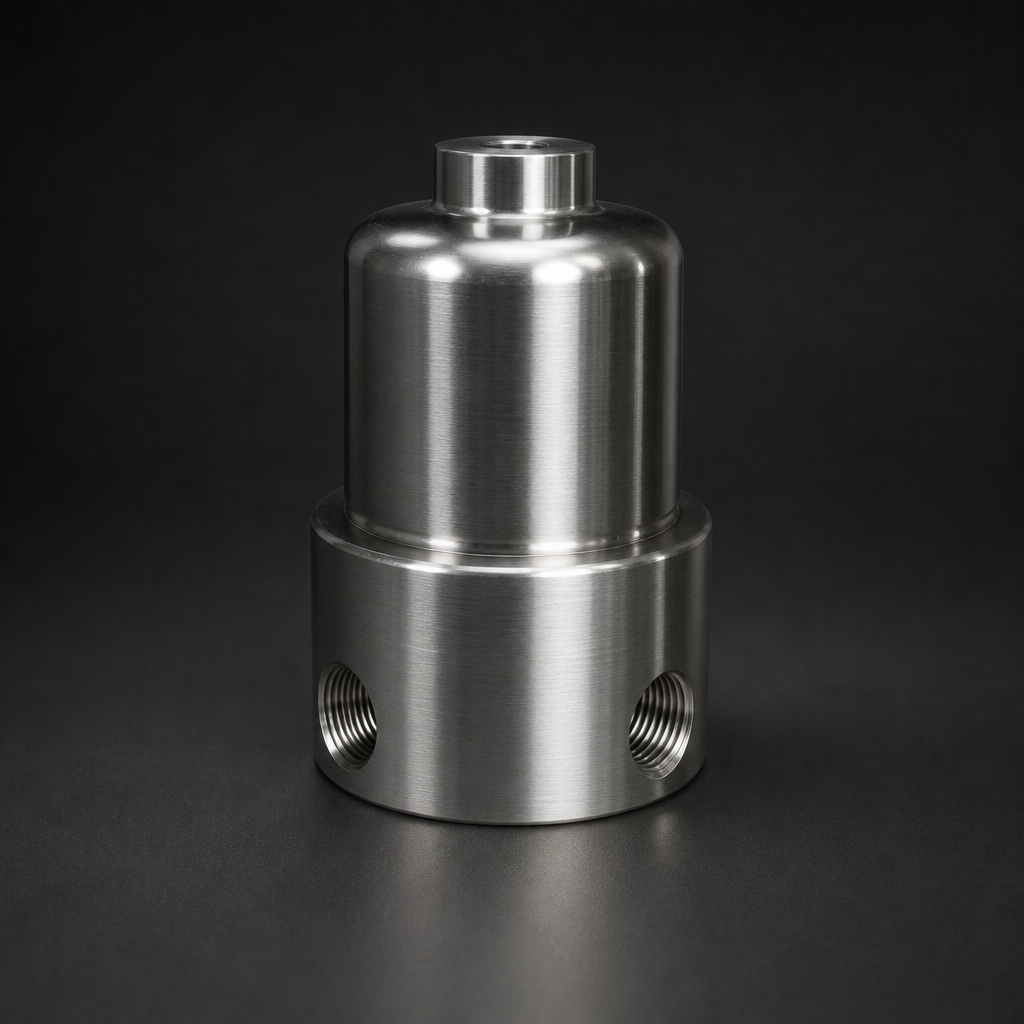
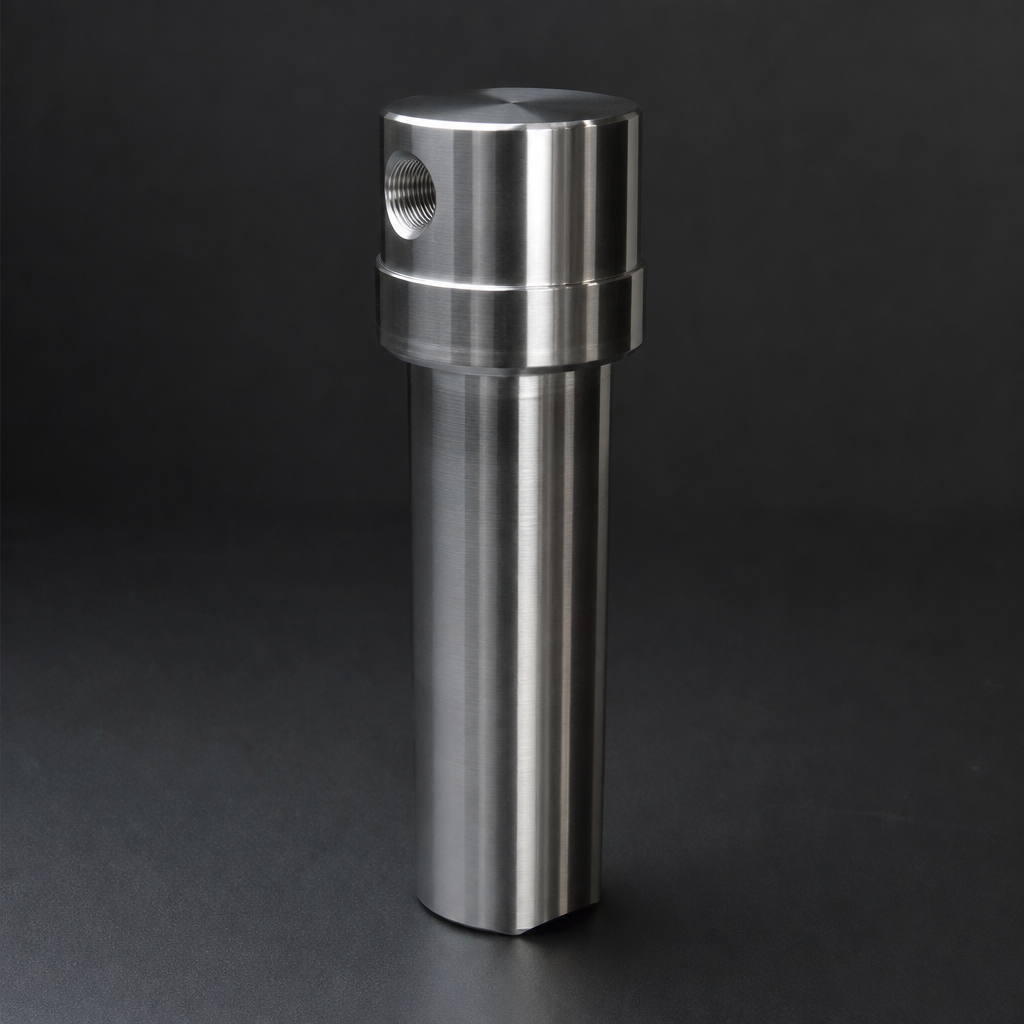
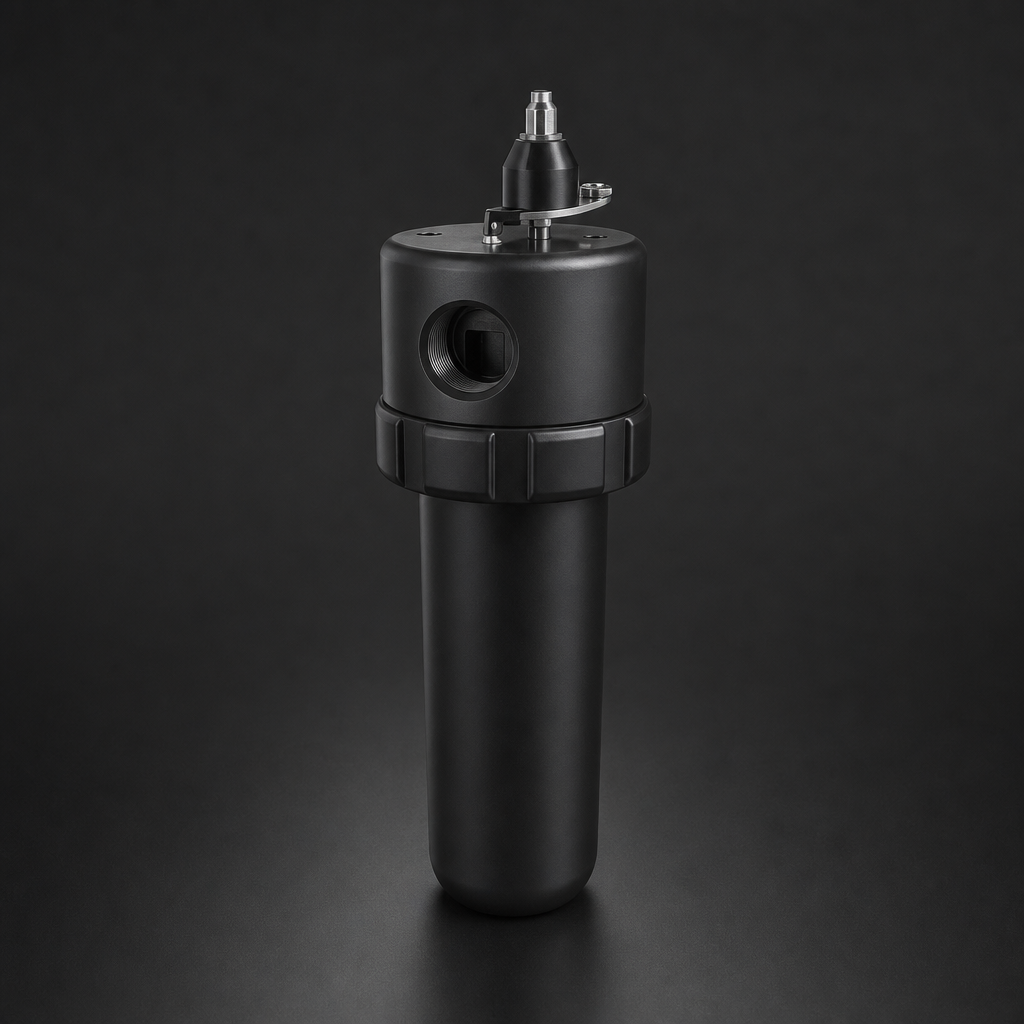
R+F FilterElements offers its own range of compressed air filter housings and elements designed specifically for this kind of multi-stage installation. The RF-H-385AI large-body coalescing filter housing is a workhorse for high-flow food and beverage lines, handling flows up to 12,000 Nm³/h at 17 bar. Paired with RF-C coalescing elements (borosilicate glass microfibre, 99.99% efficiency at ≥ 0.1 µm) and RF-AC activated carbon adsorption elements (residual oil < 0.003 mg/m³), it delivers the oil removal performance that Class 1 oil demands.
For smaller flow rates or point-of-use protection, the RF-H-310 to RF-H-360 series housings accept the same RF-C and RF-P element range in compact form factors, making them easy to install at individual machine drops without disrupting the main ring main.
Selecting the Right Filter Elements
The element grade you choose determines the filtration class you achieve. R+F FilterElements supplies elements in the following grades for compressed air duty:
| Element Code | Type | Efficiency | Residual Oil | Typical Application |
|---|---|---|---|---|
| RF-C (coalescing) | Borosilicate glass microfibre | 99.99% ≥ 0.1 µm | ≤ 0.01 mg/m³ | High-efficiency coalescing, pre-dryer and post-dryer |
| RF-P (particulate) | Borosilicate glass microfibre | 99.99% ≥ 0.3 µm | N/A | Final particulate barrier, sterile-grade protection |
| RF-AC (adsorption) | Activated carbon | Oil vapour removal | < 0.003 mg/m³ | Oil vapour polishing, odour removal |
Elements are available in sizes 12032, 12057, 25064, 25178, 51230, and 51476 to match the corresponding housing series. Always confirm the element size code when ordering to ensure compatibility with your existing housings.
For a detailed comparison of coalescing and particulate element technologies, see our guide: Coalescing vs Particulate Filter Elements — Which Do You Need?
Use our free Engineering Tool to get a filtration recommendation for your specific application in under 2 minutes.
Monitoring and Documentation — What Auditors Expect
Installing the correct filtration train is necessary but not sufficient. BRC and IFS both require ongoing monitoring and documented evidence that your compressed air continues to meet the specified quality class. Auditors will look for:
- A written compressed air quality policy — defining the ISO class required for each use point (direct contact, indirect contact, instrument air, etc.).
- A risk assessment — justifying the chosen class based on product type, process, and contact risk.
- Periodic air quality testing — typically annual or semi-annual third-party testing for particles, dew point, and total oil at representative sample points. Some sites test quarterly for high-risk applications.
- Filter change records — documented evidence of element replacement at the manufacturer's recommended intervals (or based on differential pressure monitoring).
- Differential pressure monitoring logs — showing that filters are not bypassed or running in a blocked condition.
- Compressor and dryer maintenance records — demonstrating that upstream equipment is maintained and cannot introduce contamination.
Differential pressure indicators are standard on all RF-H series housings, and R+F FilterElements recommends replacing elements when differential pressure reaches 0.5 bar, or at least annually — whichever comes first. For food-grade applications, annual replacement is the minimum; many customers on high-duty cycles replace every six months.
Common Audit Failures and How to Avoid Them
Based on the most frequently cited non-conformances in food and beverage compressed air audits, the following issues come up repeatedly:
- No documented risk assessment — the most common finding. Even if your filtration is technically adequate, the absence of a written risk assessment is itself a non-conformance under BRC Clause 4.6.2 and IFS 4.9.8.
- Incorrect filter sequence — placing the activated carbon adsorber before the high-efficiency coalescing filter allows liquid oil to saturate and destroy the carbon bed. The coalescing filter must always precede the adsorber.
- Expired or overloaded elements — elements left in service beyond their rated life or beyond the differential pressure limit. Blocked elements can rupture, releasing accumulated contamination downstream.
- No point-of-use testing — testing only at the compressor outlet and assuming quality is maintained throughout the distribution system. Pipe corrosion, dead legs, and condensation can degrade air quality between the compressor room and the point of use.
- Oil-free compressor complacency — assuming that an oil-free compressor eliminates the need for oil filtration. Oil-free machines can still introduce atmospheric hydrocarbons drawn in at the inlet, and ISO 8573-1 Class 1 oil limits still apply.
Sizing Your Filtration System
Correct sizing is critical. An undersized filter housing increases pressure drop, wastes energy, and shortens element life. An oversized housing may allow air velocity to fall so low that coalescing efficiency drops. R+F FilterElements provides a free online sizing tool that calculates the correct housing and element size based on your flow rate, operating pressure, and temperature. For complex multi-stage installations or high-flow food production lines, the R+F technical team can provide a full system recommendation — contact us at [email protected].
As a general guide, the RF-H-385AI housing is suitable for flows from 1,000 to 12,000 Nm³/h at pressures up to 17 bar. For flows below 1,000 Nm³/h, the RF-H-310 to RF-H-360 series covers the range from a few Nm³/h up to approximately 900 Nm³/h, with the same element compatibility and the same food-grade performance.
Putting It All Together — A Practical Checklist
Before your next BRC or IFS audit, work through the following checklist to confirm your compressed air system is compliant:
- ☐ Risk assessment completed and documented, distinguishing direct and indirect contact air.
- ☐ ISO 8573-1 quality class defined for each use point and justified in the risk assessment.
- ☐ Filtration train correctly sequenced: pre-filter → dryer → high-efficiency coalescing → activated carbon → final particulate.
- ☐ R+F RF-C coalescing elements and RF-AC adsorption elements installed in the correct housings.
- ☐ Differential pressure indicators fitted and monitored.
- ☐ Element replacement schedule documented and followed.
- ☐ Annual (or more frequent) third-party air quality testing at point-of-use sample points.
- ☐ Test certificates retained and available for audit.
- ☐ Compressor and dryer maintenance records up to date.
Compressed air quality is not a one-time installation task — it is an ongoing programme of monitoring, maintenance, and documentation. The good news is that with the right filtration equipment and a clear management system, achieving and maintaining ISO 8573-1 Class 1.2.1 for BRC and IFS compliance is entirely straightforward.
For further guidance on compressed air filtration for food and beverage applications, or to request a system recommendation for your specific flow and pressure conditions, contact the R+F FilterElements team at [email protected] or use the online sizing tool.
- Water and liquid aerosols
- Both BRC Issue 9 and IFS Food Version 8 require a documented risk assessment for compressed air.
- ISO 8573-1:2010 defines compressed air purity in three dimensions: solid particulate, water (pressure dew point), and total oil content.
- Pre-filter (coalescing, 1 µm grade)