A gas pressure regulation station is one of the most critical assets in any natural gas distribution or industrial gas supply network. Pressure reducing valves (PRVs) and regulators maintain safe, stable downstream pressures — but they are also among the most contamination-sensitive components in the entire system. When pipeline debris reaches the regulator seat, the consequences range from costly maintenance shutdowns to catastrophic over-pressure events. Installing a dedicated gas pressure regulator filter upstream of every regulator is not an optional extra; it is the single most cost-effective form of protection available.
This article explains why pipeline contamination is so damaging to pressure regulation equipment, what particle sizes cause the most harm, and how a correctly specified pressure reducing station filter from R+F FilterElements can protect your assets and keep your process running safely.
What Contaminates a Gas Pipeline?
Natural gas and biogas pipelines accumulate a surprisingly wide variety of contaminants over their service life. Even a newly commissioned pipeline contains residual debris from fabrication, welding, and installation. Over time, corrosion products, scale, and condensed hydrocarbons add to the burden. The main contamination categories are:
- Solid particulates: Mill scale, weld spatter, rust flakes, sand, and pipe-thread sealant fragments. These range from several millimetres down to sub-micron fines.
- Liquid aerosols: Condensed water, hydrocarbon liquids, and compressor lubricating oil carried over as fine droplets.
- Soft deposits: Iron sulphide, bacterial biofilm, and pipeline coating debris that can deform under pressure and lodge in tight clearances.
- Construction debris: Grit, wire brush fragments, and thread-cutting swarf introduced during maintenance or tie-in work.
In a biogas application, the contamination profile is even more aggressive. Hydrogen sulphide (H₂S) accelerates internal corrosion, siloxanes deposit as hard glassy residues, and biological matter can block small orifices rapidly. A pressure reducing station filter must therefore be selected not just for particle size, but for chemical compatibility with the gas stream.
How Contamination Damages Pressure Regulators
Pressure regulators rely on precision-machined seats, plugs, and diaphragms operating with clearances often measured in tens of microns. Even a single hard particle lodged in the seat can prevent full closure, causing the regulator to pass gas continuously — a condition known as "seat leakage" or "creep." The downstream pressure then rises uncontrolled, potentially triggering safety relief valves or, in the worst case, exceeding the design pressure of downstream equipment.
Soft particles present a different but equally serious problem. They can temporarily seal a seat, causing the regulator to hunt or oscillate, before breaking free and allowing a sudden pressure surge. Liquid slugs — particularly water or hydrocarbon condensate — can hydraulically lock a diaphragm or cause water hammer that fractures internal components.
The table below summarises the relationship between particle size, the regulator components most at risk, and the typical failure mode observed in natural gas and biogas pressure regulation stations.
Particle Size vs. Regulator Damage — Reference Table
| Particle Size | Typical Source | Component at Risk | Failure Mode | Recommended Filter Rating |
|---|---|---|---|---|
| > 1,000 µm (1 mm+) | Weld spatter, scale flakes, construction debris | Pilot orifice, main valve plug | Mechanical jamming, valve stuck open or closed | Strainer / coarse filter ≥ 500 µm |
| 100–1,000 µm | Rust particles, pipe scale, sand | Seat and plug sealing surfaces | Seat scoring, permanent leakage, creep | Particulate filter 50–100 µm |
| 10–100 µm | Fine corrosion products, iron sulphide | Pilot valve orifice, sensing lines | Pilot blockage, loss of control signal, instability | Particulate filter 10–25 µm |
| 1–10 µm | Compressor oil aerosol, fine rust fines | Diaphragm, O-ring seals | Seal swelling, diaphragm degradation, leakage | Coalescing filter + particulate filter |
| < 1 µm | Siloxanes (biogas), sub-micron aerosols | All precision surfaces | Glassy deposits, abrasive wear, orifice blockage | High-efficiency coalescing + adsorption stage |
| Liquid slugs | Condensed water, hydrocarbon liquids | Diaphragm, actuator | Hydraulic lock, water hammer, diaphragm rupture | Coalescing filter with auto-drain |
The data above makes clear that a single-stage coarse strainer — still common in older installations — is wholly inadequate for protecting modern pilot-operated regulators. A properly specified gas pressure regulator filter must address the full particle size spectrum relevant to the application.
The Economics of Upstream Filtration
Operators sometimes resist the capital cost of a high-quality filter skid, viewing it as an unnecessary addition to an already complex station. The numbers tell a very different story. A typical pilot-operated pressure regulator for a medium-pressure natural gas station costs between €3,000 and €15,000 to supply and install. A full regulator replacement, including shutdown, purging, isolation, and recommissioning, can easily reach €30,000–€80,000 when labour, lost production, and emergency call-out rates are included.
By contrast, a correctly specified gas regulator protection filter assembly — housing, element, and automatic drain — typically costs €800–€3,500 depending on line size and pressure rating. The element replacement interval in a clean natural gas application is commonly 12–24 months. The return on investment is measured in weeks, not years.
For biogas applications, where contamination loads are substantially higher and regulator damage occurs far more rapidly, the economic case is even stronger. Operators who have retrofitted upstream filtration consistently report a reduction in regulator maintenance frequency of 60–80%.
Install as close to the regulator inlet as practicable.
Selecting the Right Filter for Your Pressure Regulation Station
Correct filter selection for a pressure reducing station filter application requires consideration of several interdependent parameters:
1. Operating Pressure and Pressure Drop Budget
The filter housing must be rated for the maximum allowable operating pressure (MAOP) of the upstream pipeline, not the downstream regulated pressure. In natural gas distribution, this commonly ranges from 4 bar(g) for medium-pressure networks up to 100 bar(g) or above for high-pressure transmission. The filter must also contribute minimal pressure drop at maximum flow, to avoid starving the regulator of inlet pressure during peak demand.
2. Flow Rate and Sizing
Undersizing a filter housing is a common and costly mistake. A housing that is correctly sized at commissioning may become a bottleneck as network demand grows. R+F FilterElements offers a free online sizing wizard that calculates the correct housing and element combination for your flow rate, pressure, and gas composition — removing the guesswork from specification.
3. Filtration Efficiency and Particle Size Rating
For most natural gas pressure regulation stations, a two-stage approach is recommended: a coarse particulate stage (25–50 µm) to capture bulk debris, followed by a fine coalescing stage to remove liquid aerosols and sub-10 µm particles. For biogas, an additional adsorption stage may be required to address siloxanes and H₂S.
4. Material Compatibility
Natural gas containing H₂S requires sour-gas-rated materials throughout. R+F FilterElements offers K-type filter elements specifically engineered for sour gas service, with binders and media selected for resistance to hydrogen sulphide attack. Housing seals should be FKM/Viton for temperatures up to 200 °C, or EPDM where oxygen compatibility is required.
5. Drain Configuration
Liquid-loaded applications — particularly biogas and wet natural gas — require automatic float drains or timed electronic drains to prevent liquid accumulation in the filter bowl. A flooded filter bowl dramatically reduces effective filtration area and can allow liquid slugs to pass downstream to the regulator.
Use our free Engineering Tool to get a filtration recommendation for your specific application in under 2 minutes.
R+F FilterElements Solutions for Gas Pressure Regulation Stations
R+F FilterElements, a German-based filtration specialist, offers its own range of process gas filter housings and elements specifically suited to natural gas and biogas pressure regulation applications. Two products are particularly relevant to this duty:
RF-H-150 — Compact Process Gas Filter Housing
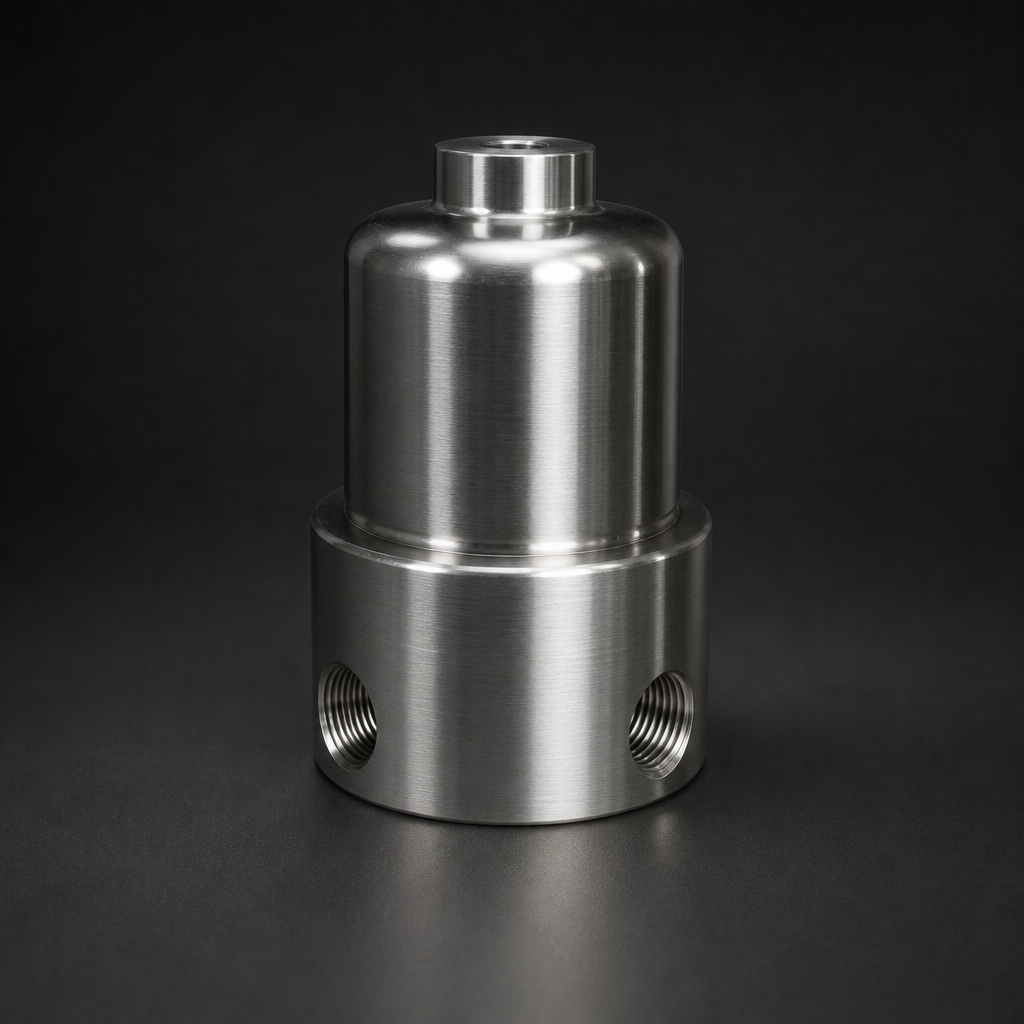
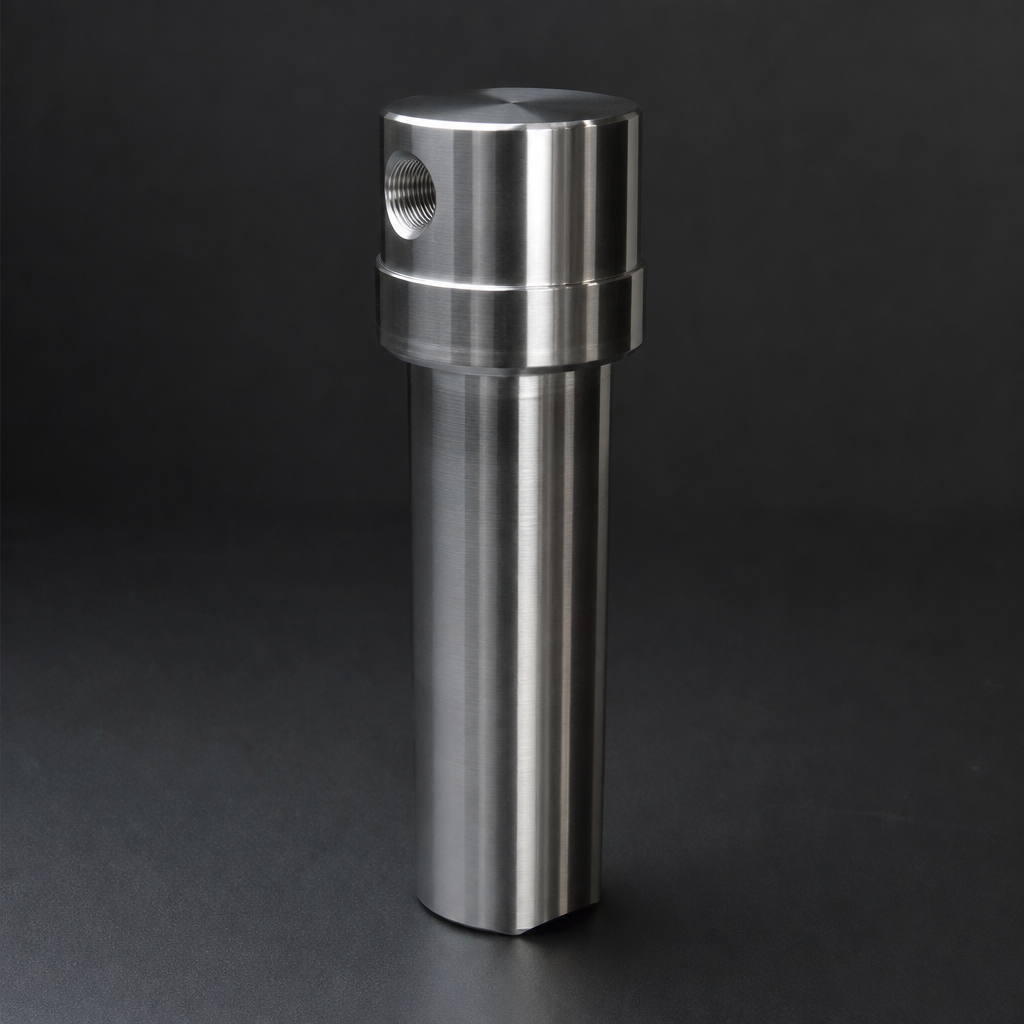
The RF-H-150 is a 316L stainless steel process gas filter housing rated to 100 bar(g), making it suitable for high-pressure natural gas transmission and city gate stations. Its compact body accepts standard RF-C coalescing and RF-P particulate elements, and the housing is available with FKM or PTFE seals for compatibility with sour gas and wet gas streams. The RF-H-150 is ATEX-compatible and can be supplied with a manual or automatic drain as standard.
For applications where the upstream pressure exceeds 100 bar(g), the RF-H-160 (rated to 250 bar(g)) provides the same element compatibility in a heavier-duty body, ensuring that the filter can be installed directly on the high-pressure inlet of a pressure regulation and metering station (PRMS) without the need for a separate pressure let-down stage upstream of the filter.
RF-P and RF-C Filter Elements
The RF-P particulate elements achieve 99.99% efficiency at ≥ 0.3 µm, capturing the fine corrosion products and iron sulphide particles that cause pilot valve blockage and seat scoring. The RF-C coalescing elements achieve 99.99% efficiency at ≥ 0.1 µm, removing liquid aerosols before they can reach the regulator diaphragm. Both element types are available in K-type (sour gas) variants with enhanced resistance to H₂S environments — an important consideration for biogas and sour natural gas applications.
Elements are available in a range of sizes (12032, 12057, 25064, 25178, 51230, 51476) to match the housing and flow requirements of the station, and replacement is straightforward without specialist tooling, minimising maintenance downtime.
Installation Best Practice
Even a correctly specified filter will underperform if it is poorly installed. The following installation guidelines apply to all PRV contamination filter applications:
- Install as close to the regulator inlet as practicable. A long unfiltered pipe run between the filter and the regulator allows corrosion products from that section to reach the regulator seat. Ideally, the filter should be within 1–2 pipe diameters of the regulator inlet.
- Orient the housing correctly. Most coalescing filter housings must be installed vertically with the drain at the bottom to allow coalesced liquid to drain by gravity. Horizontal installation is possible with some housings but requires confirmation from the manufacturer.
- Provide isolation valves and a bypass. A filter that cannot be isolated for element replacement will either be bypassed permanently (defeating its purpose) or will require a full station shutdown for maintenance. A properly valved filter skid with a bypass allows element changes under live conditions.
- Install a differential pressure indicator. A ΔP gauge or transmitter across the filter provides real-time indication of element loading. This allows element replacement to be scheduled on condition rather than on a fixed calendar interval, reducing both maintenance cost and the risk of operating with a blinded element.
- Commission with a new element. After any pipeline construction or maintenance work, the contamination load in the first hours of operation can be extremely high. Consider installing a sacrificial element for the first 24–48 hours of operation, then replacing it with a fresh element once the initial debris flush has been captured.
Summary: Filtration Is the Cheapest Insurance You Can Buy
The case for installing a high-quality gas pressure regulator filter upstream of every pressure reducing valve and regulator is overwhelming. Pipeline contamination — from coarse weld debris to sub-micron liquid aerosols — causes progressive and often sudden damage to precision regulator components. The cost of a single regulator failure, including emergency maintenance, lost production, and safety incident management, dwarfs the lifetime cost of a properly specified filter assembly many times over.
R+F FilterElements offers a complete range of process gas filter housings and elements suited to natural gas and biogas pressure regulation applications, from compact 100 bar(g) housings for city gate stations to high-pressure 250 bar(g) assemblies for transmission-level PRMS installations. All products are available with sour-gas-rated K-type elements and FKM or PTFE seals for the most demanding gas compositions.
To specify the correct pressure reducing station filter for your application, use the R+F online sizing wizard or contact the engineering team directly via the enquiry page. Getting the specification right at the design stage costs nothing; getting it wrong after a regulator failure costs a great deal more.
- pressure reducing station filter
- gas pressure regulator filter
- gas regulator protection
- pressure reducing station filter