Capturing an aerosol is only half the job. A coalescing element must also get rid of the liquid it collects — continuously, without blocking and without releasing it again. How well that works depends to a large extent on the filter medium. Borosilicate glass microfibre has two properties that make it particularly suitable: it is non-absorbent, and it is hydrophobic.
Non-absorbent media keep their properties
Glass microfibre media neither absorb liquid into the fibre nor adsorb it onto the fibre surface. The fibres therefore do not swell, soften or change structure when they are wetted with oil or water. As a result, the media retain their original properties over the service life — which is what allows high efficiency with very low pressure drop.
Hydrophobic: droplets instead of a film
Glass microfibres used in R+F coalescing elements are hydrophobic (water-repellent). Captured water aerosols therefore bead up as droplets instead of spreading as a continuous film across the fibres. Droplets leave open flow paths between them; a film would close them. This condition is favourable for maintaining filtration efficiency and a stable differential pressure.
From aerosol to drained liquid
Once oil or water aerosols are captured on the fibres, they must leave the system. To do so they first coalesce: small droplets unite to form larger ones. The large drops then have enough mass to gravitate to the bottom of the media and into the filter sump. A manual or automatic drain discharges the collected liquid. If the drain is not working, the sump fills and liquid is carried back into the gas — see liquid carryover in gas filters.
Need help selecting the right element grade?
Use our free Engineering Tool to get a filtration recommendation for your specific application in under 2 minutes.
Conditions that decide whether coalescence works
Coalescence is a physical process that occurs only when conditions are favourable. Pressure, temperature, gas velocity, humidity and the properties of the aerosol itself — density, viscosity and surface tension — all influence it. The configuration, arrangement, size and type of media are therefore critical.
| Factor | Effect on coalescence | What to check |
|---|---|---|
| Gas velocity | Too high: re-entrainment, higher Δp | Actual flow vs. housing rating |
| Temperature | Changes viscosity and vapour share | Filter after the cooler, within element and housing limits |
| Aerosol properties | Density, viscosity, surface tension | Oil type, water, solvents |
| Liquid load | Slugs overload the element | Separator or catch pot upstream |
| Drainage | Full sump = carryover | Drain function, orientation |
- Glass microfibre media neither absorb liquid into the fibre nor adsorb it onto the fibre surface.
- Glass microfibres used in R+F coalescing elements are hydrophobic (water-repellent).
- Once oil or water aerosols are captured on the fibres, they must leave the system.
- Coalescence is a physical process that occurs only when conditions are favourable.
Selecting the element
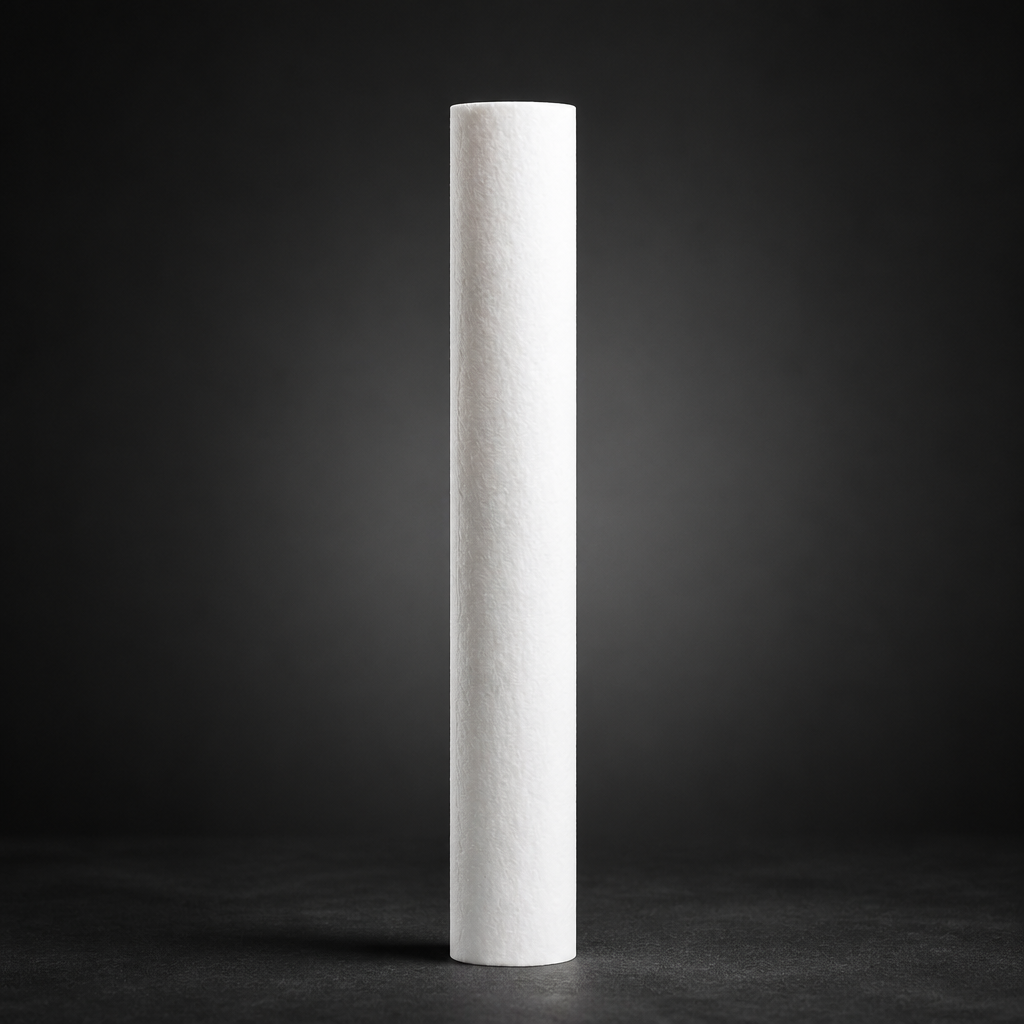
For oil and water aerosol in compressed air and process gas, a final coalescer such as RF-C-51230-HE (99.99 % @ 0.01 µm) is the standard; for small housings, RF-C-25064-ME (99.5 % @ 0.01 µm) is a common choice. Standard coalescing elements operate from −50 to +150 °C; silica-bonded elements tolerate higher temperatures, but the housing limit always applies (aluminium 120 °C, stainless steel 200 °C, seal-dependent). Where water or electrolyte must be stopped absolutely, a membrane separator downstream adds a liquid barrier.
More background: Technical Note "Why borosilicate glass microfibre?" (PDF) and all datasheets in the download library.
Try our Engineering Sizing Tool → or send us your operating data — we reply with a concrete R+F configuration.