When Standard Filters Fail: Protecting Chlorine Analysers in Produce Washing Systems
Food processing facilities face a filtration challenge that rarely appears in textbook examples: protecting the sensitive analysers used to monitor chlorine levels in produce washing water. When pre-filtration is inadequate, the consequences are not merely inconvenient — they can trigger plant shutdowns, compromise food safety compliance, and generate costly maintenance cycles. This article examines how R+F FilterElements has worked with OEM customers to solve this problem using a combination of instrumentation-grade filters and cyclone filter housings.
The Problem: Why Analysers Block and Give False Readings
Produce washing systems — used for leafy greens, root vegetables, and ready-to-eat salads — rely on carefully controlled chlorine concentrations to eliminate pathogens such as E. coli and Listeria. Continuous chlorine analysers sample the wash water directly, drawing a small side-stream through a measurement cell. The problem is that wash water is far from clean: it carries fine particulate matter from soil, plant debris, and organic residues.
Without adequate pre-filtration, this particulate load accumulates rapidly on analyser membranes and flow cells. The results are predictable and damaging:
- Blocked sample lines — flow drops below the minimum required for accurate measurement
- False low readings — fouled electrodes under-report chlorine concentration, potentially allowing under-dosed water to reach produce
- Frequent manual cleaning — maintenance teams must strip and clean analysers daily or even per shift
- Unplanned shutdowns — when analysers fail mid-production, the line must stop until compliance is restored
The root cause is almost always the same: a standard particulate filter installed upstream of the analyser, sized for a clean-gas application, becomes overwhelmed by the wet, particulate-laden sample stream within hours.
Key Performance Figures in Produce Washing Filtration
Solution Progression: From Standard Filters to Cyclone Housings
When R+F FilterElements first engaged with OEM customers building chlorine monitoring systems for food processors, the initial approach was straightforward: install an instrumentation-grade filter upstream of the analyser. The RF-DIL disposable inline filter range offered a compact, cost-effective solution for point-of-use particulate removal, and in many clean-water applications it performs reliably for weeks between changes.
In produce washing duty, however, even the RF-DIL elements required replacement within a single shift. The economics were unsustainable: frequent element changes, production interruptions, and the risk of an operator forgetting to replace a blocked element before restarting the analyser.
The Cyclone Housing Approach
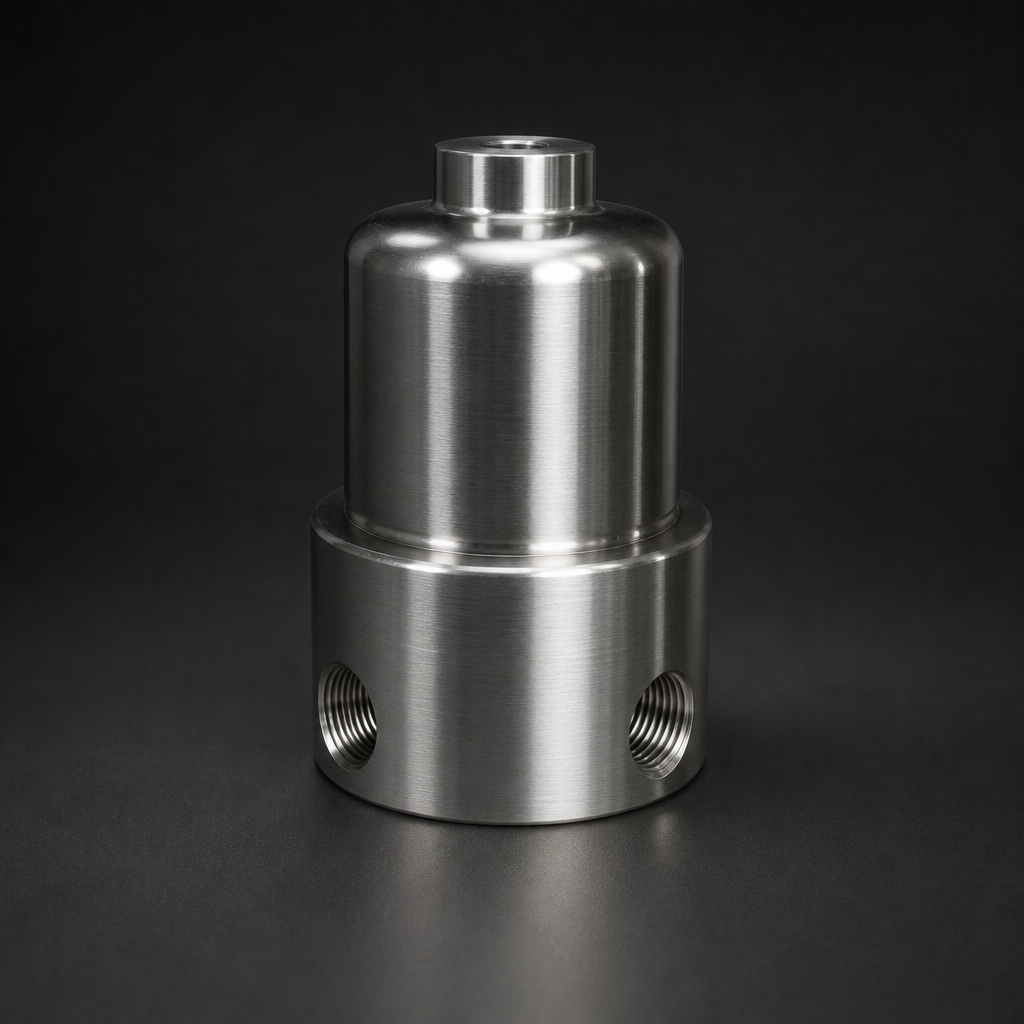
The breakthrough came from applying a principle well-established in gas processing: cyclone pre-separation. In a cyclone filter housing, the incoming sample stream is introduced tangentially, creating a rotational flow. Centrifugal force drives heavier particulate matter to the housing wall, where it falls to a collection sump, while the cleaner central stream passes through to the filter element. The key advantage is that increased water velocity across the filter surface — maintained by the cyclone geometry — continuously sweeps the element face, preventing the rapid cake build-up that defeats conventional housings.
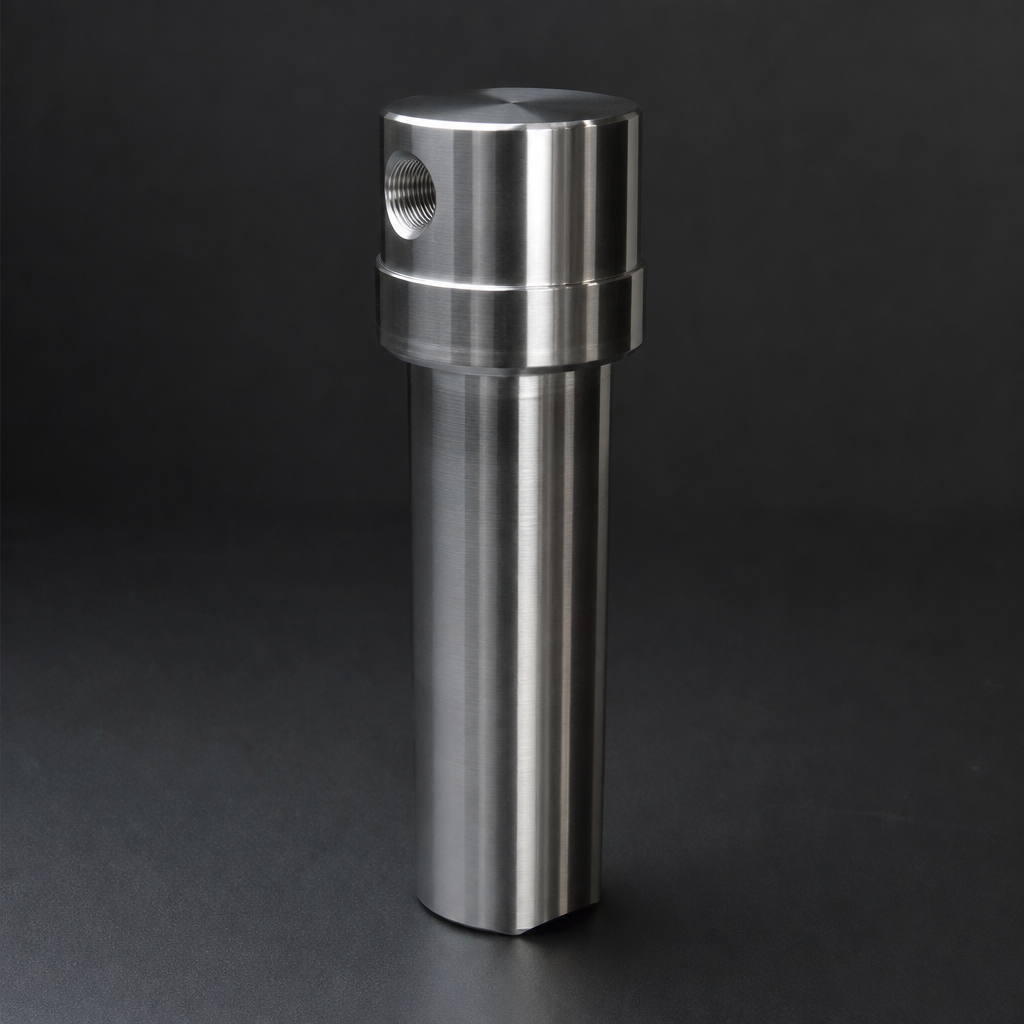
R+F FilterElements worked with OEM partners to adapt the RF-H-150 stainless steel process housing for this application. The 316L stainless steel construction is fully compatible with chlorinated water, and the compact form factor fits within the space constraints of a typical analyser cabinet. Paired with an appropriate particulate element, the cyclone-assisted housing extended filter service intervals from hours to days — in some installations, to weeks.
Need help selecting the right filter for your analyser protection application?
Comparing Filter Approaches for Chlorine Analyser Protection
| Approach | Typical Service Interval | Maintenance Burden | Best Suited For |
|---|---|---|---|
| Standard inline filter (RF-DIL) | <1 shift in heavy wash water | Very high — multiple changes per day | Clean water / low-particulate streams |
| Instrumentation filter housing (RF-H-110 series) | Hours to 1 day | High — daily element changes | Moderate particulate loads |
| Cyclone housing (RF-H-150 adapted) | Days to weeks | Low — scheduled maintenance only | Heavy particulate / produce wash water |
Use our free Engineering Tool to get a filtration recommendation for your specific application in under 2 minutes.
Working with OEM Customers: Finding the Optimal Configuration
One of the most valuable aspects of R+F FilterElements' approach is the willingness to work iteratively with OEM customers rather than simply supplying a catalogue product. For chlorine monitoring applications, this typically involves:
- Sample stream characterisation — understanding the particulate load, particle size distribution, and flow rate of the wash water sample
- Pilot testing — trialling filter configurations on a single analyser before committing to a fleet-wide specification
- Element grade selection — choosing between 1 µm, 5 µm, and coarser ratings depending on the analyser's sensitivity to particulate ingress
- Housing material confirmation — verifying that 316L stainless steel seals and wetted parts are compatible with the chlorine concentrations in use
This collaborative process is particularly important because produce washing systems vary significantly between facilities. A leafy greens washer handling field-harvested product carries a very different particulate load from a root vegetable line where soil ingress is the primary concern. The analytical instrumentation filtration solutions developed through this process are therefore tailored rather than generic.
For facilities already operating standard instrumentation filter housings, R+F FilterElements can also supply replacement elements in the RF-H-110 to RF-H-170 series that offer improved dirt-holding capacity — a useful interim measure while a cyclone housing upgrade is being evaluated. See the full instrumentation filter range for available configurations.
Beyond Chlorine: Other Food Industry Filtration Challenges
The chlorine monitoring application is one of several unusual filtration challenges that R+F FilterElements has encountered in the food and beverage sector. Others include:
- CO₂ purity monitoring — carbonation gas used in beverages must meet strict purity standards; analyser protection filters must handle both gas-phase and condensed moisture
- Compressed air quality — food-contact compressed air must meet ISO 8573-1 Class 1 for oil and particulate; see our guide to ISO 8573-1 compressed air quality
- Nitrogen blanketing — modified atmosphere packaging relies on high-purity nitrogen; inline adsorbers such as the RF-DIA can remove residual oxygen and moisture
In each case, the common thread is that food industry applications demand higher reliability and lower maintenance burden than equivalent industrial applications — because the cost of analyser downtime is measured not just in lost production, but in food safety risk.
- Frequent manual cleaning
- When R+F FilterElements first engaged with OEM customers building chlorine monitoring systems for food processors, the initial approach was straightforward: install an instrumentation-grade filter upstream of the analyser.
- Sample stream characterisation
- CO₂ purity monitoring
Related Reading
- Coalescing vs Particulate Filter Elements — Which Do You Need?
- ISO 8573-1 Compressed Air Quality: A Practical Guide
- Oxygen Filtration Safety: What Every Plant Engineer Should Know
Try our Engineering Sizing Tool → or discuss your requirements with our team.