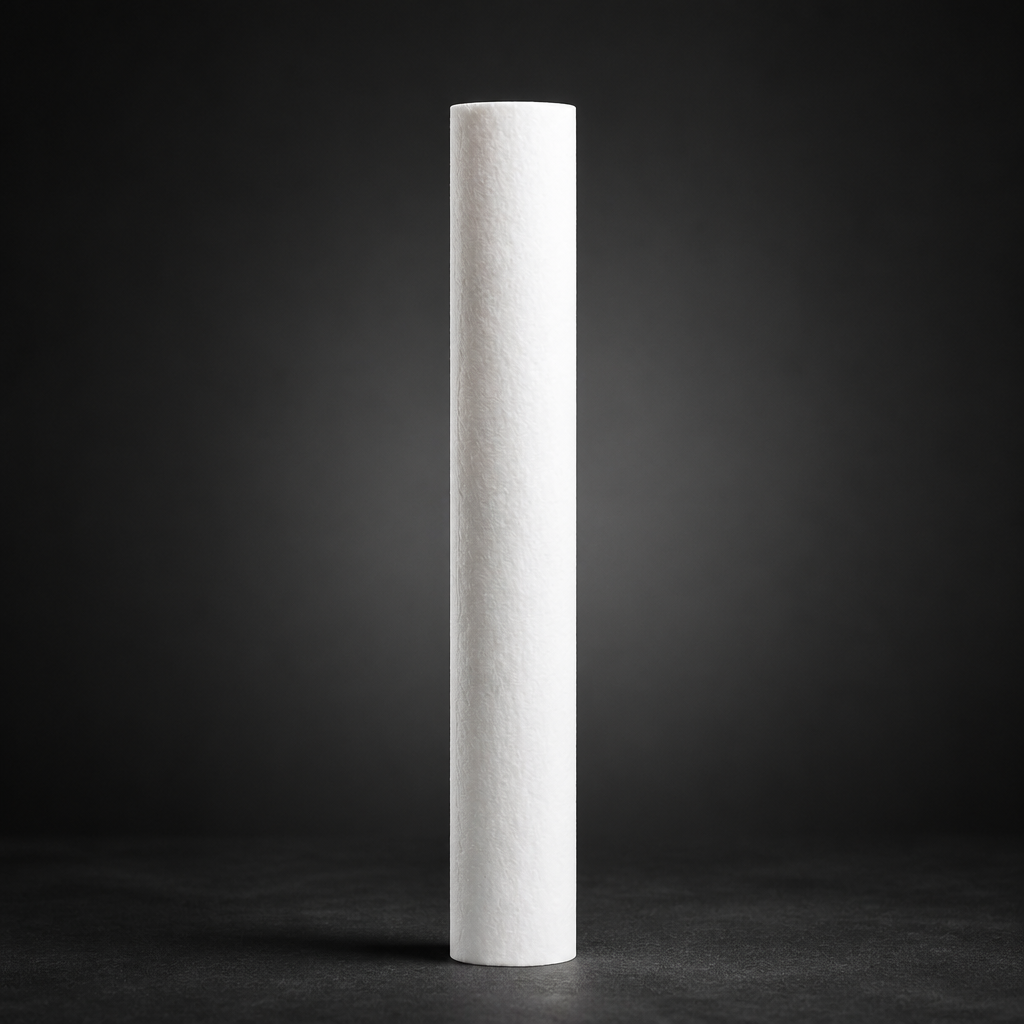
"What is the pore size of this element?" is one of the most common questions we receive. It sounds sensible — a sieve with smaller holes stops smaller particles. But a coalescing element made of borosilicate glass microfibre is not a sieve. It is a depth filter, and for a depth filter a "pore size" tells you very little about what actually reaches your process.
A depth filter has no defined pores
Glass microfibre media are built from many in-depth layers of fibres laid down in a random fashion. There is no regular mesh and no single opening size. The gaps between fibres vary from place to place and are, in many places, far larger than the particles the element removes. If the element worked by sieving alone, fine aerosols would simply pass through.
Instead, a particle is captured when it collides with a fibre. Once it touches the fibre it is held there by intermolecular forces — the Van der Waals forces. These forces are essentially independent of what the particle is made of and of external conditions such as relative humidity or temperature. The element is designed to maximise the chance of that collision along the full depth of the media.
How particles actually reach the fibre
Four mechanisms bring particles into contact with the fibres, each dominant in a different size range: gravitational settling for large droplets, inertial impaction above about 1 µm, direct interception between roughly 0.3 and 1 µm, and diffusion (Brownian motion) below 0.3 µm. We explain them in detail in our article on the four capture mechanisms. Together they allow borosilicate glass microfibre to remove aerosols from above 50 µm down to below 0.01 µm.
What to compare instead of pore size
A meaningful comparison needs three pieces of information: the efficiency in percent, the particle size it refers to, and the test method. A percentage without a particle size is as incomplete as a pore size. R+F states the efficiency of every borosilicate microfibre grade at 0.01 µm, so the grades can be compared directly:
| Grade | Efficiency | Typical use |
|---|---|---|
| AX | 99.99998 % @ 0.01 µm | Ultra-fine final stage |
| UX | 99.9999 % @ 0.01 µm | High-purity final stage |
| HE | 99.99 % @ 0.01 µm | Standard final coalescing |
| ME | 99.5 % @ 0.01 µm | Intermediate stage |
| ST | 95 % @ 0.01 µm | Pre-coalescing, long life |
| PF | 90 % @ 0.01 µm | Pre-filtration, lowest Δp |
The grade is selected by position in the system: ST or PF as a pre-coalescer to take the bulk of the aerosol load at low differential pressure, HE as the standard final coalescer — for example RF-C-51230-HE — and UX or AX where downstream equipment needs the highest purity. Particulate elements such as RF-P-51230-HE follow the same principle for dry particles.
Need help selecting the right element grade?
Use our free Engineering Tool to get a filtration recommendation for your specific application in under 2 minutes.
Why the test particle size matters
Standard test methods for high-efficiency filters, such as the DOP test and the sodium flame test, deliberately challenge filters with particles in the 0.3 to 0.6 µm range. This is close to the most penetrating particle size, where neither impaction and interception nor diffusion is fully effective. Read more in MPPS — why 0.3 µm is the hardest size to filter.
- collides with a fibre
- Four mechanisms bring particles into contact with the fibres, each dominant in a different size range: gravitational settling for large droplets, inertial impaction above about 1 µm, direct interception between roughly 0.
- efficiency in percent
- Standard test methods for high-efficiency filters, such as the DOP test and the sodium flame test, deliberately challenge filters with particles in the 0.
Practical checklist
- Ask for efficiency and particle size, never one without the other.
- Check whether a micron figure is a pore size, an absolute liquid rating or a gas efficiency.
- Compare clean differential pressure at your actual flow, not just the efficiency.
- Choose the grade by position: pre-coalescer, final coalescer or high-purity stage.
- Download our Technical Note "Why borosilicate glass microfibre?" (PDF) or browse all datasheets in the R+F download library.
Try our Engineering Sizing Tool → or send us your operating data — we reply with a concrete R+F configuration.