
Long Sample Lag Time — Why the Analyser Reacts Too Late
A process analyser can only be as fast as its sample system. Long lines, large filter housings and dead volume in the analyser branch add minutes between a change in the process and the measured value. A fast loop with a flow-through filter housing and small-volume filter stages keeps the sample fresh.
Reconocer los síntomas
- The analyser follows process changes with a delay of several minutes
- Control loops based on analyser values react slowly or oscillate
- Values after a grade or feed change take long to settle
- Calibration gas takes much longer to show a stable reading than expected
- Sample filters are large housings designed for process lines, not for analyser flows
Causas
No fast loop
the analyser draws its small flow through the whole sample line
Filter housings with large internal volume in the analyser branch act as mixing volumes
Dead legs and oversized tubing between the conditioning stages
High pressure in the sample line
the gas volume stored in lines and filters rises with pressure
Filter elements loaded with liquid or particles reduce flow and increase lag time further
Lista de comprobación de diagnóstico
- 1Estimate lag time: internal volume of line and filters at line pressure divided by actual flow
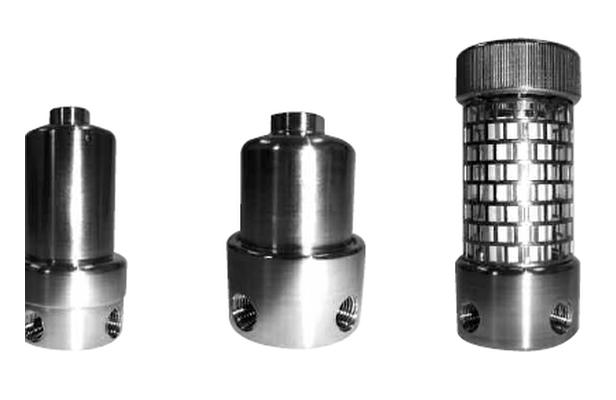
- 2Use a fast loop and take the analyser sample from a flow-through housing such as RF-HFL-126 (¼″ NPT plus ¼″ sample port, 340 bar, 200 °C)
- 3Use small-volume housings in the analyser branch: RF-H-120 (⅛″ NPT) or RF-H-122 / RF-H-126 (¼″ NPT) with 12 × 57 mm elements
- 4Reduce pressure close to the tap where the analyser allows it
- 5Remove dead legs and check that drains are not left open as unintended bypasses
- 6Change loaded coalescing elements every 3 months or earlier when the differential pressure rises
Encontrar el filtro adecuado para este problema
Introduzca sus datos de operación — nuestras herramientas le guiarán al elemento y carcasa adecuados. O envíenos sus datos para una recomendación a medida.
Buscador de elementos
RecomendadoEl elemento filtrante adecuado para el medio y la operación en menos de 60 segundos — punto de partida recomendado.
Encontrar elementoUtilizar selección de carcasa
Seleccionar la carcasa adecuada — material, nivel de presión, conexiones y purga.
Seleccionar carcasaSolicitar asesoramiento
¿Prefiere atención personal? Envíe sus datos de operación y le recomendaremos la configuración adecuada.
Enviar solicitudLectura complementaria
Describa su situación — encontraremos la solución adecuada
Cada problema de filtración tiene causas específicas que requieren soluciones específicas. Envíenos sus condiciones de operación y elaboraremos una recomendación a medida.