
Misleading Micron Ratings — Why "Pore Size" Says Little About a Coalescing Filter
Datasheets mix pore sizes, absolute liquid ratings and gas efficiencies at different particle sizes — all expressed in microns. For borosilicate glass microfibre depth filters, a pore size is not meaningful: particles are captured when they collide with a fibre, not because they are too big for a hole. Comparing elements correctly requires the efficiency, the particle size it refers to and the test method.
Recognise the Symptoms
- Two elements with the same micron label give very different oil carryover or purity downstream
- A supplier quotes a "pore size" for a coalescing element, another quotes an efficiency in percent
- A replacement element with a "finer" micron rating does not improve the result — or blocks faster
- Efficiency figures are given without a particle size or without a test method
- Uncertainty which grade is needed for a pre-filter, a final coalescer or a high-purity stage
Root Causes
Pore size used for a depth filter
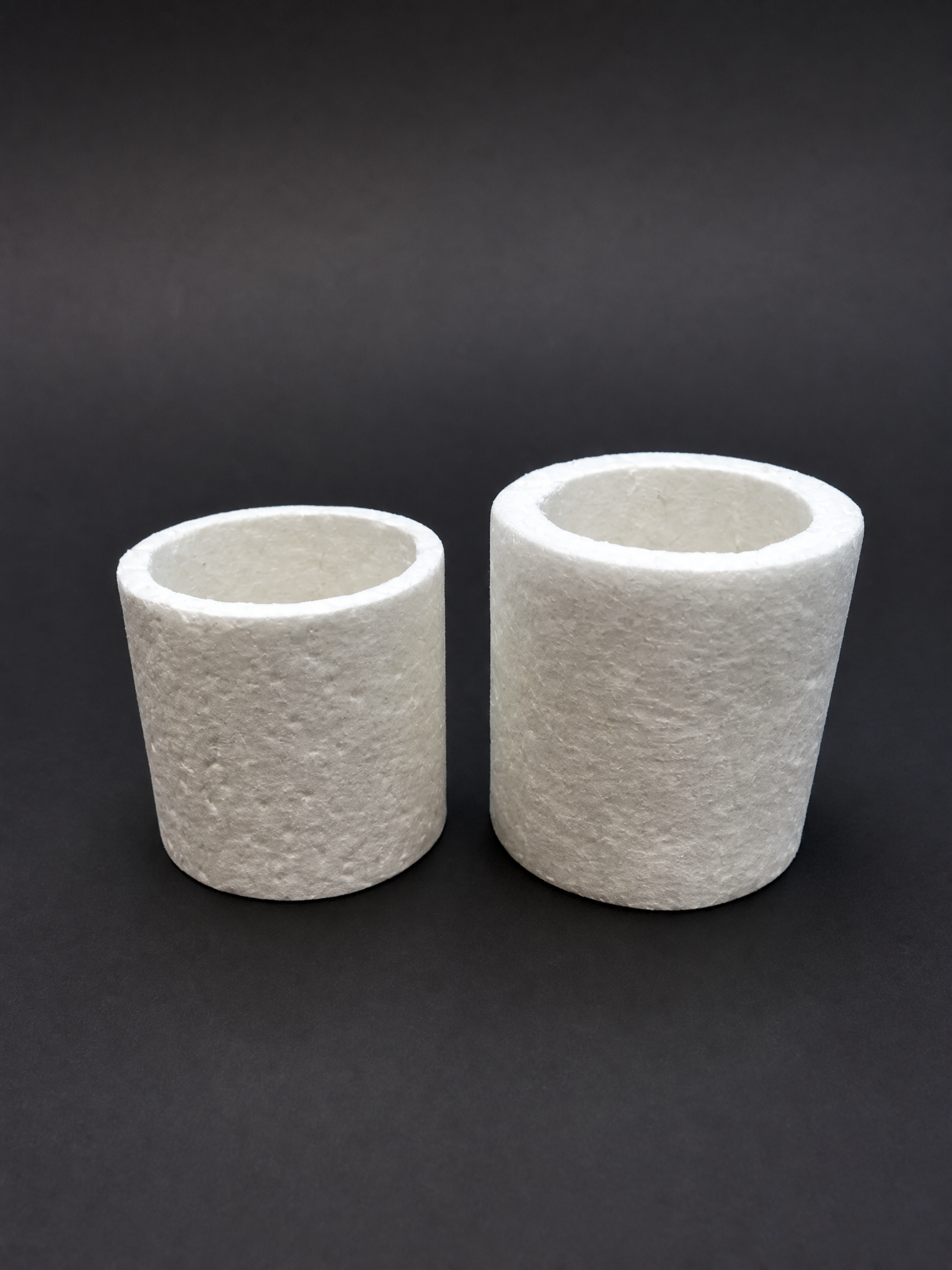
borosilicate glass microfibre consists of randomly laid fibre layers without a defined opening size; the spaces between fibres are often larger than the particles captured
Capture mechanism ignored
particles are captured by gravitational settling, inertial impaction, direct interception and diffusion, and held on the fibre by intermolecular (Van der Waals) forces, largely independent of particle material, humidity and temperature
Different particle sizes compared
a percentage at 0.01 µm, at 0.3 µm or at 1 µm describes different things; the most penetrating particle size lies around 0.3 µm
Different test methods compared
DOP and sodium flame tests challenge filters at 0.3–0.6 µm, liquid tests and nominal ratings follow other rules
Grade chosen by number, not by position
a very fine final grade used as the only stage overloads quickly when the aerosol load is high
Sizing on catalogue flow
excessive media velocity reduces diffusion capture and can re-entrain coalesced liquid regardless of the grade
Diagnostic Checklist
- 1Ask for efficiency in percent, the particle size it refers to and the test method — never compare one of these alone
- 2Check whether a micron figure is a nominal pore size, an absolute liquid rating or a gas efficiency
- 3Compare grades on one basis: all R+F borosilicate microfibre grades are stated at 0.01 µm — AX 99.99998 %, UX 99.9999 %, HE 99.99 %, ME 99.5 %, ST 95 %, PF 90 %
- 4Choose the grade by position: ST or PF as pre-coalescer, HE as final coalescer, UX or AX for high-purity duties
- 5Check the clean differential pressure at your actual flow and operating pressure, not only the efficiency
- 6Confirm element dimensions: for 51 × 230 / 51 × 476 the OD is 62.5 ± 1.5 mm (coalescing) and 58 ± 1.5 mm (particulate)
- 7Confirm temperature: standard coalescing elements −50 to +150 °C, silica-bonded elements higher — the housing limit always applies
Find the right filter for this problem
Enter your operating data and let our tools point you to the right element and housing — or send us your details for a tailored recommendation.
Element Finder
RecommendedIdentify the right filter element for your medium and duty in under 60 seconds — recommended starting point.
Find your elementUse Housing Selector
Select the matching housing — material, pressure rating, connections and drain.
Select a housingRequest a Consultation
Prefer a person? Send your operating data and we will recommend the right configuration.
Send enquiryDescribe Your Situation — We Will Find the Right Solution
Every filtration problem has specific root causes that require specific solutions. Send us your operating conditions and we will provide a tailored recommendation.