
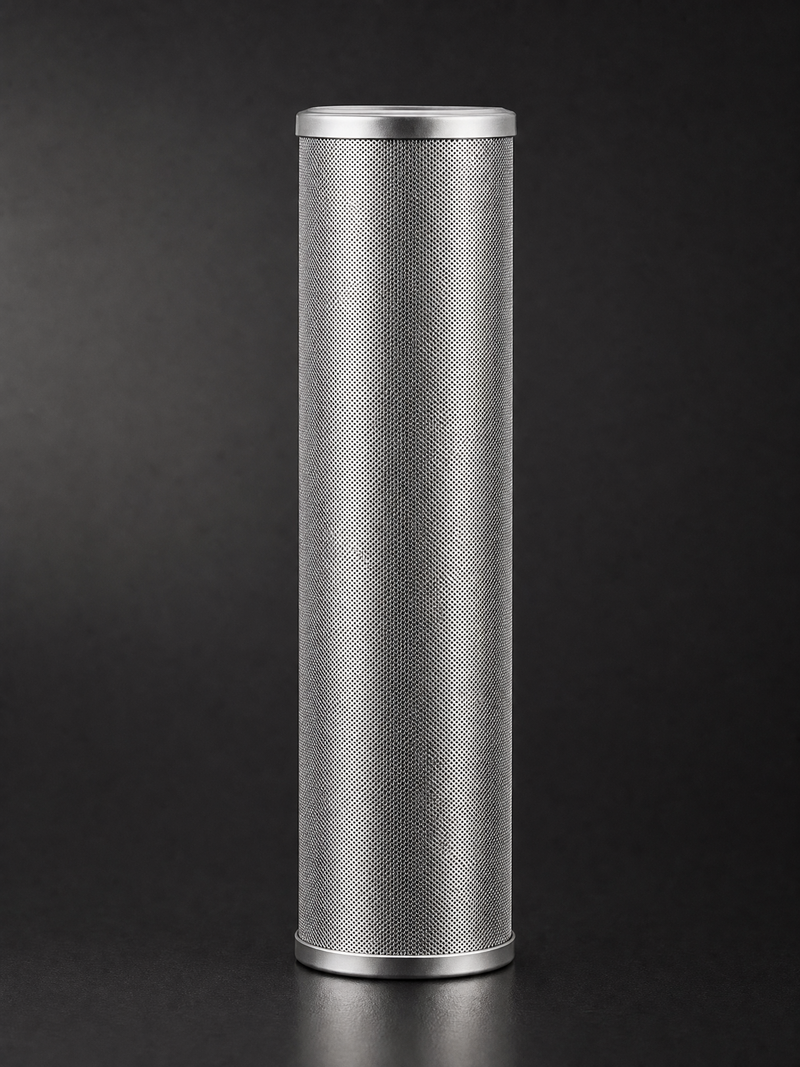
Particles in the Electrolyte Circuit — Filtering the KOH Loop of Alkaline Electrolysers and Test Benches
The circulating KOH electrolyte of an alkaline electrolyser carries particles from assembly, corrosion, gasket wear and cell components. Without a filter in the loop they reach pump, flow meter, valves and cell. A liquid filter in the electrolyte circuit has to withstand hot caustic — housing, gasket and element material matter as much as the micron rating. Long-term resistance in concentrated KOH depends on the individual process and should be confirmed in a test under your own operating conditions.
Recognise the Symptoms
- Increasing wear or failure of the electrolyte circulation pump
- Flow meters or level sensors in the lye circuit drifting, sticking or blocking
- Particles or grey/black deposits found in the cell frame, on the separator or on the electrodes during inspection
- Valves in the electrolyte loop no longer closing tightly
- Only a coarse strainer in the loop — fine debris keeps circulating
- Scattering test bench results after rebuilds or cell changes, caused by assembly debris in the loop
Root Causes
Assembly and commissioning debris
swarf, sealing tape, gasket fragments and residues from new pipework enter the loop at first fill
Corrosion and wear products
particles from pumps, valves and materials that are not resistant to hot KOH
Degradation of cell components
fragments of separators or gaskets carried along with the circulating electrolyte
No filter or only a coarse strainer
fine particles circulate indefinitely and accumulate at the narrowest points of the loop
Unsuitable filter materials
glass-fibre elements, NBR/FKM O-rings and aluminium or plated parts are attacked by caustic and become a particle source themselves
Diagnostic Checklist
- 1Is there a filter in the electrolyte circuit — typically downstream of the pump and upstream of flow meter and cell?
- 2What KOH concentration, temperature, pressure and flow rate does the loop run at?
- 3Which component is most sensitive (pump, flow meter, cell inlet)? This defines the required retention, e.g. 10 µm or 25 µm
- 4Are housing and fittings made of 316L, and is a solid PTFE gasket used instead of NBR/FKM?
- 5Are the elements sintered stainless steel or sintered PTFE rather than glass fibre or cellulose?
- 6Is differential pressure monitored so the change or cleaning point can be identified?
- 7Before series use, run a defined test: log differential pressure, then remove and inspect elements and seals after a set operating time
Find the right filter for this problem
Enter your operating data and let our tools point you to the right element and housing — or send us your details for a tailored recommendation.
Element Finder
RecommendedIdentify the right filter element for your medium and duty in under 60 seconds — recommended starting point.
Find your elementUse Housing Selector
Select the matching housing — material, pressure rating, connections and drain.
Select a housingRequest a Consultation
Prefer a person? Send your operating data and we will recommend the right configuration.
Send enquiryDescribe Your Situation — We Will Find the Right Solution
Every filtration problem has specific root causes that require specific solutions. Send us your operating conditions and we will provide a tailored recommendation.